Logo
IndianGlobalBlogsPublicationsPodcastsMarketAboutContact
Logo
IndianGlobalBlogsPublicationsPodcasts
7News
Heritage Foods inaugurates new Ice Cream PlantFSSAI makes registration to all milk vendors in IndiaGujarat Ice Cream Makers Face Cone ShortageSummer Heat to Stress India’s Dairy Cold ChainSavencia Profit Drops on Rising Milk Costs

Indian Dairy News

Heritage Foods  inaugurates new Ice Cream Plant
Mar 13, 2026

Heritage Foods inaugurates new Ice Cream Plant

Heritage Foods Limited, a leading dairy company offering a wide range of milk and value-added dairy products, today announced the inauguration of its new greenfield Ice cream manufacturing facility at...Read More

17 High-Genetic US Bulls Arrive to Boost Kashmir Dairy
Mar 13, 2026

17 High-Genetic US Bulls Arrive to Boost Kashmir Dairy

In a major step to strengthen dairy productivity, the Animal Husbandry Department (AHD) of Jammu & Kashmir has imported 17 high-genetic-merit dairy bulls from the United States as part of a breeding i...Read More

Jigawa to Partner India for Dairy Development
Mar 13, 2026

Jigawa to Partner India for Dairy Development

The Jigawa State Government in Nigeria has announced plans to collaborate with the National Dairy Development Board (NDDB) of India to promote livestock development and expand dairy production in the...Read More

DairyNews7x7
Advertisement

Latest Blogs

See More
FSSAI makes registration to all milk vendors in India
Mar 13, 2026

FSSAI makes registration to all milk vendors in India

The recent advisory issued by Food Safety and Standards Authority of India (FSSAI) mandating registration of milk vendors is a timely and progressive step towards strengthening traceability and accou...Read More

Rajahmundry Milk Incident: Accident or Adulteration?
Mar 10, 2026

Rajahmundry Milk Incident: Accident or Adulteration?

The recent editorial “Bitter Milk” published by The Hindu raises important concerns about food safety in India. The editorial deserves appreciation for attempting to broaden the conversation and under...Read More

Milk Prices Rise in South & West: Is North Next?
Mar 05, 2026

Milk Prices Rise in South & West: Is North Next?

The recent round of retail milk price increases across South India and Maharashtra is no longer an episodic adjustment but a clear signal of structural stress building up in India’s milk economy. Over...Read More

India’s Dairy Climate Paradox: Production Triumph Meets Methane Time-Bomb
Mar 02, 2026

India’s Dairy Climate Paradox: Production Triumph Meets Methane Time-Bomb

India’s rise to the top of the global dairy league board has been one of the most remarkable agricultural success stories of the 21st century. With milk production surpassing 247 million tonnes per ye...Read More

Global Dairy News

Lactose-Free Milk Seen as Growth Driver in Coffee
Mar 13, 2026

Lactose-Free Milk Seen as Growth Driver in Coffee

Lactose-free milk is emerging as a major growth opportunity for the dairy industry, particularly in the rapidly expanding coffee and café segment. A recent US-based study highlighted that lactose-free...Read More

Nigeria’s Dairy Challenge: Many Cows, Little Milk
Mar 13, 2026

Nigeria’s Dairy Challenge: Many Cows, Little Milk

Despite having more than 20 million cattle, Nigeria produces far less milk than it consumes, highlighting deep structural challenges in its dairy sector. Most cattle in the country are...Read More

Israel Drops Controversial Dairy Reform From Budget
Mar 12, 2026

Israel Drops Controversial Dairy Reform From Budget

The Israeli government has removed a controversial dairy reform proposed by Finance Minister Bezalel Smotrich from the 2026 Arrangements Law, a key legislative package linked to the country’s state bu...Read More

DairyNews7x7
Advertisement
Dairy News 7x7

Your trusted source for all the latest dairy industry news, market insights, and trending topics.

FOLLOW US
CATEGORIES
  • Global News
  • Indian News
  • Blogs
  • Publications
  • Podcasts
SUBSCRIBE TO OUR NEWSLETTER

Stay informed with the latest updates and trending news in the dairy industry.

No spam, unsubscribe at any time

GET IN TOUCH
C-49, C Block, Sector 65,
Noida, UP 201307
+91 7827405029dairynews7x7@gmail.com

© 2026 Dairy News 7x7. All Rights Reserved.

Terms of ServicePrivacy Policy
Prefer Us
Prefer Us

In Arunachal Pradesh, growing market for yak milk products

By DairyNews7x7•Published on February 04, 2024

In Arunachal Pradesh, growing market for yak milk products
Prefer on

The yak-rearing brokpas of the Eastern Himalayas are banking on an additional source of income with climate change threatening livelihoods.

The marketplaces in Arunachal Pradesh are brimming with an array of local delights, including seasonal kiwis, persimmons, nuts, etc. What’s most captivating to the waves of tourists flocking into the state as winter unfolds are the garlands of light brown and white candies hanging in every store. Inquisitive buyers with adventurous palates desire to savour a piece and are often seen enquiring with the shopkeepers.

Despite the resemblance, they are not candies, but hardened cheese, known locally as chhurpi, crafted from milk. The white variant is special for it is made from yak milk.
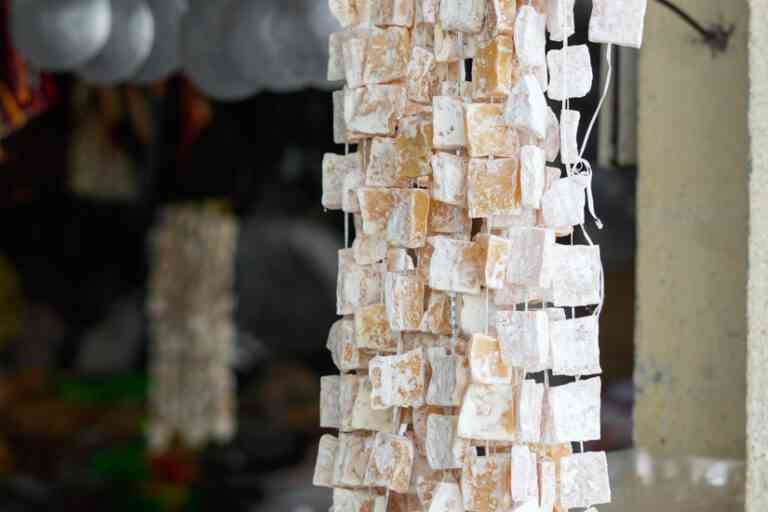
Yak milk cheese or chhurpi seen hanging in front of shops at marketplaces in Arunachal Pradesh. Yak milk products are exclusive creations of Brokpa pastoralist herders. Photo by Surajit Sharma/Mongabay. Yak milk cheese or chhurpi seen hanging in front of shops at marketplaces in Arunachal Pradesh. Yak milk products are exclusive creations of Brokpa pastoralist herders. Credit: Surajit Sharma/Mongabay.

On brisk winter days, visitors delight in sipping a steaming cup of Tibetan buttermilk tea, a quintessential beverage in the Himalayan region. But those in the know prefer this delectable concoction to be prepared not with the regular market-bought butter, but with a generous dollop of yak ghee.

These yak milk products are an exclusive creation of the Brokpa (Brok means pastures and Pa refers to man) pastoralist herders, a yak-rearing community of the Himalayan regions of India. In Arunachal Pradesh, the Brokpas are a sub-tribe of the larger Monpa tribe, residing in the West Kameng and Tawang districts in the eastern Himalayan region.

As climate change and shifting socio-cultural dynamics threaten the livelihoods of pastoralists, the need for an additional income in their otherwise sustainable yet economically-challenging lifestyle becomes more pressing. The rising demand for yak milk derivatives serves as a potential solution.

https://youtu.be/djk5EZl1GQ0

Increasing need for currency

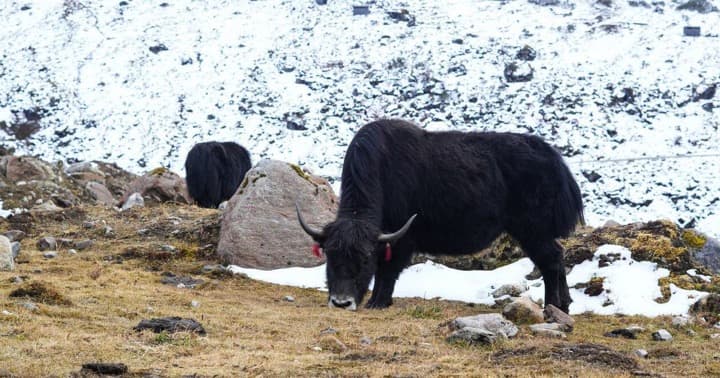
The Brokpas are transhumance pastoral nomads, practising seasonal migration to high-altitude grazing grounds. They easily adapt to climate variability and grazing pressure from seasonal dips in pasture availability. Accessing food resources at the right time is crucial for yaks (Peophagus grunniens).

Currently, India has a yak population of around 58,000, with approximately 24,700 located in Arunachal Pradesh. Out of the roughly 2,500 Brokpas nationwide, about 1,200 reside in the state.
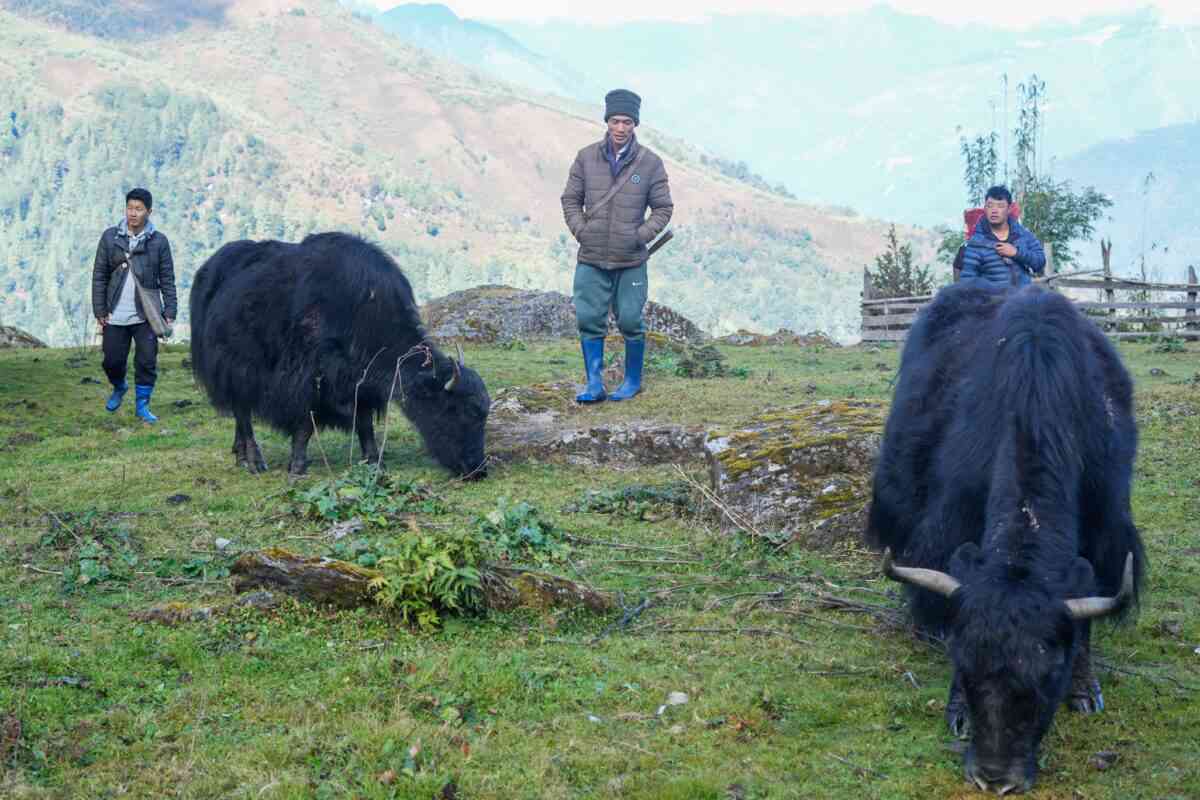
Brokpa villagers take their yaks out for grazing. The Brokpas are transhumance pastoral nomads, practising seasonal migration to high-altitude grazing grounds. Credit: Surajit Sharma/Mongabay.
Brokpa Ringchin Kesang from Lubrang, a pastoral village situated at an altitude of 10,000 feet, said, “My family owns a herd of 80 pure-breed yaks. Yaks are susceptible to high temperatures, and after surviving on limited feed in the winter, they starve for nutrition. So, in April-May when the temperature begins to rise, my wife, sister and I start the ascent with our herd, accompanied by other herders of the region.”

Kesang added that herders from Lubrang, Mandala-phudung, and other areas first reach Sela Pass via Vijay Gompa in Bhutan. “It is a three-day journey. We halt there for a day or two to stock up on essentials and for other Brokpas to gather with their herds. From there, we ascend as a group to Luguthang in Tawang, which is at 14,500 feet. It takes us about 10 days to reach. The snow doesn’t melt in the high mountains and we have to cut paths through it for the herds. There are transit shelters on the route to spend the nights.”

Other herders follow similar migratory routes to Rampu, Lungthang, Dongchepu and Churkhatang in West Kameng; and Thingbu, Broxer Tanglung, and Zithang in Tawang.
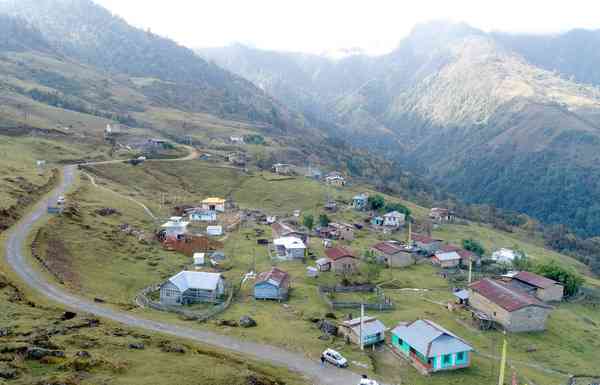
An aerial view of a Brokpa village in Arunachal Pradesh. Credit: Surajit Sharma/Mongabay.
These forays into grazing grounds come at a cost, as different rin (fee) are levied for accessing them. Meadows and forests are owned by either individuals, clans, communities or even monasteries and the fees are paid to them. The rin is calculated depending on the number of animals, season and nature of the grassland (new or already grazed), size of the pasture and duration.

While in transit, the herders are required to pay the Lamrin, which permits them to stay for approximately three nights along the transit route. Purin is charged for grazing in forest areas. Traditionally, butter, cheese and livestock were used as currency until the money economy became significant in herders’ lives. Kesang shared that he had to pay over Rs 10,000 in the last winter (for the entire season of six months) just as taxes in addition to ghee and chhurpi. Milk products are also included as tax.

The herders sell the leftover yak milk products after their consumption. Yak milk products help them survive the harsh winters in the high mountains and provide essential nutrition throughout their migration period when alternative sources are scarce.

“We carry rations for four-five months,” Kesang said. The vegetables and perishables are consumed first. Being Buddhists, they do not kill animals and eat the meat only of the dead animal. “The milk is churned to chhurpi, churkam, ghee, curd, etc. Whatever remains after our consumption is sold to the local markets. We come down to the village once and sometimes even twice during the migration period to restock on our essentials, and sell our products,” he shared.

With changing times, the younger Brokpas are opting for formal education and are less inclined to pursue the semi-nomadic lifestyle of their ancestors primarily due to the hard work involved and the economic and social uncertainties associated with the traditional way of life. Like his fellow Brokpas, Kesang’s family has also bought a plot of land at a lower-elevation town area and built a second house. His three children stay there and attend school.
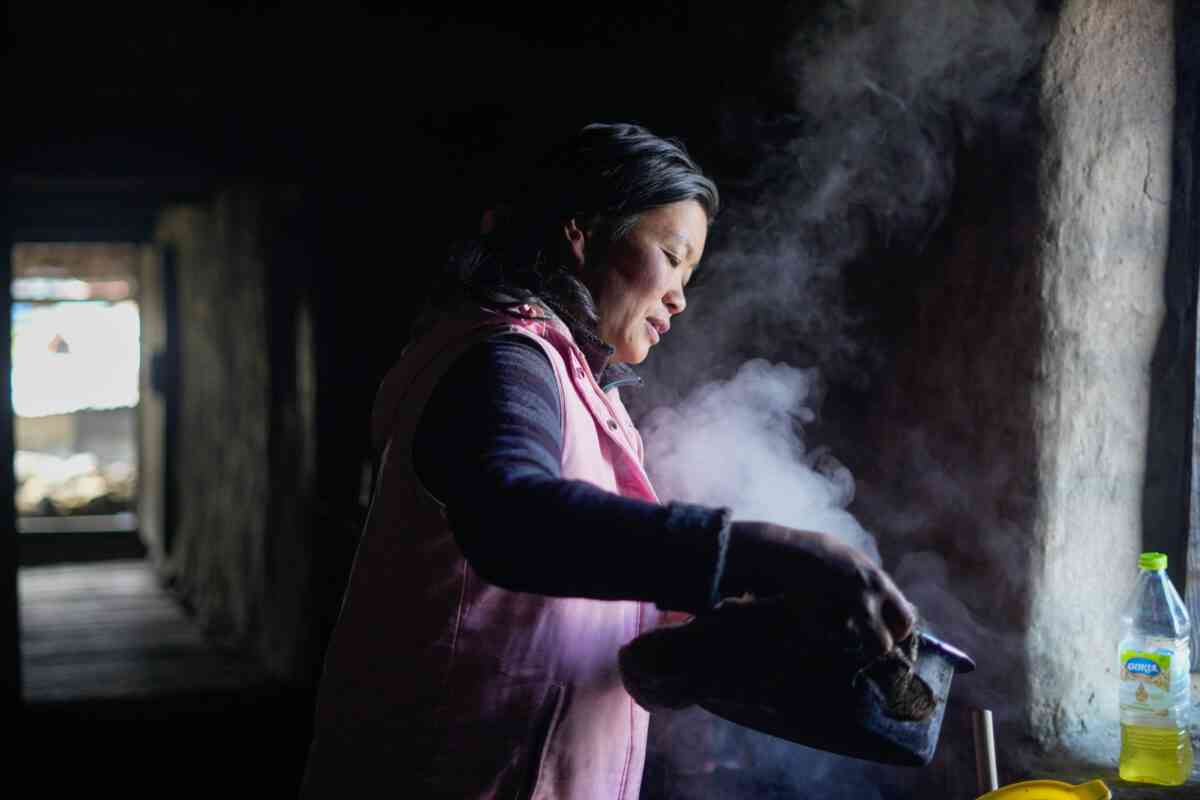
A Brokpa woman in her kitchen. The herders sell the leftover yak milk products after their consumption. These products help them survive the harsh winters in the high mountains and provide essential nutrition. Photo by Surajit Sharma/Mongabay.

Earnings sustain community

Traditionally, value-addition to yak milk is done using indigenous technology. The skimmed yak milk (called dhara) is fermented using curd inoculums. The soft wet cheese left after churning out the butter is the chhurpi which is for immediate consumption. The dried chhurpi, called churtang with a longer shelf life, is stored in yak skin bags. The butter is clarified to make ghee and preserved similarly. Yak skin bags render a pungent smell to the cheese and ghee stored inside which needs to be removed before they are sold in the market.

Of all the yak milk products available in the market, chhurpi and ghee are the most popular and the demand consistently outstrips supply. Moreover, product availability is largely limited to the markets of West Kameng and Tawang districts, with marginal supply outside.

Brokpas sell chhurpi at Rs 600- Rs 650 per kilogram and ghee at Rs. 400 per kilogram. In retail, shopkeepers often add a profit margin of Rs 50 to chhurpi sales; bite size pieces are sold at Rs 10 a piece. Ghee is retailed at Rs 600 per kilogram
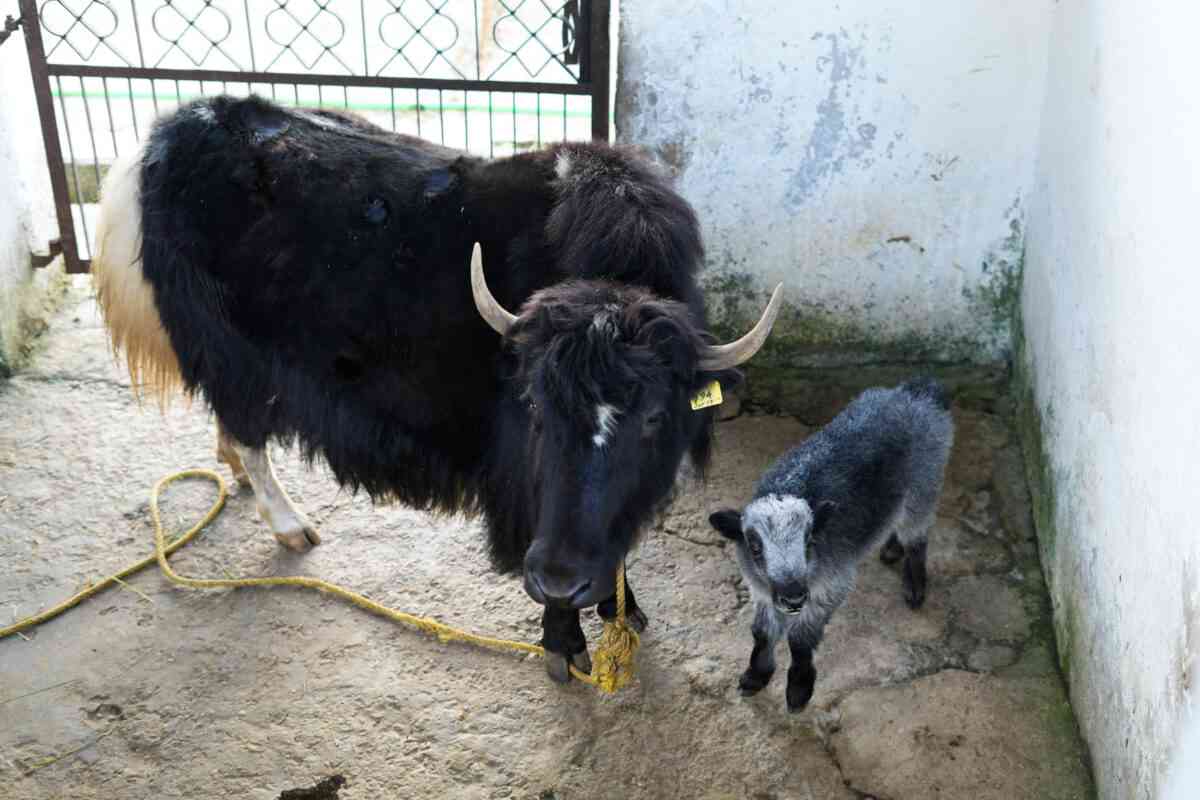
A yak and its calf at the NRC Yak Farm. Since the traditional milk derivative production is labour-intensive, the government-run farm has come up with various interventions to support the Brokpa community. Credit: Surajit Sharma/Mongabay.

Value addition

The traditional production method is labour-intensive. The Yak Centre (National Research Centre-Yak) has come up with various interventions to support the community to tap into the demand for the milk and its derivatives.

“Processing and packaging yak milk products at high elevations where the milk is produced is not always hygienic and outsiders are often reluctant to consume it. To expand the market, we are addressing these issues, providing hands-on training to the Brokpas in hygiene and quality control measures,” Vijay Paul, principal scientist at the NRC-Yak said.

To make yak farming more remunerative by popularising yak milk derivatives, the institute has opened a high-altitude yak milk dairy and parlour at Nyukmadung. The Arunachali Yak chhurpi has also recently acquired a Geographical Indication (GI) tag.

The milk yield of the medium-sized Arunachali yak is relatively low with short lactation periods compared to hill cattle and yak-cattle hybrids (Dzomo). On average, a female yak produces 0.98–1.04 kilogram of milk per day, totalling about 185 kilogram of milk in a 180-day lactation period. Despite the modest yield, yak milk is more nutritious than that of other bovines.
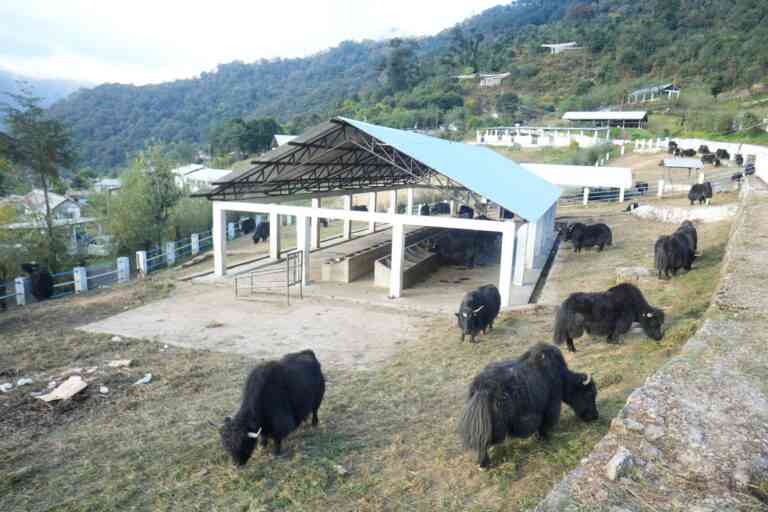
Yaks at the NRC Yak Farm in Arunachal Pradesh. Credit: Surajit Sharma/Mongabay.
An assessment of the nutrient composition and physicochemical properties of Arunachali yak milk, reared under farm conditions, by the Indian Council of Agricultural Research-NRC-Yak in Dirang, revealed it is nutritionally superior to other bovine milk.

Dr Vijay Paul, principal scientist at the NRC-Yak said, “In general, yak milk is considered a naturally concentrated milk enriched with a higher nutrient density and loaded with omega-3, fatty acids, amino acids, and antioxidants; it also has vitamins and minerals.” Thick and sweet yak milk is richer in protein, fat, lactose, minerals, and total solids than cow’s milk.

In addition to the traditional products, the NRC-Yak has introduced innovative value-added items, such as dietary fibre-enhanced low-fat paneer, vegetable-extended paneer, kiwi-flavoured and Vitamin C-enriched whey beverages and even mozzarella and cheddar-style cheese.
Semi-sedentary

The yak milk production is contingent on the availability of feed. There is fodder shortage in winters when the yaks lose 25-30% of their body weight. To ensure nutritional security of the bovines at all times, the NRC-Yak has developed Complete Feed Blocks (CFB) using locally available crop residue, and suitable biomass such as green maize fodder, napier, salix, etc. and distributed to the herders. Besides, herders are trained on fodder conservation techniques and cultivation of efficient varieties of maize.

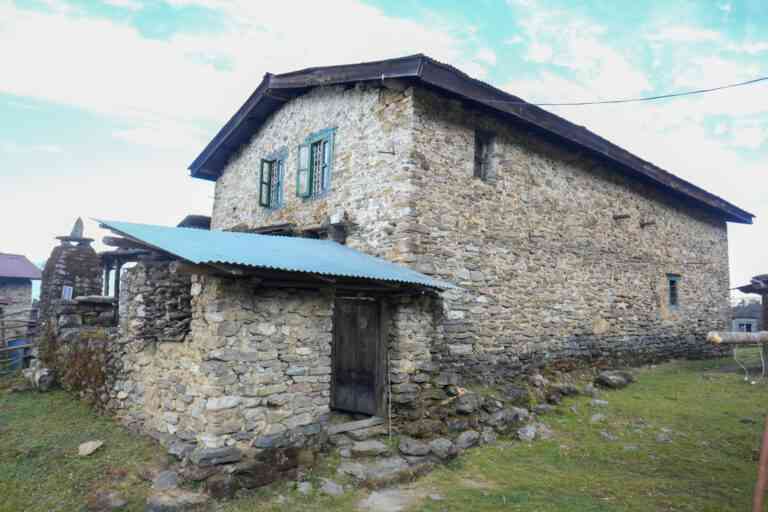
A house in a Brokpa village. Credit: Surajit Sharma/Mongabay.
Additionally, the NRC-Yak has developed a semi-sedentary model of yak rearing in its Nyukmadung farm, located at an altitude of 9,000 feet. In this model, yak herds are permanently kept at a particular elevation and the rearing needs including breeding, feed development, etc. are scientifically managed to minimise the need to migrate.

It presently has 125 yaks and 17 dzomos. A low-cost silage-making technology has also been developed and is in use at the farm. “We have been working on this successful model for the past 25 years, whereby we can sustain milk production even in the winter months,” Paul said.

The Brokpas are being educated on the semi-sedentary model and a viable bankable scheme has been introduced for profitable yak farming. “This is particularly directed at the younger generation who are reluctant to take up herding. We are also advocating the introduction of tourism to such farms for added economic benefit,” he shared.

Nomadic yak herding relies on ecosystem awareness and inherited traditional knowledge and is crucial for the preservation of both. Yet, with changing times, its subsistence economy is causing its gradual decline. As such, value-addition to yak milk presents a distinctive opportunity for the economic rejuvenation of yak pastoralism.

Stay Updated

Get the latest dairy industry news directly in your feed.

Prefer Us on Google Search

Swipe to continue reading

Previous Article

Next Article