Logo
IndianGlobalBlogsPublicationsPodcastsMarketAboutContact
Logo
IndianGlobalBlogsPublicationsPodcasts
7News
Summer Heat to Stress India’s Dairy Cold ChainSavencia Profit Drops on Rising Milk CostsTN Milk Output Claim Sparks Data DisputeHormuz Disruption Threatens Dairy Supply ChainUP Approves Dairy Expansion in Bundelkhand

Indian Dairy News

Summer Heat to Stress India’s Dairy Cold Chain
Mar 11, 2026

Summer Heat to Stress India’s Dairy Cold Chain

India’s dairy industry could face a major operational test this summer as rising temperatures and growing demand for chilled dairy products put increasing pressure on the country’s cold-chain infrastr...Read More

TN Milk Output Claim Sparks Data Dispute
Mar 11, 2026

TN Milk Output Claim Sparks Data Dispute

A debate has emerged over Tamil Nadu’s milk production after the Tamil Nadu Milk Dealers’ Welfare Association (TNMDWA) challenged claims made by Chief Minister M.K. Stalin that the State produces 3 cr...Read More

UP Approves Dairy Expansion in Bundelkhand
Mar 11, 2026

UP Approves Dairy Expansion in Bundelkhand

The Uttar Pradesh government has approved a proposal to expand dairy processing capacity in the Bundelkhand region by setting up a new dairy plant and upgrading an existing facility to strengthen the...Read More

DairyNews7x7
Advertisement

Latest Blogs

See More
Rajahmundry Milk Incident: Accident or Adulteration?
Mar 10, 2026

Rajahmundry Milk Incident: Accident or Adulteration?

The recent editorial “Bitter Milk” published by The Hindu raises important concerns about food safety in India. The editorial deserves appreciation for attempting to broaden the conversation and under...Read More

Milk Prices Rise in South & West: Is North Next?
Mar 05, 2026

Milk Prices Rise in South & West: Is North Next?

The recent round of retail milk price increases across South India and Maharashtra is no longer an episodic adjustment but a clear signal of structural stress building up in India’s milk economy. Over...Read More

India’s Dairy Climate Paradox: Production Triumph Meets Methane Time-Bomb
Mar 02, 2026

India’s Dairy Climate Paradox: Production Triumph Meets Methane Time-Bomb

India’s rise to the top of the global dairy league board has been one of the most remarkable agricultural success stories of the 21st century. With milk production surpassing 247 million tonnes per ye...Read More

India’s First Cow Culture Museum in Mathura
Feb 16, 2026

India’s First Cow Culture Museum in Mathura

India’s first national “Cow Culture Museum” is set to be established in Mathura, Uttar Pradesh, on the campus of Pandit Deendayal Upadhyaya Veterinary Science University, announced the Uttar Pradesh B...Read More

Global Dairy News

Savencia Profit Drops on Rising Milk Costs
Mar 11, 2026

Savencia Profit Drops on Rising Milk Costs

Savencia Profit Drops on Rising Milk Costs French dairy major Savencia Fromage & Dairy reported a sharp fall in profitability for 2025, with its net income dropping by €32.2 million to €74.7 million,...Read More

Hormuz Disruption Threatens Dairy Supply Chain
Mar 11, 2026

Hormuz Disruption Threatens Dairy Supply Chain

Escalating geopolitical tensions around the Strait of Hormuz are creating new risks for the global dairy sector by disrupting key inputs such as energy, fertilisers and shipping routes. The strait car...Read More

Data Replaces Handshakes in Dairy Lending
Mar 10, 2026

Data Replaces Handshakes in Dairy Lending

The dairy financing landscape is undergoing a major transformation as traditional relationship-based lending gives way to data-driven credit evaluation, according to industry insights. Historically, d...Read More

DairyNews7x7
Advertisement
Dairy News 7x7

Your trusted source for all the latest dairy industry news, market insights, and trending topics.

FOLLOW US
CATEGORIES
  • Global News
  • Indian News
  • Blogs
  • Publications
  • Podcasts
SUBSCRIBE TO OUR NEWSLETTER

Stay informed with the latest updates and trending news in the dairy industry.

No spam, unsubscribe at any time

GET IN TOUCH
C-49, C Block, Sector 65,
Noida, UP 201307
+91 7827405029dairynews7x7@gmail.com

© 2026 Dairy News 7x7. All Rights Reserved.

Terms of ServicePrivacy Policy
Prefer Us
Prefer Us

How the regenerative economy can advance social and gender equality

By DairyNews7x7•Published on January 07, 2023

How the regenerative economy can advance social and gender equality
Prefer on

  • Women, who are disproportionately represented among the world’s poor, are also overexposed to the impacts of climate change.
  • Regenerative solutions which consider equity, climate and gender can accelerate climate action while advancing gender equality and social inclusion.
  • Collaborating with social enterprises to scale innovative solutions enables organizations to make meaningful impact across multiple SDGs.
COP27 highlighted that the people who will bear the brunt of the climate crisis are also the world’s most vulnerable and marginalized. This is particularly true for women – as discussed at COP27’s gender day – who are overexposed to the impacts of climate change for two reasons.

First, women are disproportionately represented among the world’s poor, are more susceptible to climate hazards than wealthy households. According to the World Bank’s Women Business and the Law 2022 report, nearly 2.4 billion women globally lack the same economic rights as men. The report notes that the gap between men’s and women’s expected lifetime earnings globally is $172 trillion – nearly two times the world’s annual GDP.

Second, and compounding this first issue, female livelihoods are more climate dependent. Women bear the major responsibility for ensuring household water and energy supply for cooking and heating, and they produce between 60-80% of food in low- and middle-income countries (LMICs).

As a result, of those displaced by climate change, around 80% are women. When climate disasters hit, women that survive lose their homes, crops, education and livelihoods – and have less means to look for alternatives through circular mobility and migration.

Women need to be part of the climate solution

While these statistics represent an injustice, they also point to an opportunity. A report by Project Drawdown ranked empowering women and girls in developing countries second of 76 solutions for curbing global warming to 2C. One reason is that educating girls and family planning are important elements of climate adaptation and resilience.

Another reason is that when women are invited to participate in climate action, they are particularly effective agents of change.

Female farmers are more likely than men to embrace regenerative agriculture practices. For example, increasing plant diversity and integrating pest and weed management to improve crop quality and output, because on average they have a greater interest in protecting the environment. This is also seen in the corporate world, where organizations with more female executives and board members have better environmental performance than those with more homogenous leadership.

Upskilling women to adopt green business practices is a powerful catalyst for change

This is the experience of the Industree Foundation, which for more than two decades has been working to empower women micro-entrepreneurs, artisans and producers, particularly within marginalized and tribal communities across India. Supported by USAID, HSBC, HCL, HDFC, BNP Paribas and Target Foundation, it is strengthening an extremely fragmented ecosystem along with the Indian government.

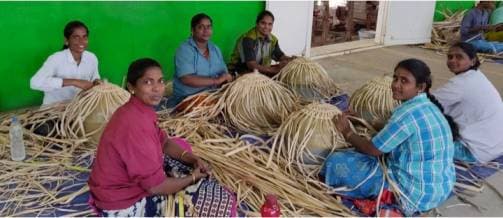
Focusing on sustainable natural fibre and regenerative agricultural value chains, such as banana, bamboo and non-timber forest produce, Industree upskills women to adopt green business practices and connects them with national and global markets for natural and biodegradable products.

As a result, female producers are rising out of poverty by building sustainable, rural livelihoods that also support conservation and biodiversity. Industree’s interventions have impacted more than 500,000 producers in the last 20 years, creating markets worth $58 million and empowering women from marginalized communities in rural areas.

The aim is for many more of the most vulnerable women to take ownership of their collective enterprises, which are environmental, social, and corporate governance (ESG)-compliant small and medium-sized enterprises capable of supplying sustainable products at scale to the stringent standards of global consumers, as well as to fast-growing local economies, which need access to more localized supply chains with reduced carbon footprints.

Should equity, climate and gender be at the heart of ESG?

Already, hundreds of social enterprises are advancing gender equality and helping low-income countries to achieve their economic development objectives while addressing – not adding to – the climate crisis. Inspiring examples can be seen in the report, Local Solutions from the Global South, which documents the work of members of Catalyst 2030, the fast-growing global movement of social entrepreneurs launched at the World Economic Forum in Davos in January 2020, including Industree, Fairtrasa and Sahel Consulting.

Fairtrasa gives smallholder farmers and agricultural workers in Peru the economic impetus to engage in regenerative agriculture. At their ginger processing plant in Satipo, women are employed in two-thirds of the positions, with many generating the only income in their homes. Farmers involved in Fairtrasa programmes have experienced income growth of 10-30% and seen biodiversity flourish on their farms. Bees, insects, butterflies and birds have returned to their fields as the ecological balance is restored for the first time in many years.

In Nigeria, Sahel Consulting is catalysing a vibrant local dairy sector in an inclusive way that improves the livelihoods, productivity, nutrition and the empowerment of smallholder women dairy farmers and their communities. It’s Advancing Local Dairy Development in Nigeria (ALDDN) programme organizes women dairy farmers into formal groups, provides training and support services, including the adoption of improved practices and access to quality feed, and links them to the formal market.

Putting fairer incomes and green techniques into the hands of women – and collaborating with social enterprises for local implementation – is an obvious strategy for organizations to achieve positive outcomes across multiple SDGs. Industree has been supplying its sustainable banana fibre baskets crafted by women across India to IKEA since 2012, shipping to over 400 stores in 50 countries.

Unilever and EY – both also members of the World Economic Forum’s Global Alliance for Social Entrepreneurship alongside IKEA – are collaborating around the TRANSFORM programme together with the UK’s Foreign, Commonwealth and Development Office to support over 75 projects in sub-Saharan Africa and South Asia to scale inclusive and sustainable market-based solutions.

With the potential to accelerate climate action while advancing gender equality and social inclusion, no wonder a growing number of public and private sector institutions are putting equity, climate and genderat the heart of their ESG roadmap.

Stay Updated

Get the latest dairy industry news directly in your feed.

Prefer Us on Google Search

Swipe to continue reading

Previous Article

Next Article