Logo
IndianGlobalBlogsPublicationsPodcastsMarketAboutContact
Logo
IndianGlobalBlogsPublicationsPodcasts
7News
Heritage Foods Seeks Policy Support for Dairy in FY 27 budget20% Drop in Nitrogen Fertiliser Use on Dairy FarmsProtect Cattle from Cold Wave, Expert Urges Dairy OwnersICAR and NDDB to Strengthen Research, Innovation, and ExtensionIndia’s First Glyphosate-Free A2 Ghee from Two Brothers

Indian Dairy News

Heritage Foods Seeks Policy Support for  Dairy in FY 27 budget
Jan 15, 2026

Heritage Foods Seeks Policy Support for Dairy in FY 27 budget

Heritage Foods Ltd., a leading organised dairy company, has appealed to the government for targeted policy support in the Union Budget 2026–27 to accelerate growth in India’s organised dairy sector. C...Read More

Protect Cattle from Cold Wave, Expert Urges Dairy Owners
Jan 14, 2026

Protect Cattle from Cold Wave, Expert Urges Dairy Owners

As severe cold and dense fog continue across Punjab, livestock experts from Guru Angad Dev Veterinary and Animal Sciences University (GADVASU) have issued urgent guidelines for dairy owners to protect...Read More

ICAR and NDDB to Strengthen Research, Innovation, and Extension
Jan 13, 2026

ICAR and NDDB to Strengthen Research, Innovation, and Extension

The Indian Council of Agricultural Research (ICAR) has entered into a landmark Memorandum of Understanding (MoU) with the National Dairy Development Board (NDDB) to enhance collaboration in multidisci...Read More

DairyNews7x7
Advertisement

Latest Blogs

See More
From Forecast to Fact: 2025 Lessons, 2026 Dairy Outlook
Jan 01, 2026

From Forecast to Fact: 2025 Lessons, 2026 Dairy Outlook

As we step into 2026, it is worth pausing to reflect on how the Indian dairy sector navigated the challenges of 2025 and how closely reality tracked the forecasts I outlined in the first blog of last...Read More

India–NZ Dairy FTA: Safeguards or Silent Slippages?
Dec 26, 2025

India–NZ Dairy FTA: Safeguards or Silent Slippages?

The recently concluded India–New Zealand Free Trade Agreement (FTA) marks an important milestone in bilateral trade, while carefully ring-fencing India’s sensitive dairy sector. Under the agreement, c...Read More

Vision 2047: India’s Dairy Development Roadmap
Dec 21, 2025

Vision 2047: India’s Dairy Development Roadmap

As India moves steadily toward Vision 2047, the dairy sector stands at a strategic inflection point. From being a food security instrument in the decades following Independence, dairy has evolved into...Read More

Global Dairy Dynamics: Innovation, Sustainability & Inclusion
Dec 18, 2025

Global Dairy Dynamics: Innovation, Sustainability & Inclusion

The International Dairy Processing Conference (IDPC) 2026, organised by the Trade Promotion Council of India (TPCI) at Yashobhoomi Convention Centre, Dwarka, New Delhi on 7 January 2026, will serve as...Read More

Global Dairy News

20% Drop in Nitrogen Fertiliser Use on Dairy Farms
Jan 14, 2026

20% Drop in Nitrogen Fertiliser Use on Dairy Farms

Dairy farms in New Zealand have recorded a roughly 20% reduction in nitrogen fertiliser use over the past few years, reflecting a combination of regulatory limits, higher input prices and changes in f...Read More

World Pays More, Demands More: New Frontier of Dairy Trade
Jan 12, 2026

World Pays More, Demands More: New Frontier of Dairy Trade

Higher prices, tighter rules and an uncomfortable truth for the industry: without compliance, there is no market The start of 2026 has delivered a signal the global dairy industry cannot afford to ign...Read More

Midan’s Top 10 Meat & Dairy Trends to Watch in 2026
Jan 10, 2026

Midan’s Top 10 Meat & Dairy Trends to Watch in 2026

Midan Marketing has published its annual Top 10 meat and dairy industry trends for 2026, highlighting the forces likely to shape consumer behaviour, product development and value-chain strategies in t...Read More

DairyNews7x7
Advertisement
Dairy News 7x7

Your trusted source for all the latest dairy industry news, market insights, and trending topics.

FOLLOW US
CATEGORIES
  • Global News
  • Indian News
  • Blogs
  • Publications
  • Podcasts
SUBSCRIBE TO OUR NEWSLETTER

Stay informed with the latest updates and trending news in the dairy industry.

No spam, unsubscribe at any time

GET IN TOUCH
C-49, C Block, Sector 65,
Noida, UP 201307
+91 7827405029dairynews7x7@gmail.com

© 2026 Dairy News 7x7. All Rights Reserved.

Terms of ServicePrivacy Policy

How Infrared Imaging Spots Subclinical Mastitis Early

By DairyNews7x7•Published on November 14, 2025

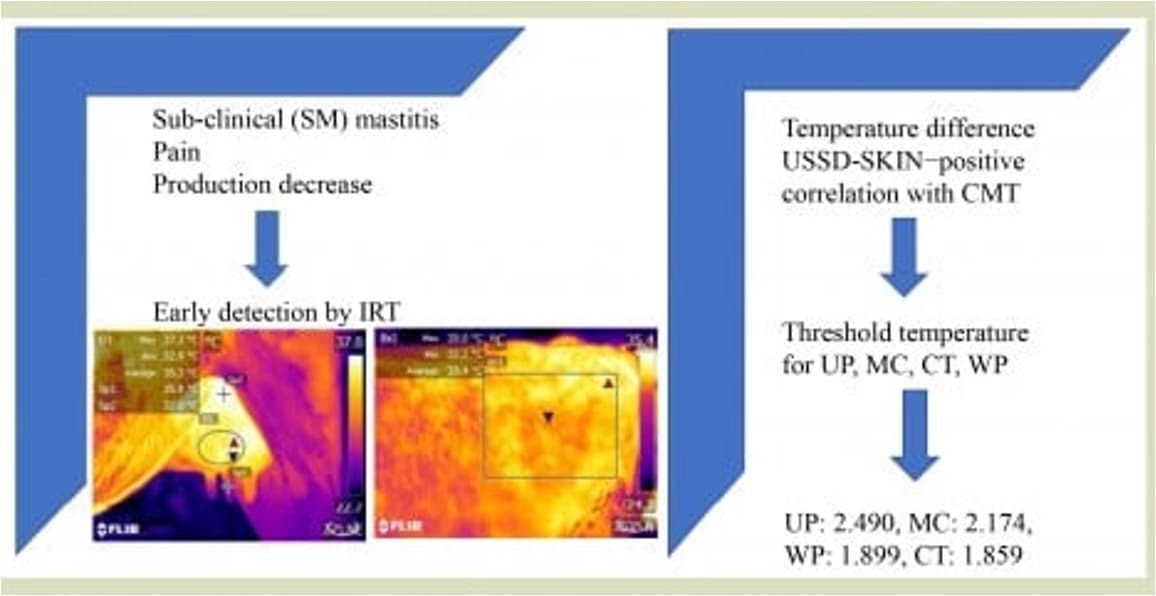
The article describes how infrared thermography (IRT)—a non-invasive imaging method—can accurately screen for subclinical mastitis (SM) in dairy cows by measuring the skin surface temperature of the udder relative to surrounding body parts. In one dataset cited, SM-positive quarters (udder quarters) showed a statistically significant higher udder skin surface temperature (USST) compared with healthy quarters. For example, in one region the difference (ΔT) was about 2.49 °C in lower ambient temps (22.6 °C) and about 1.86 °C in higher ambient temps (29.7 °C).

The article also underscores that the thresholds for ΔT vary depending on environmental temperature and temperature-humidity index (THI): as ambient temperature increases, the temperature difference between udder surface and flank skin decreases (approx. 0.08 °C per °C ambient increase, and 0.05 °C per unit THI increase) because cows’ thermoregulation raises the baseline of flank/udder similarly.

In short: the method can flag potential SM by detecting higher surface temperatures, but success depends on controlling for ambient conditions and using region-specific thresholds.

Technical Implications for Dairy Practice

  • Advantage: IRT provides a rapid, contact-free, on-farm screening tool. Unlike somatic-cell-count (SCC) lab tests which require sampling and waiting, thermal imaging gives almost immediate visual feedback.

  • Limitations: The diagnostic threshold (ΔT) is not universal — it must be calibrated for the local climate, breed, housing/ventilation conditions. Also, IRT alone cannot confirm infection—it gives a strong suspicion requiring follow-up with SCC or bacteriological tests. The review paper by Korelidou et al shows there are still gaps in standardization of camera settings, anatomical region selection, and interpretation protocols.

  • Practical integration: For a dairy laboratory or farm analytics operation, pairing IRT with existing udder-health monitoring (like SCC, EC, CMT) makes sense. The workflow could be: image → raise alert if ΔT above threshold → collect milk sample for confirmatory test → segregate/quarantine if needed.

  • Cost-benefit: Early detection of subclinical mastitis can reduce yield losses, improve milk quality (lower SCC), reduce antibiotic use and improve animal welfare. Implementing IRT requires investment in camera, software and training but may yield ROI in large herds.

  • Key for the Indian context: Given varied ambient conditions across India (from cool hill farms to hot plain farms), thermography thresholds must be locally validated. Also breed differences (Indigenous, crossbreds) may influence baseline surface temperatures.

Source : Dairynews7x7 Nov 14th 2025 Read full story here

Swipe to continue reading

Previous Article

Next Article