Latest Blogs
See More

Indian Dairy News
DairyNews7x7
Global Dairy News

DairyNews7x7
As we step into 2026, it is worth pausing to reflect on how the Indian dairy sector navigated the challenges of 2025 and how closely reality tracked the forecasts I outlined in the first blog of last year.
2025-dynamic-year-ahead-indian-dairy
In January 2025, the central thesis was clear — Indian dairying would confront seasonal volatility, heat-induced supply stresses and tighter forage conditions, but would sustain growth through adaptive procurement, evolving demand patterns and a resilient demand base. What unfolded over the course of the year bore out much of that narrative. Extended summer heat put pressure on milk availability in several regions, testing the lean season assumptions; dairy processors and cooperatives responded with active procurement management and price adjustments rather than routine passivity. Meanwhile, consumer demand remained robust — especially for value-added dairy products — even as feed and fodder costs stayed elevated, validating the expectation that the sector would be tested, not upended by macro pressures.
The most authoritative confirmation of the 2025 outlook came with the release of Basic Animal Husbandry Statistics (BAHS) 2025, which showed that Indian milk production grew by about 3.58 % over the previous year — tightly within the 3.5–4 % range I had projected in January 2025. India maintained its status as the world’s top milk producer, with output nearing 248 million tonnes despite uneven regional flows and weather-linked supply disruptions. This outcome underscores a nuanced reality: production growth remains intact, but the margins of surplus are slim, and the sector’s elasticity to absorb shocks is increasingly dependent on technology adoption, herd productivity improvements and effective risk management.
Throughout 2025, several structural themes emerged that will shape dairy’s trajectory in 2026. Domestic markets saw strong demand for cheese, ghee and specialty products, while quick commerce and new retail formats deepened penetration into urban consumption segments. At the same time, supply remained fragmented; a large proportion of milk still bypasses organised channels, constraining urban availability despite overall growth. Seasonal events — from uneven monsoon distribution affecting fodder growth to heat stress in key producing states — highlighted the growing influence of climatic volatility on milk yields and cow wellbeing. With heatwaves now lasting longer and recovery periods shorter, the sector’s sensitivity to temperature and moisture patterns is a risk that cannot be brushed aside. This interplay of climate and productivity was not only a point of industry discussion in 2025 but will increasingly inform investment and policy priorities going into 2026.
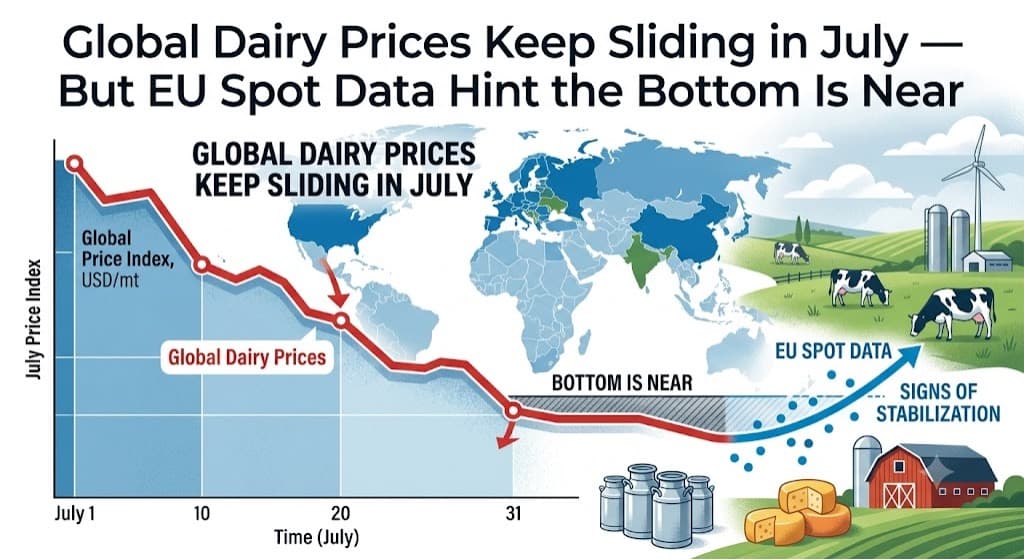
On the global front, dairy commodity markets exited 2025 with price pressures on products like SMP and butter, as supply in key exporting regions remained elevated relative to demand — a dynamic reflected in softer global dairy price indices into year-end. While the Indian market is largely insulated from the full brunt of global cycles due to its domestic demand orientation, butter prices domestically are likely to feel continued tightness in early 2026 as global inventories and trade flows adjust, especially in the wake of slower growth in export volumes and persistent demand from markets in the Middle East and Asia.
Amid these demand and supply dynamics, another issue that merits sustained attention in 2026 is the evolving discourse around the India–New Zealand FTA.
Read it here : India–NZ Dairy FTA: Safeguards or Silent Slippages?
While there is broad consensus — and vocal advocacy across the industry — for 100 % exclusion of dairy from the agreement, the finer details of the proposed commitments, particularly the clauses related to the use of imported dairy ingredients for 100 % export production, remain unclear and, in some respects, ambiguous. On the surface, a full dairy exclusion appears to safeguard India’s producers, but without transparent and enforceable regulatory frameworks around how imported ingredients can be used, tracked and administered under export-linked incentives, there is a risk of unintended competitive distortions. This uncertainty compounds a structural challenge we highlighted in 2025 — even as milk volumes grew, farmers did not see commensurate increases in income, leaving producers squeezed between rising costs and flat returns.
Read it here : More Milk, Less Money: India’s Dairy Crisis
This is an area where the industry cannot afford complacency — high-level assurances must translate into robust governance protocols that align trade objectives with dairy sector realities. How this grey area is ultimately resolved will be as consequential as tariff lines themselves.
Weather patterns will be a critical lens through which to view the year ahead: La Niña-like conditions, if they materialise, could bring above-average rainfall during the monsoon, improving fodder and pasture conditions but raising risks of floods in some belts. Conversely, a shift toward El Niño conditions could disrupt rainfall distribution, escalate heat stress and strain both crop and livestock productivity — with direct implications for feed availability, milk yields and the performance of summer-linked fresh dairy products across North and South India. Any talk of external risk must also consider trade negotiations, such as those under discussion between India and partners like the US and Australia, where tariff adjustments on maize or dairy products could influence feed cost structures and competitive dynamics for Indian producers.
As we move into 2026, these threads — validated forecasts, structural shifts, climate uncertainty, and global price dynamics — form the backdrop against which India’s dairy sector will write its next chapter. The key questions for this year will revolve around strengthening supply resilience, managing input cost inflation, harnessing export opportunities for value-added products, and mitigating climate-linked production risks. In this context, forecasting is not a speculative exercise but a strategic imperative for farmers, processors, policymakers and investors alike.
In the blogs that follow in coming weeks, I will unpack these risks and scenarios in greater depth, moving beyond broad forecasts to examine what they mean for farmers, processors and market makers on the ground. For now, the immediate signals within India are encouraging. Institutional buying in January, an extended and intensive marriage season through February, and the demand push from Ramadan during February–March are expected to keep domestic markets well supported. Against this backdrop, the first quarter of 2026 appears materially stronger for Indian dairying than the global environment, which is likely to remain under pressure from weak commodity sentiment and subdued demand until at least mid-2026. This contrast — domestic resilience amid global uncertainty — will be the defining theme of the months ahead, and how the industry responds to it will shape outcomes well beyond this year.
Source : Dairynews7x7 Jan 1st 2026 written by Kuldeep Sharma