Exotic cows,desi cows and buffaloes grew by 26%,10% and 1 % in 2020 livestock census
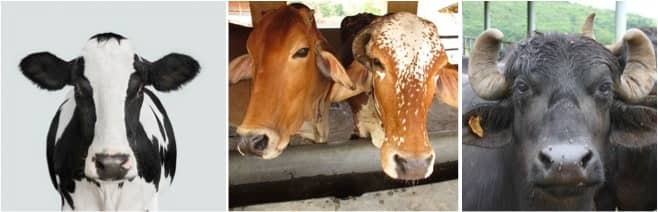
The Department of Animal Husbandry & Dairying under Ministry of Fisheries, Animal Husbandry & Dairying attributes critical importance to livestock and to the collection and availability of up-to-date and accurate data related to livestock, as they are the vital component of rural economy. For proper planning and formulation of any programme meant for bringing further improvement in this sector and its effective implementation and monitoring, valid data are required at every decision making stage.
The Livestock Census is the main source of such data in the country. The livestock census is conducted across the country periodically since 1919. The census usually covers all domesticated animals and head counts of these animals are taken. So far, 19 Livestock Censuses were conducted in participation with State Governments and UT Administrations. The 20th Livestock Census was launched during the month of October, 2018.
The enumeration was done in both rural and urban areas. Various species of animals (cattle, buffalo, mithun, yak, sheep, goat, pig, horse, pony, mule, donkey, camel, dog, rabbit and elephant)/poultry birds (fowl, duck and other poultry birds) possessed by the households, household enterprises/non-household enterprises were counted at that site. Another important feature of 20th Livestock Census is it has been designed to capture Breed-wise number of animals and poultry birds.
Online data collection
For the first time, livestock data were collected on line in 20th Livestock Census. Advance technology has been adopted to collect data through tablet
computers. The National Informatics Centre, Ministry of Electronics & IT has developed Android based mobile application for data collection with various features such as data entry module to facilitate recording the data on tablets, web-based work application, local government directory codes etc. The data captured by the enumerators have been verified through proper data checking process carried out by the supervisors through web-based programmes. Besides the initial scrutiny, another level of validation of data was also carried out with the help of a separate web-based data validation programme in which supervisors were allowed to correct any wrong entry.
The Animal Husbandry Departments of States/UTs have been entrusted to conduct the field operations. In the 20th Livestock Census, the data were collected and scrutinised mostly by para-veterinarians and veterinarians. In this whole Census operations more than 80,000 field staff were deployed for smooth conduct of 20th Livestock Census. Training was an important component for 20th Livestock Census as for the first time field staff were required to operate tablet computers for such massive census operations. Training was conducted at various levels starting from “All India
Training Workshop for Trainers” at Delhi, followed by State, District level trainings. Apart from training, Training Manual, Tutorial video, online e-learning classes etc. have been arranged.
The 20th Livestock Census was carried out in about 6.6 lakhs villages and 89 thousand urban wards across the country covering more than 27 Crores of Households and Non households.
First cut of report
The present report provides certain key results of 20th Livestock Census. It consists of All India total population of major livestock species. The report
also contains State level data of various parameters along with distribution of livestock species according to their age, sex, usages etc. For the purpose of assessing the total count of livestock, the species namely, cattle, buffalo, mithun, yak, sheep, goat, pig, horse, pony, mule, donkey, camel were considered. Besides livestock, the various category of poultry birds possessed by each households and poultry farms were also counted on the spot in 20th Livestock Census.
Key outcomes of the census
The total Livestock population is 535.78 million in the country showing an increase of 4.6% over Livestock Census 2012
Total Bovine population (Cattle, Buffalo, Mithun and Yak) is 302.79 Million in 2019 which shows an increase of 1.0% over the previous census.
The total number of cattle in the country is 192.49 million in 2019 showing an increase of 0.8 % over previous Census.
The Female Cattle (Cows population) is 145.12 million, increased by 18.0% over the previous census (2012).
The Exotic/Crossbred and Indigenous/Non-descript Cattle population in the country is 50.42 million and 142.11 million respectively.
The Indigenous/Non-descript female cattle population has increased by 10% in 2019 as compared to previous census.
The population of the total Exotic/Crossbred Cattle has increased by 26.9 % in 2019 as compared to previous census.
There is a decline of 6 % in the total Indigenous (both descript and non-descript) Cattle population over the previous census. However, the pace of decline of Indigenous Cattle population during 2012-2019 is much lesser as compared to 2007-12 which was about 9%.
The total buffaloes in the country is 109.85 Million showing an increase of about 1.0% over previous Census.
The total milch animals (in-milk and dry) in cows and buffaloes is 125.34 Million, an increase of 6.0 % over the previous census.
The total sheep in the country is 74.26 Million in 2019, increased by 14.1% over previous Census.
The Goat population in the country in 2019 is 148.88 Million showing an increase of 10.1% over the previous census.
The total Camel population in the country is 2.5 Lakhs in 2019, decreased by 37.1% over previous Census.
The total Poultry in the country is 851.81 Million in 2019, increased by 16.8% over previous Census.
The total Backyard Poultry in the country is 317.07 Million in 2019, increased by 45.8% over previous Census.
The total Commercial Poultry in the country is 534.74 Million in 2019, increased by 4.5% over previous Census.
The report contains State-wise details of both livestock and poultry. Since Census operations in Delhi has not been completed, the figures in respect of Delhi is that of previous Census. The present report reflects the aggregate counts of various species combined for both rural and urban areas. It also contains comparative picture of livestock population with previous Census
as well.