Latest Blogs
See More



Indian Dairy News



DairyNews7x7
Global Dairy News

DairyNews7x7
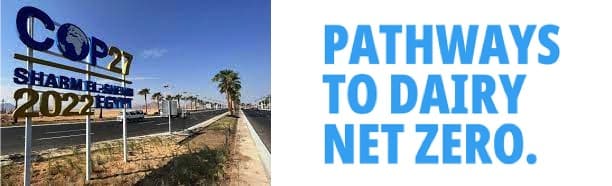
At COP27 today the dairy sector reported its progress underway as part of its global Pathways to Dairy Net Zero effort, the first of its kind in agriculture in terms of size and scope.
Research has identified practical mitigation options suited to dairy production systems throughout the world and is estimating their impact on emission reduction to 2050.
Improving animal health, increasing feed digestibility, enhancing manure storage and treatment, more efficient fertilizer use and the potential adoption of methane-inhibiting feed additives are some of the suggested mitigation options.
The global dairy sector produces nutritious food for six billion people and provides livelihoods for one billion people worldwide.
The dairy sector today announced progress of its global Pathways to Dairy Net Zero (P2DNZ) climate initiative, which was launched last year. The ground-breaking effort is achieving positive results in many regions and accelerating action in others, according to speakers at a COP27 side event, “The Global Dairy Sector’s Climate Ambition and Progress Towards Achievement of the Paris Agreement.”
P2DNZ is backed by more than 140 leading organizations and governments, including the 10 largest dairy companies in the world. Collectively, supporters represent more than 40% of global dairy production throughout the supply chain, making it one of the largest initiatives of its kind in agriculture.
“Dairy is a major force for good in the world, especially when you consider how the sector helps provide important nutrition to the hungry and malnourished and helps build strong, resilient economies, said Hein Schumacher, chair of Global Dairy Platform, one of the founders of Pathways to Dairy Net Zero, and CEO of Royal FrieslandCampina. “By systematically introducing and enhancing climate action in global dairy systems, dairy is tackling the challenge and making progress in reducing our impact on the planet,” he said.
“While there are good options emerging for dairy systems in developed countries, our analysis reinforces the importance of developing and implementing appropriate options for regions and systems where the climate, soil and access to markets have limited options”
Research is Identifying Practical Pathways for Dairy Systems Worldwide Research commissioned as part of P2DNZ has identified six primary dairy production systems throughout the world, along with potential mitigation options and their estimated impact on emissions reduction. The research is led by the Global Research Alliance on Agricultural Greenhouse Gases (GRA) in close collaboration with the UN Food and Agriculture Organization (FAO). They have defined the composition of GHGs emitted by the various dairy production systems around the world and learned there is variability by system. For instance, methane is a large proportion of GHGs in pastoral and agropastoral systems, driven largely by enteric fermentation. However, high-input, high-output production emits a different mix of GHGs from not only enteric fermentation but also manure management, animal feed and energy use.
The six dairy production systems include:
Although mitigation options will vary by each dairy production system, some of the primary pathways include improving animal health, increasing feed digestibility, enhanced manure storage and treatment, more efficient fertilizer use and the potential adoption of methane-inhibiting feed additives.
“Because GRA brings together leading expertise in agricultural GHG emissions, we are pleased to be working on the Pathways to Dairy Net Zero initiative to map emissions and mitigation potential within the diverse range of global dairy production systems,” said Dr. Harry Clark, co-chair of the Livestock Research Group of GRA and co-director of the New Zealand Agricultural Greenhouse Gas Research Centre. “While there are good options emerging for dairy systems in developed countries, our analysis reinforces the importance of developing and implementing appropriate options for regions and systems where the climate, soil and access to markets have limited options,” he said.
Progress in Developed Markets Dairy companies around the world are reducing their impacts on the environment by improving farming and production practices and developing new technologies. FAO reports that during the period from 2005 – 2015, the global dairy sector’s emission intensity declined by 11%. Dairy farming has become more efficient which is resulting in declining emission intensities per unit of product all over the world. This is especially true in developed dairy markets where emission intensities have declined to between 1.3 to 1.4 kg CO₂ equivalent kg fat-and-protein corrected milk. For comparison, developing dairy regions’ emission intensities can range between 4.1 to 6.7 kg CO₂ equivalent per kg fat-and-protein corrected milk.
Tackling Emissions in Emerging Markets Many of the best practices that have already been developed are being implemented in emerging dairy countries, where approximately 80% of the global dairy sector’s emissions are generated.
To help facilitate and accelerate these efforts, the global dairy sector, the Global Methane Pledge, FAO and others have invited 10 developing dairy countries to join P2DNZ as “early adopters.” Collectively these countries represent more than 30% of the sector’s global GHG emissions and include (those in bold have already accepted):
Partners include: Global Dairy Platform, International Dairy Federation, Sustainable Agriculture Initiative Platform, International Livestock Research Institute, Dairy Sustainability Framework and IFCN Dairy Research Network.
The Global Research Alliance on Agricultural Greenhouse Gases is a knowledge partner.