There has never been any doubt about the great love we Indians have for all things dairy – from milk to all the products it churn out – yoghurt, buttermilk, butter, cottage cheese… in all its sweet and sour ways.
There’s no doubt about the importance of dairy in our diet, and the goodness it bestows to our body, for both children and adults alike. However, there are also those who have completely eliminated milk from their diet.
I prefer taking the middle path. While I believe that milk can and should be had by everyone who can handle it (digest it) simply because it is one of the most nutrient-dense food sources available (relative to the calories it provides), and also because it makes scoring important nutrients like protein and calcium easier.
Also watch : Know everything about A1 A2 milk and milk products
That said I do not believing in forcing it on anyone. To each their own is my diktat. But if you decide to partake dairy then equipping oneself with right knowledge to be able to decide which milk is right for you and your family is paramount.
The above mentioned factors are extremely important and must be ascertained first. Then only one must/can get embroiled in the important (and trending) debate that is on right now — the difference between A1 and A2 milk.
Let me try to explain the difference as simply as possible.
What’s The Source: A1vs A2?
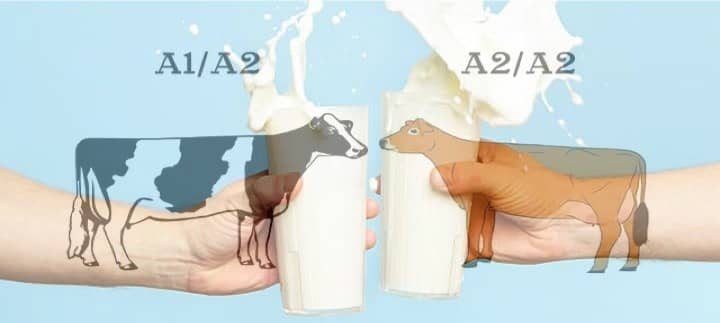
A1 milk is more commonly available and is obtained from cow breeds originated in the USA, North Europe, Australia like Jersey, Holstein Friesian, Ayrshire, and British Short horn. These, also called hybrid cows yield a large quantity of milk and produce 15-20 litres of milk per day.
A2 milk is obtained by cows that are not genetically mutated. A2 cows are Gir, Red Sindhi, Sahiwal, Kankrej and they naturally produce 3- 9 litres of milk per day.
Lactose & the ‘A’ Factor
Lactose, the carbohydrate component of the milk (that causes trouble to those who are lactose intolerant and have weaker gut like tummy disturbances, bloating, gas etc) is of similar composition in both.
But many people who have been avoiding milk due to gut issues find that they can tolerate A2 milk. This is because very often people are intolerant not to lactose, but to A1 protein.
The most important differentiating factor between A1 and A2 is their protein component – casein.
Almost 80 percent of the total protein content in the milk is found in the form of different types of casein, and the most abundant type is beta-casein.
This is present in thirteen different forms, and A1 and A2 are the most abundant variants. Regular milk contains both A1 and A2 beta-casein, but A2 milk contains only A2 beta-casein.
The two proteins are almost identical — they each contain 209 amino acids (the building blocks of any protein).
And the difference is only of one amino acid in the chain, the 67th amino acid. At this position, A1 has a histidine amino acid, while A2 has a proline amino acid.
A1 milk releases histidine, which leads to the formation of histamine (which may cause allergic reactions in some people). A2 casein, proline, on the other hand has been found to be compatible to our body and leads to no adverse effects and so is fats gaining the reputation of being more tummy-friendly.
The Final Word
When choosing your milk one must consider all factors and opt for the one with least red flags. It is important to check if the milk you are buying ticks the factors mentioned in the first point (source), as that criteria is of utmost importance. Whether the milk is A1 or A2 milk, it might be full of (or devoid of) antibiotics, adulterants, pesticides, stress hormones etc, so ascertain that first, and make your voice based on that too.
A2 milk definitely sounds better on paper but it tends to be expensive so make a judicious choice after weighing all the factors and information available.
Also the proof of the pudding is in trying, so instead of depending on marketing hype, take your call after using both types of milk and noticing what they do to your body.
Source : The Quint May 08 2023 by Kavita Devgan
(Kavita Devgan is a nutritionist, weight management consultant, and health writer based in Delhi. She is the author of The Don’t Diet Plan: A no-nonsense guide to weight loss, Fix it with Food, Ultimate Grandmother Hacks, and Don’t Diet! 50 Habits of Thin People.)
Never miss an important dairy update
Follow DairyNews7x7 on Google to get live milk prices, policy alerts, and daily headlines directly in your feed.