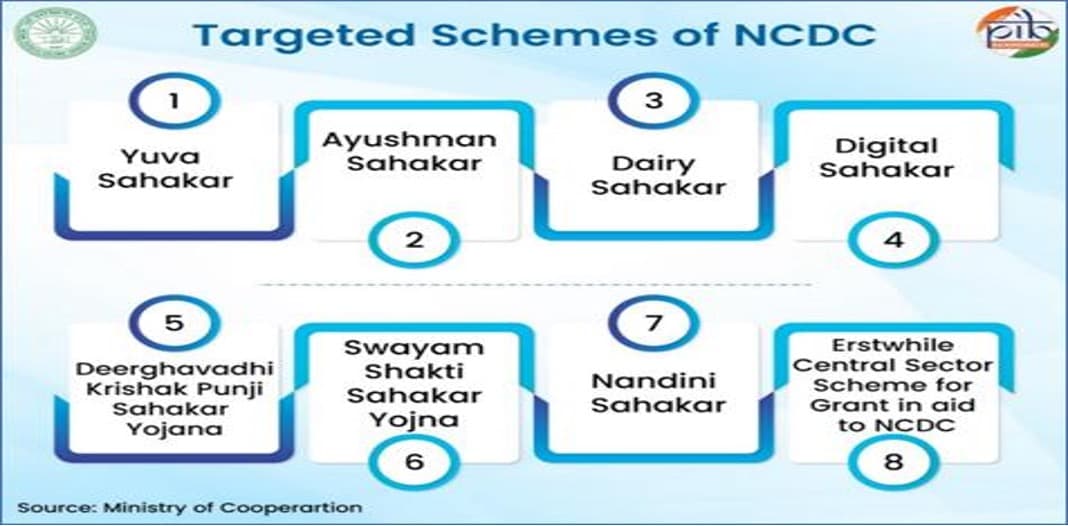
India’s cooperative sector has received a significant financial boost, with the NCDC reporting ₹49,799.06 crore disbursed as of October 2025 for the current financial year 2025-26. This follows a sharp rise in disbursements from ₹5,735.51 crore in 2014-15 to ₹95,182.88 crore in 2024-25.
Importantly for the dairy sector, the NCDC’s support extends well beyond conventional procurement and collection. Under its Dairy Sahakar scheme (launched FY 2021-22), the corpus is directed at end-to-end dairy co-operatives — covering new projects, modernisation/expansion of existing dairy plants, value‐addition, branding, packaging, export of dairy products, and allied segments such as feed manufacturing, equipment & machinery, ICT solutions and cold‐chain infrastructure.
The report underscores that India now hosts over 8.44 lakh co-operative societies with 30 crore members, and nearly 94% of farmers have some linkage with a cooperative entity. For dairy entrepreneur-and-technology players, this translates into a widening window of opportunity — spanning from milk procurement networks through to processing, automation, packaging innovation and exports.
By prioritising segments such as cattle-feed, processing infrastructure, cold-chain, packaging and machinery manufacturing, the NCDC is aligning its funding to enable deeper value-chain capture for dairy. For example, the press release explicitly mentions support to “manufacturing of dairy equipment and machinery” and “value-addition, branding, packaging, marketing … export of dairy products”.
For industry stakeholders like your lab (Safe Labs), engineering consultancy and the dairy entrepreneurship ecosystem you’re developing, this means:
-
Larger budget allocations and favourable funding patterns (loans/grants) for cooperatives wanting to upgrade processing lines, adopt membrane technologies, expand value-added dairy product portfolios, or launch packaging/automation innovations.
-
Opportunities for coalition projects — where your lab, a dairy plant and equipment supplier collaborate under a cooperative-funded scheme.
-
Ensuring that your offering (equipment, product development, packaging solutions) is co-operative friendly (i.e., small/medium co-ops can leverage them) because NCDC’s outreach includes smaller co-operatives, women-led co-operatives and those in aspirational districts.
In short, the announcement marks an important “enabler” moment for India’s dairy cooperative infrastructure: more funds, more reach, broader value‐chain focus. For your weekly exports brief (India–Africa focus) and your dairy innovation agenda, it signals that India’s ‘make-in-dairy’ narrative is increasingly backed by strong institutional funding.
Policy Brief: NCDC’s Dairy Sahakar – Financing India’s Dairy Value Chain
1. Background
The National Cooperative Development Corporation (NCDC) under the Ministry of Cooperation is the apex financial and developmental institution for India’s cooperative movement.
In FY 2025-26 (till October 2025), NCDC has already disbursed ₹49,799 crore, with cumulative support rising from ₹5,735 crore (2014-15) to ₹95,182 crore (2024-25).
This includes significant allocations for dairy, livestock, feed, cold-chain, and machinery manufacturing — the backbone of India’s rural and cooperative dairy ecosystem.
2. About the Dairy Sahakar Scheme
Launched: 2021-22
Corpus: ₹5,000 crore
Objective: Strengthen the entire dairy value chain — from production to processing, value addition, and export — through cooperative and producer-owned models.
Eligible Beneficiaries
-
Dairy cooperatives, producer companies, FPOs, self-help groups
-
State dairy federations and union-level cooperatives
-
Joint ventures where cooperatives hold majority stake
Eligible Activities
-
Modernisation and expansion of dairy plants
-
Manufacture of value-added dairy products (cheese, ghee, UHT, whey derivatives)
-
Setting up of milk processing, chilling and packaging infrastructure
-
Feed plants, bulk milk coolers, automatic milk collection systems
-
R&D, quality testing labs, equipment and machinery manufacturing
-
Branding, packaging, logistics, ICT, and export promotion
3. Financial Support Pattern
| Type of Support |
Typical Loan Limit |
Repayment Period |
Interest Rate |
Margin Requirement |
| Term Loan / Project Finance |
Up to 90% of project cost |
5–10 years (with 1–2 year moratorium) |
8–9% (may vary) |
10–25% (based on risk) |
| Working Capital / Bridge Finance |
Need-based |
12–24 months |
Linked to bank PLR |
— |
Credit Linked Subsidy: Available through state dairy federations or NABARD-linked subsidy components (especially for new units in aspirational districts).
Women and Youth Cooperatives: Preferential funding terms (lower interest, margin concessions).
4. How to Apply
-
Prepare a detailed DPR (technical + financial feasibility) — this is where your Safe Labs R&D and engineering teams can assist cooperatives/startups.
-
Submit the proposal through the State Registrar of Cooperatives / Dairy Federation, or directly to NCDC (if registered multi-state cooperative).
-
NCDC evaluates viability, cooperative structure, promoter equity, and technical soundness before sanction.
-
Post-sanction, funds are disbursed in tranches linked to project milestones.
5. Strategic Implications
-
For Dairy Entrepreneurs: Dairy Sahakar bridges the funding gap for scaling plant capacity, adding membrane modules, or launching new value-added products.
-
For Your Accelerator Program: Co-ops and FPOs can be onboarded as anchor clients or pilot partners under NCDC-funded projects.
-
For Safe Labs & Engineering Partners: NCDC-backed co-ops will increasingly seek certified labs, automation partners, and R&D support — aligning with your integrated service model.
-
For Policy Advocacy: This initiative underlines the government’s direction — empowering 8 crore milk producers through cooperative modernization and export readiness.
6. Key Takeaway
“Dairy Sahakar is not merely a subsidy scheme — it’s a cooperative innovation fund.
Its success depends on how innovators, engineers, and labs collaborate with dairy cooperatives to move from bulk milk to branded, value-added products.”
Source : Dairynews7x7 Nov 7th 2025 PIB