Latest Blogs
See More

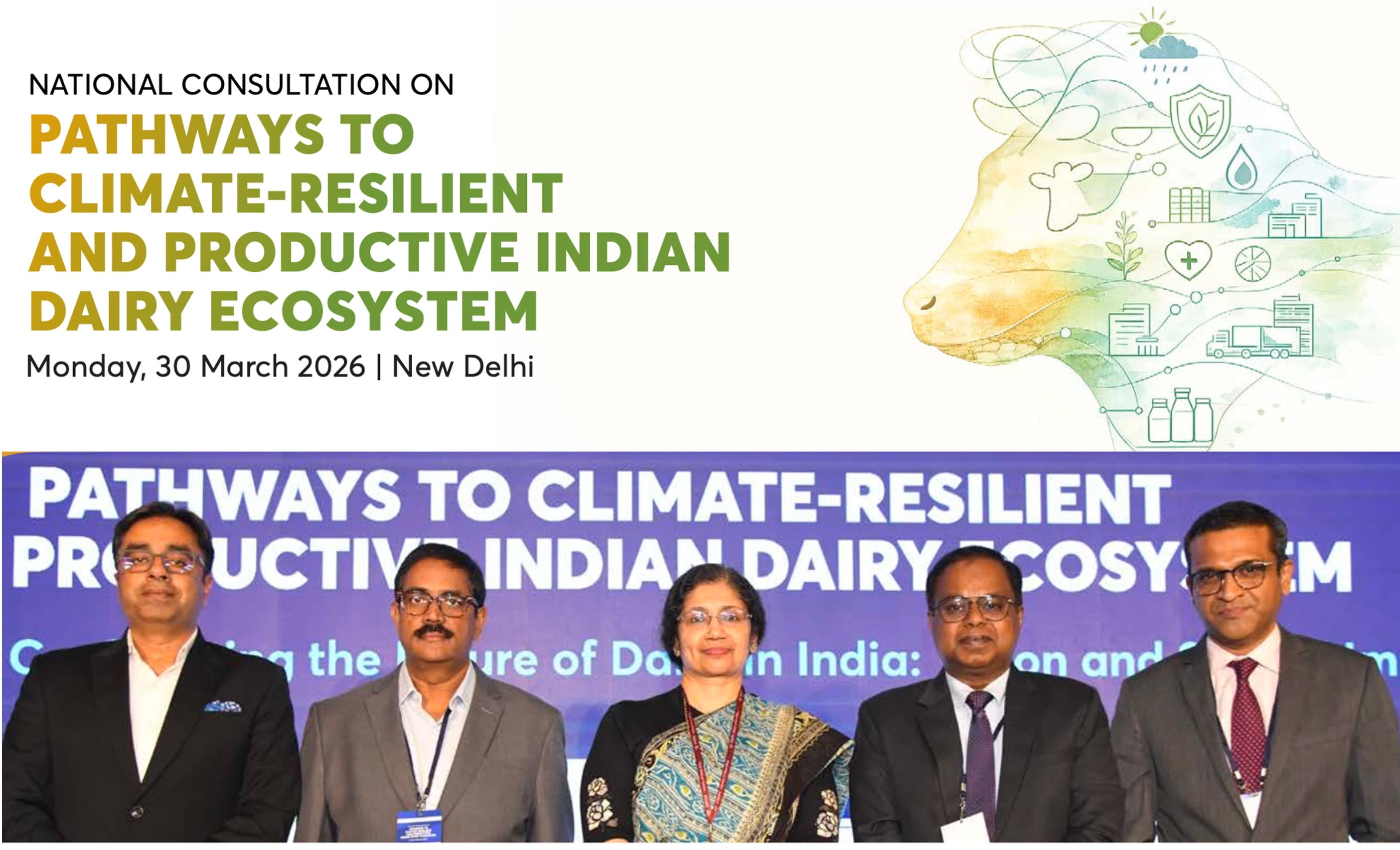
India’s dairy sector today stands at a decisive turning point. The recent National Consultation on Climate-Resilient Dairy held in New Delhi clearly reflected that the conversation around dairy is no longer limited to milk production alone. The sector is now being viewed through a much wider lens — climate resilience, farmer sustainability, productivity enhancement, nutritional security, circular economy, and rural livelihoods.
The consultation brought together policymakers, financial institutions, dairy processors, sustainability experts, technology providers, and development agencies to collectively discuss the future roadmap for Indian dairy.
One message emerged very clearly across discussions — the future of Indian dairy will depend more on productivity enhancement and resilience than simple expansion.
With rising pressure on land, water, fodder resources, and farm economics, sustainable growth can only come through higher productivity per animal, efficient resource utilisation, scientific farm management, and climate-smart dairy practices.
The consultation rightly recognised that feed and fodder systems will play a central role in this transformation. Participants highlighted that feed contributes nearly 70% of dairy production costs. Therefore, improving feeding efficiency through balanced nutrition, silage, Total Mixed Ration (TMR), bypass nutrients, and scientific feeding systems can significantly improve both profitability and resilience.
But this discussion also brings forward a larger and far more important policy question.
Can India truly build a climate-resilient dairy ecosystem without simultaneously building a far stronger and more accountable feed governance framework?
Today, feed remains one of the most critical yet unevenly monitored components of the dairy value chain. The sector has invested significantly in processing infrastructure, genetics, digitalisation, and value-added dairy products, but the foundation of productivity — scientific animal nutrition — still suffers from inconsistent quality standards, fragmented enforcement, variable feed quality, and weak traceability across several parts of the ecosystem.
If India wants to seriously pursue climate-smart dairy development, then feed quality, nutritional integrity, and scientific feeding systems can no longer remain secondary issues.
Poor-quality feed does not only reduce milk productivity. It directly impacts reproductive efficiency, animal health, methane intensity, feed conversion efficiency, antibiotic dependency, and ultimately farmer profitability.
This is no longer merely an animal nutrition issue. It has now become a climate, sustainability, food-security, and rural-income issue.
India therefore needs a far stronger and modernised framework around feed quality assurance, scientific formulation standards, nutritional transparency, traceability of raw materials, and stronger surveillance against adulteration and substandard feed ingredients.
Without addressing this foundational issue, many climate-resilient dairy interventions may struggle to deliver their full impact at the farm level.
When productivity improves, farmer incomes improve, resource efficiency improves, emission intensity reduces, animal health strengthens, and long-term sustainability improves. This “triple-win” approach — balancing farmer prosperity, food security, and environmental sustainability — was one of the strongest outcomes of the consultation.
The discussions also highlighted another important reality. India already has several technologies, pilot projects, financing mechanisms, and innovative dairy models available. The challenge now is not the absence of solutions.
The consultation repeatedly stressed the need for stronger convergence between government institutions, cooperatives, private dairy companies, financial institutions, technology providers, and development organisations. This convergence is essential if climate-resilient dairy practices are to move beyond conference discussions and pilot projects into mainstream adoption.
The role of institutions like NABARD and DAHD also received significant attention.
NABARD’s emphasis on green financing, climate-linked lending, and blended finance models indicates that dairy sustainability is increasingly entering mainstream financial thinking. Similarly, the government’s focus on digital livestock systems, disease-control programmes, veterinary infrastructure, and traceability platforms such as Bharat Pashudhan shows that the policy ecosystem is gradually aligning itself toward a more modern and resilient dairy architecture.
The launch of the Resilient Dairy Alliance (RDA) platform during the consultation was another positive development. Such collaborative platforms can help accelerate knowledge sharing, innovation dissemination, and coordinated action across geographies.
The next decade will determine whether India can successfully transition from being merely the world’s largest milk producer to becoming the world’s most sustainable and resilient dairy ecosystem.
That transition will require productivity-led growth, scientific dairy practices, integrated farm management, climate-smart nutrition, digital traceability, strong farmer-centric delivery systems, and long-term institutional coordination.
India has already achieved the White Revolution.
The next mission is to build a climate-resilient dairy revolution.
And that journey will begin from the farm itself — where productivity, sustainability, nutrition, and farmer resilience must move together.
Source : Review article by Kuldeep Sharma Chief Editor Dairynews7x7 May 15th 2026
Visit the site: Resilient Dairy Alliance