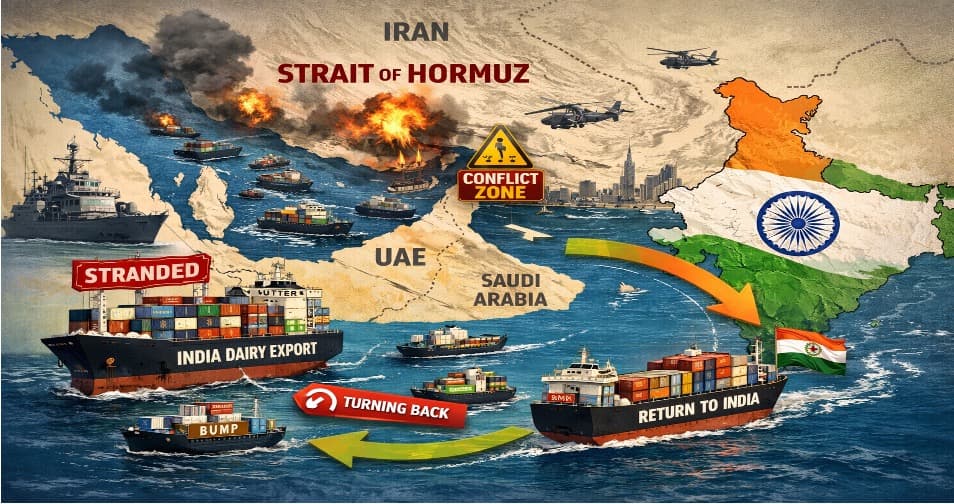
There is no confirmed advisory, restriction, or rejection of Indian dairy consignments such as butter or SMP by any Middle East country or Government authority. The narrative that “cargo is being sent back” is not backed by policy or regulatory evidence. However, dismissing the situation entirely would be equally incorrect. What is unfolding is not a rejection crisis—but a deep and evolving supply chain disruption, which, in isolated cases, can lead to cargo diversion, delays, or even commercial recall.
The Trigger: Strait of Hormuz Crisis Reshaping Global Trade
At the heart of this situation lies the ongoing crisis in the Strait of Hormuz—one of the world’s most critical trade arteries. Nearly
20% of global oil and energy trade flows through this route, and the disruption has triggered a cascading impact across global logistics. Shipping traffic through the region has
collapsed by nearly 70–75%, with over
100 vessels stranded or rerouted. Major shipping lines have either suspended or diverted routes, increasing transit times by
10–14 days while imposing
war-risk surcharges ranging from $1,500 to $4,000 per container. The scale of disruption is now being compared to one of the most severe global logistics shocks seen since COVID.
Dairy Trade Reality: What Market Intelligence Indicates
Insights from global commodity intelligence platforms like vesper ,clearly indicate that dairy markets are
not facing any form of product rejection or regulatory barrier. The disruption is instead playing out through
freight constraints, buyer hesitation, and uncertainty-driven trade behaviour. Carriers are becoming selective, routes are irregular, and shipments into Gulf markets are facing timing uncertainties. Buyers, on the other hand, are delaying procurement decisions—not because of lack of demand, but due to unpredictability in delivery and pricing. This creates a perception gap, where
delayed or diverted cargo is being interpreted as rejected cargo, which is not the case.
So, Is Return of Dairy Cargo Possible? A Candid View
The answer lies in understanding trade dynamics rather than policy action.
Yes, return or diversion of cargo is possible—but purely as a commercial outcome, not a regulatory one. In situations where importers delay lifting shipments due to price corrections, or where transit delays make contracts unviable, exporters may choose to redirect cargo to alternative markets or even recall shipments to avoid mounting demurrage costs. These are
strategic trade decisions taken under uncertainty, and not instances of rejection by importing countries. The distinction is critical and must be clearly understood by the industry.
Beyond Exports: A Full-System Shock Emerging
While the immediate focus remains on exports, the real concern for the Indian dairy sector lies in a
multi-layered systemic impact that is beginning to unfold—cutting across energy, inputs, logistics, and farm economics.
Energy Shock (Immediate Impact)
The conflict has already pushed crude oil prices beyond
$100 per barrel, with global supply disruptions estimated at nearly
10 million barrels per day. For the dairy sector, this translates directly into higher costs of
steam generation, chilling, transportation, and overall plant operations. Energy, which is a core input in dairy processing, is now entering a phase of volatility that could significantly alter cost structures. Though in
India fuel prices have not increased yet but alternative fuels like wood and coal prices moving up. In areas where dairies are dependant upon gas like Gujarat, a
major reduction in supply is bound to impact processing of milk into commodities at this fag end of flush.
Freight & Logistics Breakdown
Freight costs have surged sharply due to rising fuel prices, war-risk insurance premiums, and longer shipping routes. The result is not just increased cost, but also
loss of reliability in delivery timelines. For exporters of SMP and butter, this creates a dual challenge—shrinking margins and rising working capital blockage as shipments take longer cycles to complete. Even at domestic levels local transporters are increasing freight giving reasons of poor availability of fuel.
Fertiliser Shock Leading to Milk Cost Inflation
A less visible but more structural impact is emerging through fertiliser supply disruptions. The Gulf region plays a critical role in global fertiliser trade, and current disruptions have already started tightening availability and increasing prices. This will directly impact
fodder cultivation costs, eventually translating into
higher milk procurement prices. This is not an immediate shock, but a
slow-building inflationary pressure on the dairy value chain.
Feed & Agricultural Supply Chain Risks
Global feed and grain logistics are also witnessing disruptions, further compounding the pressure on livestock feeding costs. Any sustained increase in feed prices will directly impact farm-level economics, squeezing margins for milk producers and creating upward pressure on raw milk prices.
Packaging & Industrial Input Cost Escalation
Energy-intensive materials such as plastics, laminates, and aluminium have already started witnessing price increases. For the dairy sector, this means a direct increase in the cost of
milk pouches, butter packaging, and bulk handling materials, adding another layer to overall cost escalation.
Fuel & LPG Shortage Signals Emerging in India
Early signals are already visible within India, with
LPG consumption reportedly declining by 17% year-on-year due to supply disruptions. At the same time, global diesel markets are tightening, and Gulf energy infrastructure is under stress. This raises concerns not just about cost, but also about
availability and prioritisation of industrial fuel, which could impact processing continuity in extreme scenarios. There is a a
significant impact on HORECA demand for dairy products in domestic markets.
Emerging Challenge: LPG Shortage Triggering Labour Disruptions
An additional, less discussed challenge is now beginning to surface in the form of labour availability constraints linked to LPG shortages. A large section of the workforce that had returned to their native places during Holi became engaged in harvesting activities alongside their families. While many were expected to return to work post Eid, the emerging uncertainty around LPG availability has altered these plans.
Families, apprehensive about the difficulty of managing basic cooking needs in industrial locations, are increasingly reluctant to send workers back. This is gradually translating into a labour shortage on the ground, adding another layer of operational stress for the dairy sector—particularly at a time when plants are running at peak capacity.
What This Means for the Indian Dairy Sector
In the short term, there is
no regulatory barrier to exports, but shipments are likely to slow down due to logistical uncertainties and cautious buyer behaviour. In the medium term, over the next three to six months, the industry should prepare for
cost escalation across feed, fuel, and packaging, which will compress margins and test pricing strategies. If the disruption continues for a longer duration, global dairy trade flows may realign, and demand from the Middle East could become
erratic rather than declining, creating volatility in export opportunities. Exporters may also face increased working capital pressure and contract execution risks.
Need for better governance
The Indian dairy sector, sustaining 80–100 million farmers, deserves proactive governance to prevent unjustified spikes in fuel, packaging, and transportation costs—otherwise, the industry may be compelled to pass the pressure back to farmers through lower raw milk prices.
There is
no evidence of Indian dairy cargo being rejected or banned in the Middle East till now. What the industry is witnessing is a
global logistics and cost disruption of significant scale, which in certain cases may lead to cargo diversion or commercial recall—but not rejection.
“This is not a demand crisis. This is a supply chain disruption with cost inflation at its core.”
The need of the hour is to remain alert without being alarmed. The industry must closely track logistics, rework export pricing, and prepare for a phase where cost dynamics—not demand—will define the market trajectory.
Source : Written by Kuldeep Sharma Chief Editor Dairynews7x7