The earlier editorial “Bitter Milk” by The Hindu rightly called for stronger accountability in food safety governance. But the situation in Rajahmundry has now escalated far beyond a routine safety lapse.
Read our blog here :Rajahmundry Milk Incident: Accident or Adulteration?
With reported deaths rising sharply, this is no longer an isolated incident. It is a systemic failure unfolding in real time—and the silence of preventive action is deeply concerning.
Let us be clear.
If current reports are accurate, this was not a classic case of milk adulteration.
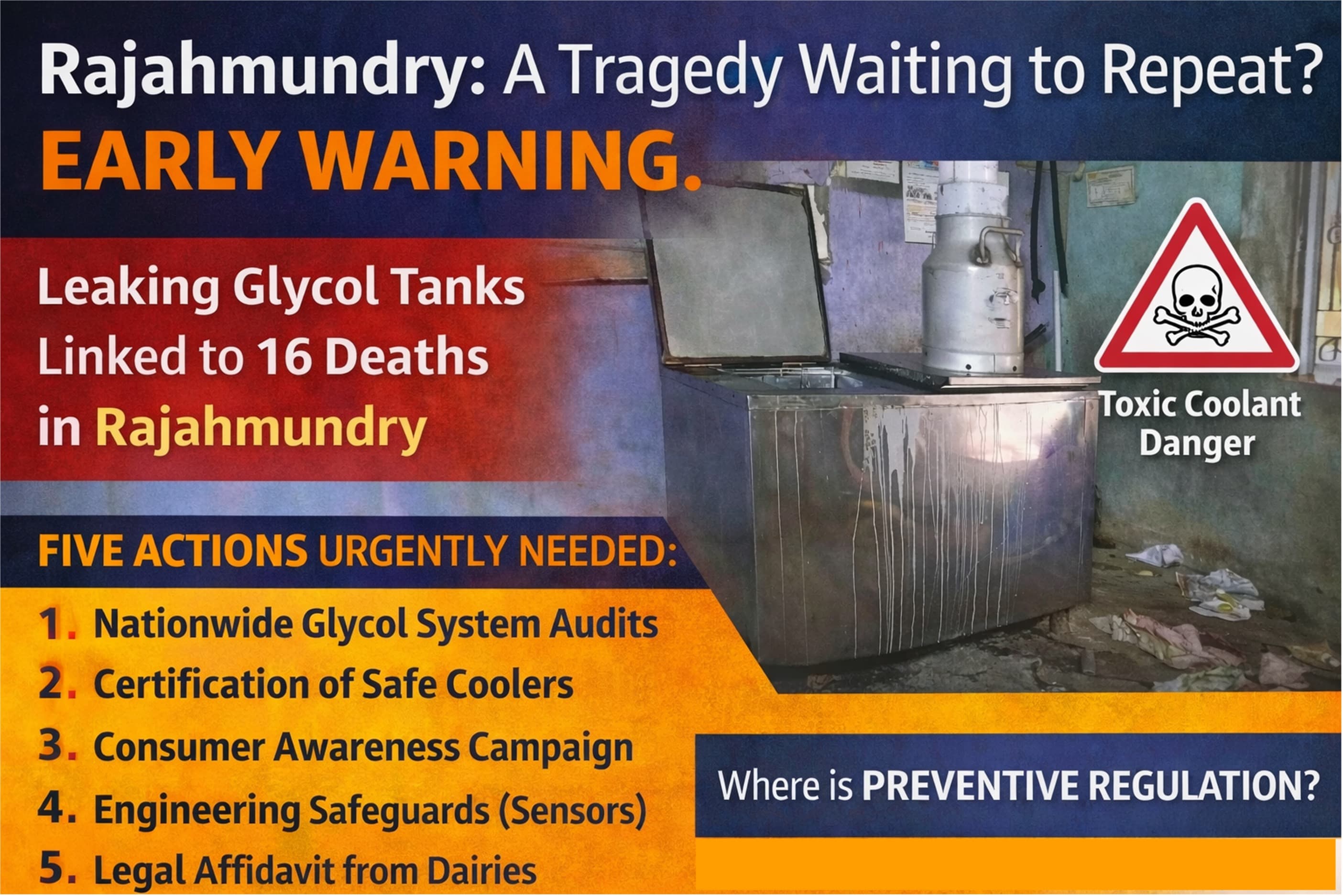
This was a toxic industrial coolant—ethylene glycol—entering the milk chain due to a failure in refrigeration systems.
And that changes everything.
This Is Not Just an Accident. It Is a National Risk.
Ethylene glycol is not an obscure substance. It is widely used in industrial cooling systems and is highly toxic when ingested.
Yet today:
- There is no nationwide advisory asking dairies to verify which coolant is being used
- There is no immediate audit drive for glycol-based milk cooling systems
- There is no temporary restriction on milk handled through such systems
- There is no visible consumer awareness initiative
This is not just regulatory delay.
This is a window where the next accident can happen.
The Uncomfortable Truth About Glycol-Based Cooling
Across India, thousands of glycol-filled milk coolers and plate heat exchangers (PHEs) are used for chilling and processing milk.
In many cases:
- These systems are installed and maintained by local technicians
- The difference between food-grade propylene glycol and industrial ethylene glycol is poorly understood
- There are no mandatory safeguards to detect leakage or cross-contamination
Which means one thing:
What happened in Rajahmundry is not an exception. It is a vulnerability built into the system.
Where Is Preventive Regulation?
When dry ice in beverages caused injuries, the Food Safety and Standards Authority of India acted swiftly and banned the practice.
Why is the same urgency missing now—when lives have already been lost?
Why are we waiting for more data when the risk pathway is already clear?
Food safety cannot be reactive.
It must move faster than the next failure point.
Five Immediate Actions That Cannot Wait
If this tragedy is to mean anything, it must trigger decisive action—now.
1. Nationwide Advisory & Immediate Audit
All dairies, chilling centres, and milk handlers must be directed to immediately verify the type of coolant used in their systems.
A time-bound audit (7–10 days) should be mandated across the country.
2. Temporary Certification of Glycol-Based Systems
Milk processed through glycol-based cooling systems should be allowed only after certification that:
- There is no risk of leakage into milk
- Only food-grade propylene glycol is used
Until then, precautionary restrictions should be considered.
3. Mandatory Consumer Awareness Drive
Consumers must be made aware of the risks.
A national poster and awareness campaign should be launched showing:
- What a glycol-based milk cooler looks like
- What to check at the retail level
- Basic red flags in loose milk handling
Food safety cannot remain invisible to the consumer.
4. Engineering Safeguards in Processing Systems
All milk processing systems using secondary coolants must be upgraded with:
- Differential Pressure sensors to prevent cross-contamination
- Fail-safe mechanisms in PHEs and tubular heat exchangers (THEs)
- Mandatory system validation protocols
This is standard engineering logic—yet not universally enforced.
5. Legal Accountability Through Self-Declaration
All registered and licensed dairy businesses must be required to submit an affidavit confirming:
- They are not using ethylene glycol in any food-contact system
- Their coolant stocks and systems have been verified
This creates both traceability and legal accountability.
A Deeper Structural Gap
This incident also exposes three long-standing gaps:
- Unregulated chemical access without food-use warnings
- Unregistered milk vendors operating outside oversight
- Weak enforcement of licensing and inspections
These are not new issues.
But now, they have fatal consequences.
Protecting Milk, Not Undermining It
Milk is not the problem.
India’s dairy sector feeds millions and sustains livelihoods across the country.
But trust, once shaken, is difficult to rebuild.
If such incidents continue without visible corrective action, the damage will not be limited to one region—it will impact consumer confidence nationwide.
The Moment of Responsibility
Rajahmundry must become a turning point.
Not another case file.
Not another editorial cycle.
But a clear shift from reactive enforcement to preventive governance.
Because the real question is no longer what went wrong.
The real question is:
Are we acting fast enough to ensure it doesn’t happen again?
Source : Article by Kuldeep Sharma Chief Editor Dairynews7x7 March 31st 2026