Logo
IndianGlobalBlogsPublicationsPodcastsMarketAboutContact
Logo
IndianGlobalBlogsPublicationsPodcasts
7News
Hatsun Agro Q3: Revenue, net profit surgeIndia Slaps 30% Duty on US Pulses; Trade Talks Feel StrainHigh-Oleic Soybeans Could Transform Dairy Feed & Milk QualityAmul Dairy Records ₹14,099 Cr Turnover, 9.2% GrowthHi-Tech dairy plant to be commissioned in Namakkal in February

Indian Dairy News

Hatsun Agro Q3: Revenue, net profit surge
Jan 19, 2026

Hatsun Agro Q3: Revenue, net profit surge

Dairy products maker Hatsun Agro Products Ltd. on Monday, January 19, reported a 48% year-on-year (YoY) growth in net profit to ₹60.6 crore for the quarter ended December 31, 2025. Net profit for the...Read More

Amul Dairy Records ₹14,099 Cr Turnover, 9.2% Growth
Jan 19, 2026

Amul Dairy Records ₹14,099 Cr Turnover, 9.2% Growth

The Kaira District Cooperative Milk Producers’ Union Ltd (Amul Dairy) reported a turnover of ₹14,099 crore in FY25, marking a 9.2 % year-on-year growth, according to figures announced at its 79th Annu...Read More

Hi-Tech dairy plant to be commissioned in Namakkal in February
Jan 19, 2026

Hi-Tech dairy plant to be commissioned in Namakkal in February

A hi-tech dairy plant, that is upcoming in Namakkal at a cost of ₹89.28 crore, will be commissioned next month (February) and the trial run of the plant has begun. The Namakkal Aavin that was bifur...Read More

DairyNews7x7
Advertisement

Latest Blogs

See More
5 Year Budget Plan to Make Indian Dairy Global Leader in 2047
Jan 15, 2026

5 Year Budget Plan to Make Indian Dairy Global Leader in 2047

I recently moderated a key session on India Dairy Vision 2047 at the TPCI's International Dairy Processing Conference 2026, gaining valuable insights from panellists. This led to me developing policy...Read More

From Forecast to Fact: 2025 Lessons, 2026 Dairy Outlook
Jan 01, 2026

From Forecast to Fact: 2025 Lessons, 2026 Dairy Outlook

As we step into 2026, it is worth pausing to reflect on how the Indian dairy sector navigated the challenges of 2025 and how closely reality tracked the forecasts I outlined in the first blog of last...Read More

India–NZ Dairy FTA: Safeguards or Silent Slippages?
Dec 26, 2025

India–NZ Dairy FTA: Safeguards or Silent Slippages?

The recently concluded India–New Zealand Free Trade Agreement (FTA) marks an important milestone in bilateral trade, while carefully ring-fencing India’s sensitive dairy sector. Under the agreement, c...Read More

Vision 2047: India’s Dairy Development Roadmap
Dec 21, 2025

Vision 2047: India’s Dairy Development Roadmap

As India moves steadily toward Vision 2047, the dairy sector stands at a strategic inflection point. From being a food security instrument in the decades following Independence, dairy has evolved into...Read More

Global Dairy News

India Slaps 30% Duty on US Pulses; Trade Talks Feel Strain
Jan 19, 2026

India Slaps 30% Duty on US Pulses; Trade Talks Feel Strain

India has quietly imposed a 30 % tariff on pulses imported from the United States — including key crops like yellow peas and lentils — in what officials present as a protective trade measure for domes...Read More

High-Oleic Soybeans Could Transform Dairy Feed & Milk Quality
Jan 19, 2026

High-Oleic Soybeans Could Transform Dairy Feed & Milk Quality

New research shows that feeding high-oleic soybeans to dairy cows can both improve milk composition and cut feed costs, offering a promising feed strategy for producers amid rising input prices. This...Read More

Dairy Protein Value Index Slips as South America Exports Shift
Jan 18, 2026

Dairy Protein Value Index Slips as South America Exports Shift

The Dairy Protein Value Index posted a modest decline in mid-December, highlighting subtle but meaningful shifts in South American dairy exports that continue to shape global protein markets — includi...Read More

DairyNews7x7
Advertisement
Dairy News 7x7

Your trusted source for all the latest dairy industry news, market insights, and trending topics.

FOLLOW US
CATEGORIES
  • Global News
  • Indian News
  • Blogs
  • Publications
  • Podcasts
SUBSCRIBE TO OUR NEWSLETTER

Stay informed with the latest updates and trending news in the dairy industry.

No spam, unsubscribe at any time

GET IN TOUCH
C-49, C Block, Sector 65,
Noida, UP 201307
+91 7827405029dairynews7x7@gmail.com

© 2026 Dairy News 7x7. All Rights Reserved.

Terms of ServicePrivacy Policy

Milk prices defy seasonal trend as supply pressures build

By DairyNews7x7•Published on January 23, 2021

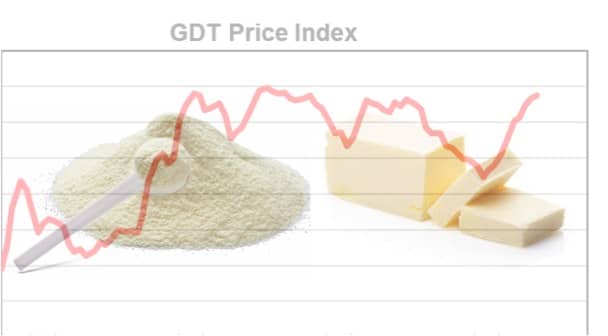
On Tuesday, skim milk powder (SMP) prices at Global Dairy Trade (GDT), the fortnightly auction platform of New Zealand’s Fonterra Cooperative, averaged $3,243 per tonne, the highest since the $3,264 of August 5, 2014.

Vegetable prices have cooled with the usual winter-time increase in supplies of carrots, cauliflower, cabbage, radish, capsicum and peas. Even onions and tomatoes aren’t on fire like they were only a couple of months ago.

That isn’t happening though in milk, whose production also tends to rise during winters when calvings by buffaloes peak. Dairies are now paying more for milk during the current “flush” season (October-March), even as prices of dairy products have firmed up. And if international market trends are any indication, they look set to climb further.

On Tuesday, skim milk powder (SMP) prices at Global Dairy Trade (GDT), the fortnightly auction platform of New Zealand’s Fonterra Cooperative, averaged $3,243 per tonne, the highest since the $3,264 of August 5, 2014.

Domestic SMP market

In the domestic market, too, dairies are selling SMP at Rs 245-255 per kg, as against Rs 180-190 in September and the Rs 140-150 lows touched in July. Even more striking is the recovery in milk fat prices. According to Ganesan Palaniappan, a leading Chennai-based dairy commodities trader, ex-factory rates of cow butter and ghee are ruling at Rs 305-310 and Rs 400 per kg, respectively. These are up from their corresponding levels of Rs 260-270 and Rs 340-350/kg in September and Rs 200-225 and Rs 280-290 in July.

All this is reflected in milk prices as well. Maharashtra dairies are procuring cow milk (with 3.5% fat and 8.5% solids-not-fat content) at Rs 27-28 per litre, compared to Rs 24-25 in September and Rs 18-20 in July.

“Global prices at more than six-year high is good for Indian farmers. It also opens up export possibilities, especially of white butter and ghee,” said R S Sodhi, managing director of Gujarat Cooperative Milk Marketing Federation (GCMMF). Anhydrous milk fat (ghee) prices soared 17.2% to $5,398 per tonne in the latest GDT auction, while butter was traded at an average of $4,735. That latter works out to around Rs 346 per kg, which is, in fact, above the Rs 305-310 being realised by Indian dairies on domestic sales.

Hardening of milk prices is unusual at this time

Hardening of milk prices is nevertheless unusual at this time. The calving season for animals, when more milk starts flowing from their udders, generally begins from September. That is when temperature and humidity levels drop, alongside improved fodder-cum-straw availability from the monsoon rains and harvesting of the kharif crop. The calvings peak in the winter and continue till March-April before the onset of summer.T

The unseasonal supply crunch being seen at present is basically a lagged effect of the Covid-19 ,induced lockdown that forced the closure of hotels, restaurants, hostels and canteens, apart from cancellation of marriages and other public functions. The demand destruction and price crash from it resulted in farmers underfeeding their animals.

Demand supply mismatch

“The impact of that is playing out just when demand is returning. Hotels and restaurants have already reopened, weddings are taking place, and schools, colleges and hostels are also restarting. So, we have a supply-demand mismatch,” Rahul Kumar, CEO of the French multinational Lactalis India, which owns Prabhat Dairy in Mumbai and Thirumala Milk Products Pvt. Ltd in Chennai, told The Indian Express.

The above mismatch could increase in the coming days due to three reasons. The first is that very few dairies – GCMMF, Karnataka Milk Federation and Tamil Nadu’s Aavin – are today holding enough stocks of powder and fat. The second is international prices, which make exports more viable than imports.

The third reason has, again, to do with Covid. The lockdown made it difficult for farmers to access artificial insemination services. There were supply chain issues – be it of liquid nitrogen containers, frozen semen straws or technicians. Not being able to inseminate on time could, in turn, translate into further delayed calvings.


Swipe to continue reading

Previous Article

Next Article