Logo
IndianGlobalBlogsPublicationsPodcastsMarketAboutContact
Logo
IndianGlobalBlogsPublicationsPodcasts
7News
Dairy Minister Telangana with Chairman Vijaya visit NDDB AnandScale up India’s dairy cooperative model: Sunita NarainHyderabad Raid Busts ₹18.26 Lakh Fake Ghee UnitNZ Seeks Opposition Support to Advance India Free Trade AgreementMiracle Boy” -"Deepak Patel" Boosts Dairy Productivity in Gujarat

Indian Dairy News

TG Dairy Seeks Action Over ‘Vijaya’ Brand Misuse
Mar 09, 2026

TG Dairy Seeks Action Over ‘Vijaya’ Brand Misuse

The Telangana Dairy Development Cooperative Federation Limited (TGDDCF) has urged the Andhra Pradesh government to immediately stop the unauthorised use of the “Vijaya” dairy brand in Telangana, alleg...Read More

Punjab Budget Boosts Dairy, Crop Diversification
Mar 09, 2026

Punjab Budget Boosts Dairy, Crop Diversification

The Punjab Budget 2026-27 has allocated ₹15,377 crore for agriculture and allied sectors, with several measures aimed at strengthening farming, dairy and sustainable agriculture, according to Agricult...Read More

Can Indian Dairy Grow Without More Milk?
Mar 09, 2026

Can Indian Dairy Grow Without More Milk?

India’s dairy sector is facing a critical question—whether the industry can continue expanding without significantly increasing milk production volumes. India is already the world’s largest milk produ...Read More

DairyNews7x7
Advertisement

Latest Blogs

See More
Milk Prices Rise in South & West: Is North Next?
Mar 05, 2026

Milk Prices Rise in South & West: Is North Next?

The recent round of retail milk price increases across South India and Maharashtra is no longer an episodic adjustment but a clear signal of structural stress building up in India’s milk economy. Over...Read More

India’s Dairy Climate Paradox: Production Triumph Meets Methane Time-Bomb
Mar 02, 2026

India’s Dairy Climate Paradox: Production Triumph Meets Methane Time-Bomb

India’s rise to the top of the global dairy league board has been one of the most remarkable agricultural success stories of the 21st century. With milk production surpassing 247 million tonnes per ye...Read More

India’s First Cow Culture Museum in Mathura
Feb 16, 2026

India’s First Cow Culture Museum in Mathura

India’s first national “Cow Culture Museum” is set to be established in Mathura, Uttar Pradesh, on the campus of Pandit Deendayal Upadhyaya Veterinary Science University, announced the Uttar Pradesh B...Read More

Why India’s Dairy Needs a National Fodder Grid ?
Feb 15, 2026

Why India’s Dairy Needs a National Fodder Grid ?

Recently, I moderated the Farmer's session at 52nd DIC. While deliberating on pathways for Kerala to move towards milk self-reliance, K S Mani, Chairman of Milma, articulated a compelling thought: jus...Read More

Global Dairy News

Argentine Dairy Exports Surpass Beef
Mar 09, 2026

Argentine Dairy Exports Surpass Beef

Argentina’s dairy industry recorded a significant milestone as dairy exports surpassed beef exports for the first time, highlighting the growing importance of milk products in the country’s agr...Read More

Farmers Demand Tariffs on Cheap Dairy Imports
Mar 09, 2026

Farmers Demand Tariffs on Cheap Dairy Imports

Dairy farmers in Serbia have warned that cheap imports of milk and cheese are threatening the survival of domestic producers, calling for the government to introduce import tariffs and other protectiv...Read More

FrieslandCampina Sets Strategic Priorities for 2026
Mar 09, 2026

FrieslandCampina Sets Strategic Priorities for 2026

Dutch dairy cooperative FrieslandCampina has outlined key strategic priorities for 2026 as it looks to strengthen resilience, expand its market reach and focus on higher-value dairy segments after a c...Read More

DairyNews7x7
Advertisement
Dairy News 7x7

Your trusted source for all the latest dairy industry news, market insights, and trending topics.

FOLLOW US
CATEGORIES
  • Global News
  • Indian News
  • Blogs
  • Publications
  • Podcasts
SUBSCRIBE TO OUR NEWSLETTER

Stay informed with the latest updates and trending news in the dairy industry.

No spam, unsubscribe at any time

GET IN TOUCH
C-49, C Block, Sector 65,
Noida, UP 201307
+91 7827405029dairynews7x7@gmail.com

© 2026 Dairy News 7x7. All Rights Reserved.

Terms of ServicePrivacy Policy
Prefer Us
Prefer Us

Meat and dairy gobble up farming subsidies worldwide

By DairyNews7x7•Published on January 14, 2022

Meat and dairy gobble up farming subsidies worldwide
Prefer on

Meat and dairy gobble up farming subsidies worldwide, which is bad for your health and the planet.

The global food system is in disarray. Animal agriculture is a major driver of global heating, and as many as 12 million deaths from heart disease, stroke, cancers and diabetes are each year connected to eating the wrong things, like too much red and processed meat and too few fruits and vegetables. Unless the world can slash the amount of animal products in its food system and embrace more plant-based diets, there is little chance of avoiding dangerous levels of climate change and mounting public health problems.

Agricultural subsidies help prop up a food system that is neither healthy nor sustainable. Worldwide, more than US$200 billion of public money (that is, money collected through taxes) is given to farmers every year in direct transfers – usually with the intention of supporting national food production and supply.

This might not be a problem in itself – after all, we all need to eat. But the way governments provide subsidies at the moment exacerbates the health and environmental issues of food production. That’s one of the findings of a new study published in Nature Communications by my colleague Florian Freund and me.

Agricultural subsidies in action

According to our analysis, about two-thirds of all agricultural transfer payments worldwide come without any strings attached. Farmers can use them to grow what they like.

In practice, this means every fifth dollar is used to raise meat, and every tenth dollar to make dairy products – the kinds of foods farmers have grown used to producing but which emit disproportionate amounts of greenhouse gas emissions, and which are also linked to dietary risks such as heart disease and certain cancers.

Farmers use another third of these payments to grow staple crops such as wheat and maize, and crops used for producing sugar and oil. These are foods that are already produced and consumed in large quantities and that, if anything, should be limited in a healthy and sustainable diet.

Less than a quarter of transfer payments are used to grow the kinds of foods that are good for human health and the environment, and which a healthy and sustainable food system would need much more of: fruits, vegetables, legumes and nuts.

Based on this breakdown, it’s clear there is plenty of room for improving how governments and farmers issue and spend agricultural subsidies. We decided to look at alternatives, and compare how they might work in the real world.
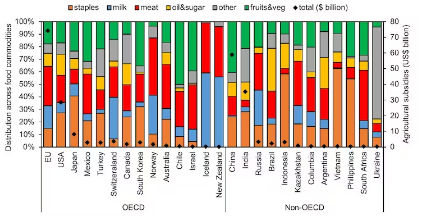
Where agricultural subsidies go ?

Reforming subsidies

We combined an economic model which tracked the knock-on effects of altering subsidies on food production and the food people eat with an environmental one which compared changes in resource use and greenhouse gas emissions – plus a health model which measured the consequences for diet-related illnesses.

In one scenario, we made all subsidy payments to farms conditional on them producing healthy and sustainable foods. Farmers would still be free to grow other crops and foods, just not with the support of subsidies. We found that fruit and vegetable production would go up substantially – by about 20% in developed countries. This would translate into people eating half a portion of fruit and veg more per day. At the same time, meat and dairy production would go down by 2% – shaving off 2% from agricultural greenhouse gas emissions.

However, we also found that the economy could suffer if all subsidies were used in this way, drawing in workers to farming from more productive parts of the economy.

Fortunately, there are ways to avoid this. Either make half of all subsidies conditional on growing healthy and sustainable foods, or combine these conditional subsidies with a reduction in the overall amount of payments – tying them, for example, to an amount informed by a country’s GDP or population. Each of those options would result in a healthier food supply and less greenhouse gas emissions without reducing economic output.

Our analysis proposes something which is largely missing from current plans: changing the mix of food production. What food farms choose to grow has a greater effect on the environment and health than how it is grown. Redirecting subsidies towards the production of healthy and sustainable food should be an essential part of reforming agriculture worldwide.

Stay Updated

Get the latest dairy industry news directly in your feed.

Prefer Us on Google Search

Swipe to continue reading

Previous Article

Next Article