Logo
IndianGlobalBlogsPublicationsPodcastsMarketAboutContact
Logo
IndianGlobalBlogsPublicationsPodcasts
7News
Mandatory Daily Record of Production and Raw Material UtilisationHeritage Foods inaugurates new Ice Cream PlantFSSAI makes registration to all milk vendors in IndiaGujarat Ice Cream Makers Face Cone ShortageSummer Heat to Stress India’s Dairy Cold Chain

Indian Dairy News

FSSAI Licences Get Perpetual Validity
Mar 14, 2026

FSSAI Licences Get Perpetual Validity

India’s food regulator, the Food Safety and Standards Authority of India (FSSAI), has announced a major reform granting perpetual validity to food licences and registration certificates, eliminating t...Read More

Dairy Sector a ‘Safety Net’ for Farmers: NABARD
Mar 14, 2026

Dairy Sector a ‘Safety Net’ for Farmers: NABARD

The Chairman of National Bank for Agriculture and Rural Development, Shaji K V, has highlighted the crucial role of India’s dairy industry in protecting rural livelihoods, describing it as a “safety n...Read More

Bihar Dairy Officer Arrested in ₹30,000 Bribery Case
Mar 14, 2026

Bihar Dairy Officer Arrested in ₹30,000 Bribery Case

A field officer of the district dairy development department in Bihar was arrested by the Vigilance Investigation Bureau (VIB) for allegedly accepting a bribe of ₹30,000 in West Champaran district. Th...Read More

DairyNews7x7
Advertisement

Latest Blogs

See More
Mandatory Daily Record of Production and Raw Material Utilisation
Mar 14, 2026

Mandatory Daily Record of Production and Raw Material Utilisation

I recently reviewed the notification issued by the Food Safety and Standards Authority of India in the context of Schedule IV of the Food Safety and Standards (Licensing and Registration of Food Busin...Read More

FSSAI makes registration to all milk vendors in India
Mar 13, 2026

FSSAI makes registration to all milk vendors in India

The recent advisory issued by Food Safety and Standards Authority of India (FSSAI) mandating registration of milk vendors is a timely and progressive step towards strengthening traceability and accou...Read More

Rajahmundry Milk Incident: Accident or Adulteration?
Mar 10, 2026

Rajahmundry Milk Incident: Accident or Adulteration?

The recent editorial “Bitter Milk” published by The Hindu raises important concerns about food safety in India. The editorial deserves appreciation for attempting to broaden the conversation and under...Read More

Milk Prices Rise in South & West: Is North Next?
Mar 05, 2026

Milk Prices Rise in South & West: Is North Next?

The recent round of retail milk price increases across South India and Maharashtra is no longer an episodic adjustment but a clear signal of structural stress building up in India’s milk economy. Over...Read More

Global Dairy News

Global Dairy Commodity Prices Show Signs of Rally
Mar 14, 2026

Global Dairy Commodity Prices Show Signs of Rally

Global dairy commodity prices have shown a rally in the first quarter of 2026, particularly for products originating from Australia and New Zealand, according to a new Q1 Global Dairy Quarterly report...Read More

How Walmart Keeps Great Value Milk So Affordable
Mar 14, 2026

How Walmart Keeps Great Value Milk So Affordable

Retail giant Walmart has managed to keep the price of its private-label Great Value milk significantly lower than many competing brands through a vertically integrated dairy supply chain and direct co...Read More

Lactose-Free Milk Seen as Growth Driver in Coffee
Mar 13, 2026

Lactose-Free Milk Seen as Growth Driver in Coffee

Lactose-free milk is emerging as a major growth opportunity for the dairy industry, particularly in the rapidly expanding coffee and café segment. A recent US-based study highlighted that lactose-free...Read More

DairyNews7x7
Advertisement
Dairy News 7x7

Your trusted source for all the latest dairy industry news, market insights, and trending topics.

FOLLOW US
CATEGORIES
  • Global News
  • Indian News
  • Blogs
  • Publications
  • Podcasts
SUBSCRIBE TO OUR NEWSLETTER

Stay informed with the latest updates and trending news in the dairy industry.

No spam, unsubscribe at any time

GET IN TOUCH
C-49, C Block, Sector 65,
Noida, UP 201307
+91 7827405029dairynews7x7@gmail.com

© 2026 Dairy News 7x7. All Rights Reserved.

Terms of ServicePrivacy Policy
Prefer Us
Prefer Us

Longer calving interval resulted in heifers with greater body weight and lower milk

By DairyNews7x7•Published on June 20, 2024

Longer calving interval resulted in heifers with greater body weight and lower milk
Prefer on

In a pioneering research study, scientists have established relationship between calving interval and its impact on the offspring's health, milk production in their first 100 days of first lactation and other important factors.

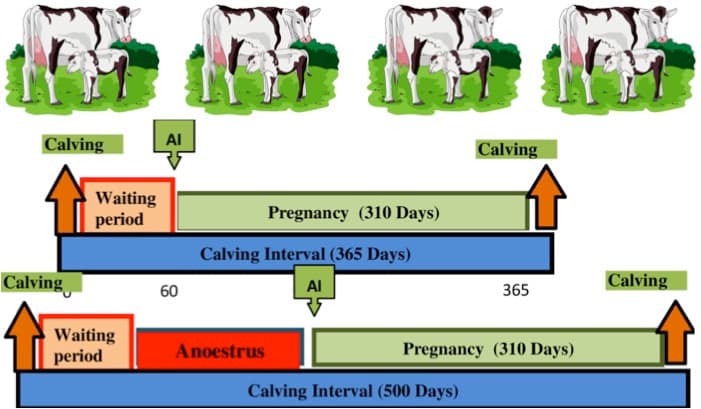
Extending the time before inseminating dairy cows voluntarily could reduce how often they give birth, aiming to choose better times for insemination when cows are less likely to have fertility issues. Researchers wanted to see how this affects the health and milk production of calves born from cows with different waiting periods before insemination and different lengths of time between calving events.

They studied Holstein Friesian dairy cows, totaling 154 (41 first-time mothers, 113 experienced mothers). The cows were grouped by factors like how much milk they produced and their somatic cell count, then randomly assigned waiting periods of 50, 125, or 200 days before insemination. They focused on female calves (62 total) born to cows with different lengths of time between calving events.

They found that the length of time between calving events didn't affect the birth weight of the calves. However, from birth until they were weaned, calves born to cows with shorter times between calving events had higher levels of a substance called plasma nonesterified fatty acids compared to calves born to cows with longer times between calving events. These shorter intervals also led to higher levels of certain antibodies in the calves before they were weaned.

After weaning until the calves themselves gave birth for the first time, those born to cows with shorter intervals between calving events tended to have higher levels of plasma nonesterified fatty acids than those born to cows with longer intervals.

During the first 100 days after giving birth for the first time, calves born to cows with longer intervals between calving events tended to have lower levels of a substance called plasma IGF_1 and produced less milk that was adjusted for fat and protein content compared to calves born to cows with shorter intervals. However, these effects were not consistent across all groups with different lengths of time between calving events.

In summary, extending the time between calving events in dairy cows did not affect the birth weight of their calves or their body weight during the period before they were weaned or raised. However, calves born to cows with longer intervals between calving events had less of certain antibodies and lower levels of a specific substance in their blood before weaning. During the first lactation period of these calves, those born to cows with longer intervals between calving events tended to have lower levels of another substance in their blood and produced less milk with adjusted fat and protein content compared to calves born to cows with shorter intervals between calving events.


Summary

In conclusion, calves born from dams with an extended calving interval differ in natural antibodies, body weight, and milk performance across different periods from birth until the first 100 DIM. More differences among CInt groups in immune variables were observed before weaning, and more in body weight, and milk production variables occurred after calving. A longer calving interval in dams, resulted in heifer calves with lower IgG and IgM levels against keyhole limpet hemocyanin (KLH) and lower plasma Non esterified Fatty acid (NEFA )concentration during the first 12 weeks of life. While during the first 100 DIM ( Days in milk )  of the offspring’s first lactation, a longer calving interval in dams resulted in heifers with greater body weight and lower milk production. This is one of the first studies that evaluated the effects of dam’s calving interval on offspring’s performance. Although we found some consequences of CInt in terms of immunity during early life and milk production during later life, results need to be confirmed in further studies.


Stay Updated

Get the latest dairy industry news directly in your feed.

Prefer Us on Google Search

Swipe to continue reading

Previous Article

Next Article