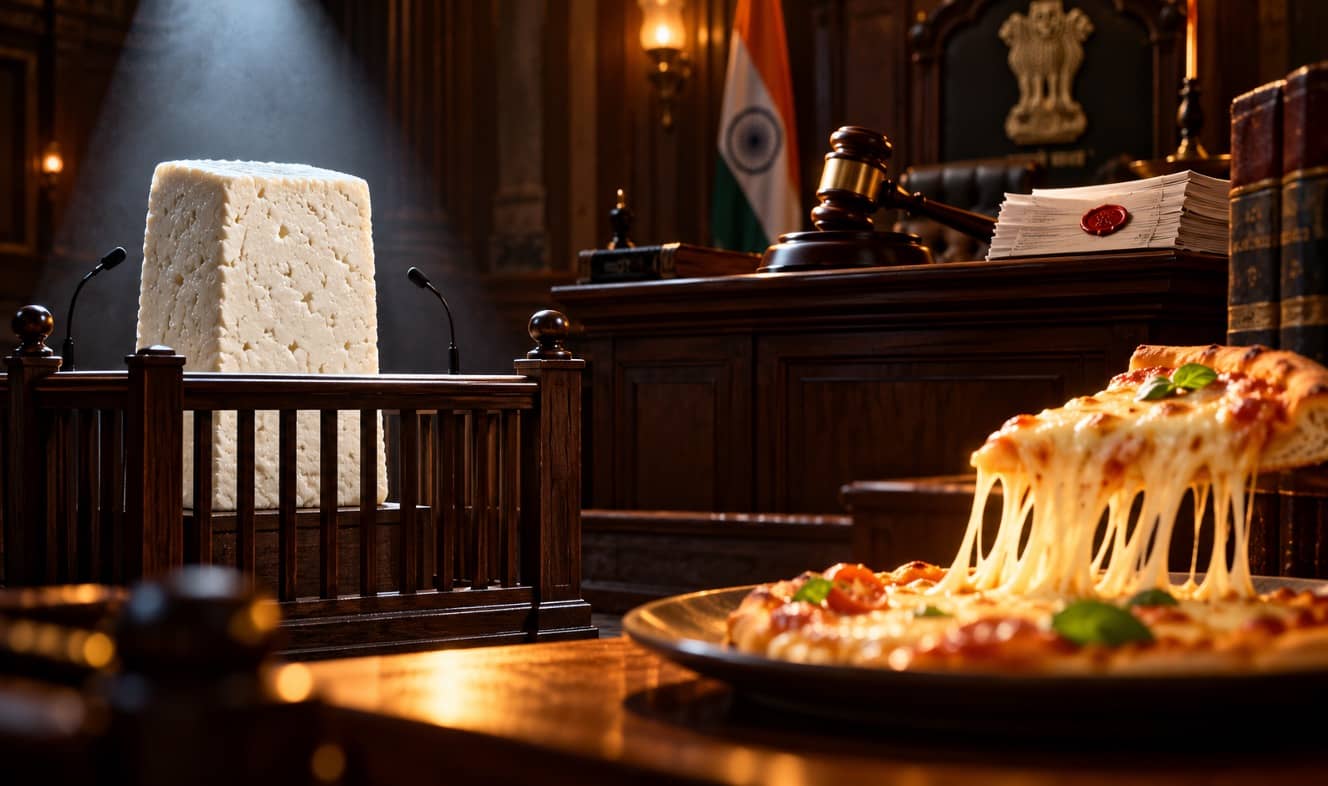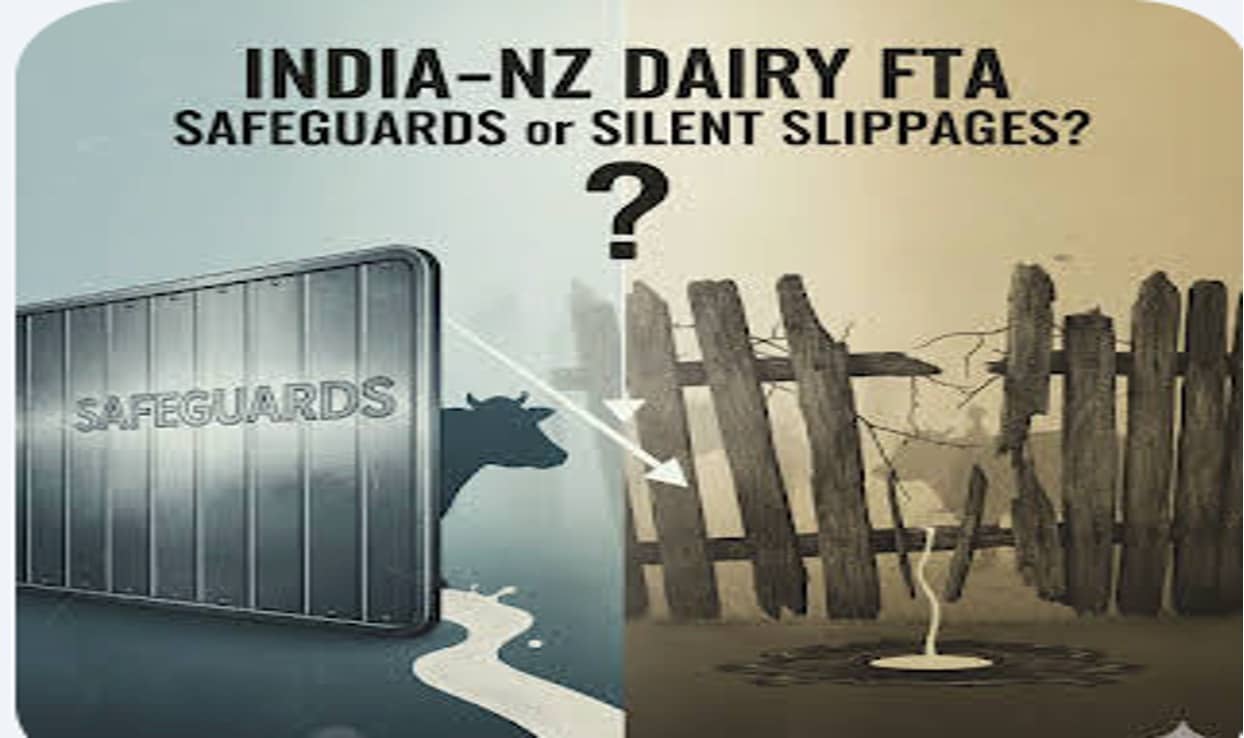
The recently concluded India–New Zealand Free Trade Agreement (FTA) marks an important milestone in bilateral trade, while carefully ring-fencing India’s sensitive dairy sector. Under the agreement, core dairy products such as milk, cream, butter, cheese, yoghurt, whey and casein remain excluded from duty-free access, reflecting India’s long-standing policy to protect millions of small dairy farmers. However, the FTA does open a narrow and conditional window for import of certain dairy inputs and ingredients from New Zealand, primarily for value addition in India with a mandatory 100% re-export obligation. This approach seeks to position India as a processing hub for high-value dairy preparations without disturbing the domestic milk economy.
A key provision under this arrangement is the import-for-processing and re-export clause, which allows New Zealand companies to bring selected dairy ingredients into India, process them into value-added products such as nutritional formulations or specialised dairy preparations, and then export the finished products entirely to third markets. These imports are not meant for domestic consumption in India and are expected to be tightly regulated through bonded warehousing, customs supervision and export-linked compliance mechanisms. On paper, this clause balances trade facilitation with farmer protection, but its effectiveness will depend entirely on enforcement.
The importance of brand integrity and origin control becomes evident when viewed against the backdrop of the Milkio Foods case in New Zealand. On 27th Aug 2024 we published this news in which , New Zealand authorities prosecuted Milkio Foods Limited, imposing a fine of NZ$420,000 after the company pleaded guilty to multiple breaches of the Fair Trading Act. Milkio had marketed its products as “100% Pure New Zealand”, while using imported butter from India, and had also made unauthorised use of the FernMark logo. The case sent a strong signal that New Zealand regulators take misrepresentation of dairy origin extremely seriously, given the global value attached to the “Pure New Zealand” dairy brand.
Under New Zealand’s domestic regulatory framework, such integrity is protected through strict origin labelling laws, trademark enforcement, active monitoring by the Commerce Commission, and severe penalties for misleading claims. Companies must demonstrate full traceability of inputs, and any deviation from approved sourcing can attract prosecution, fines and reputational damage. This system works largely because of tight domestic oversight and a clear legal boundary between local and imported ingredients.
However, when this lens is applied to the India–New Zealand FTA framework, several grey areas emerge that require urgent clarification. One such area is the treatment of products under HS Chapter 19, which covers preparations of cereals, flour, starch or milk. The FTA discussions indicate that “bulk infant formula and other dairy-based preparations” under HS 19 are eligible for phased tariff elimination over seven years. In practice, this is understood to refer mainly to bulk, unbranded ingredients or intermediate formulations, particularly those classified under HS 1901.90, which are intended for further processing and export.
The ambiguity arises around HS 1901.10, which specifically covers “preparations suitable for infants or young children, put up for retail sale.” While official statements suggest that retail infant formula remains a sensitive and largely excluded category, the absence of explicit public clarification raises concerns. If bulk infant formula is allowed under HS 19 for processing and export, how will regulators clearly differentiate between bulk industrial use and retail-ready formulations? More importantly, will any part of HS 1901.10 be permitted under the FTA framework, even indirectly, and if so, under what conditions?
Another critical grey area is end-use enforcement. While the FTA assumes that imported dairy ingredients will be used strictly for export-oriented production, tracking molecular equivalence of milk solids across complex manufacturing processes is inherently difficult. Unlike simple goods, dairy ingredients can be blended, reformulated and reclassified, making it challenging to conclusively prove that the same imported inputs have gone into the exported finished product. This creates a risk—howsoever unintended—of leakage into the domestic market, unless India issues very clear operational guidelines backed by audits, digital traceability and punitive deterrents.
In essence, while the FTA attempts to strike a fine balance between trade openness and dairy sector protection, the Milkio case underscores why clarity and enforcement are non-negotiable. New Zealand’s own regulatory actions show that brand integrity is fiercely protected at home. For the India–New Zealand FTA to work without unintended consequences, similar rigour must be built into customs procedures, HS-code interpretations, export obligations and labelling rules, especially for sensitive categories like infant nutrition. Until these grey areas—particularly around HS 19, bulk versus retail infant formula, and end-use verification—are clearly addressed, the agreement will continue to invite scrutiny from the dairy ecosystem on both sides.
Source : Dairynews7x7 Dec 26,2025 a blog by Kuldeep Sharma Chief editor Dairynews7x7
Never miss an important dairy update
Follow DairyNews7x7 on Google to get live milk prices, policy alerts, and daily headlines directly in your feed.