Logo
IndianGlobalBlogsPublicationsPodcastsMarketAboutContact
Logo
IndianGlobalBlogsPublicationsPodcasts
7News
Rajahmundry Milk Incident: Accident or Adulteration?Dairy Minister Telangana with Chairman Vijaya visit NDDB AnandScale up India’s dairy cooperative model: Sunita NarainHyderabad Raid Busts ₹18.26 Lakh Fake Ghee UnitNZ Seeks Opposition Support to Advance India Free Trade Agreement

Indian Dairy News

Bitter Milk: Lessons from Rajamahendravaram Case
Mar 10, 2026

Bitter Milk: Lessons from Rajamahendravaram Case

The milk adulteration tragedy in Rajamahendravaram in Andhra Pradesh’s East Godavari district has raised serious concerns about food safety, regulatory oversight and the vulnerability of consumers to...Read More

Sangam Dairy Chief Slams ‘Fake Propaganda’ Claims
Mar 10, 2026

Sangam Dairy Chief Slams ‘Fake Propaganda’ Claims

Dhulipalla Narendra Kumar, who is also a **Sangam Dairy chairman and MLA from Ponnur, strongly criticised leaders of the YSR Congress Party (YSRCP), accusing them of spreading false propaganda and bas...Read More

Nandini Demand Boosts Profits for Dairy Farmers
Mar 10, 2026

Nandini Demand Boosts Profits for Dairy Farmers

Rising demand for Nandini dairy products has significantly increased revenues for the Chikkaballapur District Milk Producers Cooperative Union (CHIMUL) in Karnataka, enabling the cooperative to share...Read More

DairyNews7x7
Advertisement

Latest Blogs

See More
Rajahmundry Milk Incident: Accident or Adulteration?
Mar 10, 2026

Rajahmundry Milk Incident: Accident or Adulteration?

The recent editorial “Bitter Milk” published by The Hindu raises important concerns about food safety in India. The editorial deserves appreciation for attempting to broaden the conversation and under...Read More

Milk Prices Rise in South & West: Is North Next?
Mar 05, 2026

Milk Prices Rise in South & West: Is North Next?

The recent round of retail milk price increases across South India and Maharashtra is no longer an episodic adjustment but a clear signal of structural stress building up in India’s milk economy. Over...Read More

India’s Dairy Climate Paradox: Production Triumph Meets Methane Time-Bomb
Mar 02, 2026

India’s Dairy Climate Paradox: Production Triumph Meets Methane Time-Bomb

India’s rise to the top of the global dairy league board has been one of the most remarkable agricultural success stories of the 21st century. With milk production surpassing 247 million tonnes per ye...Read More

India’s First Cow Culture Museum in Mathura
Feb 16, 2026

India’s First Cow Culture Museum in Mathura

India’s first national “Cow Culture Museum” is set to be established in Mathura, Uttar Pradesh, on the campus of Pandit Deendayal Upadhyaya Veterinary Science University, announced the Uttar Pradesh B...Read More

Global Dairy News

Data Replaces Handshakes in Dairy Lending
Mar 10, 2026

Data Replaces Handshakes in Dairy Lending

The dairy financing landscape is undergoing a major transformation as traditional relationship-based lending gives way to data-driven credit evaluation, according to industry insights. Historically, d...Read More

Rabobank Sees Cautious Dairy Price Recovery
Mar 10, 2026

Rabobank Sees Cautious Dairy Price Recovery

Global dairy commodity prices are showing early signs of recovery in 2026, but the rebound is expected to remain cautious due to abundant global milk supply, according to Rabobank’s Global Dairy Quart...Read More

US-Iran Tensions Raise Indirect Risks for Dairy
Mar 10, 2026

US-Iran Tensions Raise Indirect Risks for Dairy

Escalating tensions between the United States and Iran are creating indirect challenges for the global dairy sector, mainly through higher energy, freight and packaging costs, according to market anal...Read More

DairyNews7x7
Advertisement
Dairy News 7x7

Your trusted source for all the latest dairy industry news, market insights, and trending topics.

FOLLOW US
CATEGORIES
  • Global News
  • Indian News
  • Blogs
  • Publications
  • Podcasts
SUBSCRIBE TO OUR NEWSLETTER

Stay informed with the latest updates and trending news in the dairy industry.

No spam, unsubscribe at any time

GET IN TOUCH
C-49, C Block, Sector 65,
Noida, UP 201307
+91 7827405029dairynews7x7@gmail.com

© 2026 Dairy News 7x7. All Rights Reserved.

Terms of ServicePrivacy Policy
Prefer Us
Prefer Us

Grassland, fodder issues merit global attention

By DairyNews7x7•Published on September 26, 2022

Grassland, fodder issues merit global attention
Prefer on

India will occupy the G20 Presidency from December 1, 2022, to November 30, 2023, and host the 18th G20 Summit next year. The G20 Chair undertakes a wide range of activities to help members discuss and coordinate policies on matters of common interest. The shift in focus in recent years to the Global South is illustrative of the growing influence of emerging economies such as India in spurring international development cooperation and strengthening multilateralism. India’s vital role in global economic governance has fostered its active participation in the G20 arena.

G20 brings under its umbrella all five permanent members of the United Nation Security Council, all G7 member countries and BRICS nations. The G20 members accounts for two-thirds of the world’s population, around 85% of the global GDP and 75% of international trade.

On the agriculture front, the G20 Ministers of Agriculture have had talks on food security, nutrition and global agricultural development and sustainability issues since their first meeting in Paris in 2011. Concerted global efforts in areas such as genomics, digital agriculture, climate-smart and bio-friendly technologies, and efficient resource management issues have been the common agreed agenda at various G20 meetings. In the G20 Leaders’ Summit 2021 hosted by Italy, India stressed on the need to increase investment in agricultural research and development amid the challenges of climate change and the expected increase in food demand by 2030. However, it seems that issues concerning feed and fodder, the severe deficit of which may threat India’s numero uno position in milk production, have suffered from exclusion in all G20 Ministers of Agriculture dialogues.
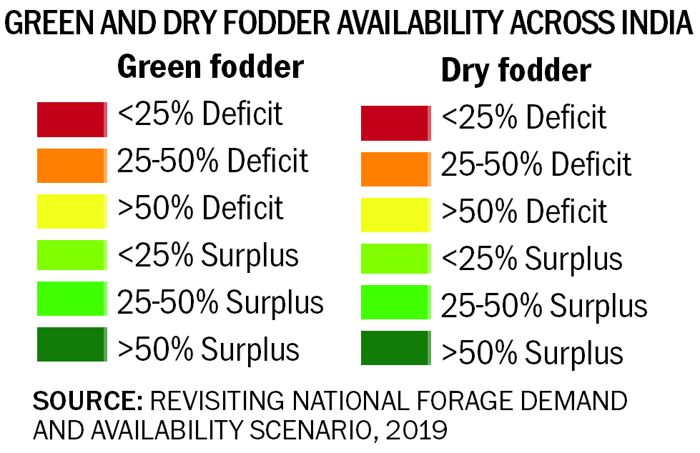
The supply of feed and fodder has always falls short of the aggregate demand in the country. Studies suggest that devoting around 14-17% of the land for fodder cultivation will be ideal for meeting fodder shortages in the country; however, fodder is being cultivated on 8.4 million hectares (nearly 4%) for the past few decades. Sparing more area for fodder is vital in the wake of rapid intense competition for additional land from commercially important crops. As per the recent report titled ‘Revisiting National Forage Demand and Availability Scenario’, for every 100 kg required, India is short of 11.24 kg of green fodder and 23.4 kg of dry fodder. The scenario is more unnerving in states where the fodder deficit is above 25%. With the burgeoning livestock population and the government’s focus on the genetic upgrade of cattle through cross-breeding programmes, the demand-supply gap of green fodder will widen considerably in the absence of appropriate policy planning and its grassroots-level implementation. As the G20 Presidency is a great opportunity for India to place its priorities and narratives on the global agenda, the country should strengthen partnership in fodder research & development as well as in fodder trade.

Premier fodder research institutes of the country can be involved in collaborative discussions with international organisations on sharing ideas as well as technologies and their implementation. Moreover, attracting global investments in strengthening fodder-based Indian start-ups should be on the priority list of agriculture and allied issues. Stakeholders in feed and fodder development hope that healthy discussions will be dedicated to this ignored sector in the upcoming global mega event.

Another important area of global talk can be conservation and rejuvenation of grasslands and rangelands, which together occupy around 70% of the world’s agricultural area; 68% of them are located in developing countries. People rely heavily on grasslands for food and forage production. Grassland degradation has become a serious global issue, especially in semi-arid regions, where it is causing land degradation and impeding crop and livestock production.

Reportedly, grasslands along with degraded grazing lands in India make up around 8.5% of the country’s total land area, but less than 5% of this natural ecosystem is under protection. India has lost 31% of its grassland area in a decade. Given the fact that around 80% of the poor livestock keepers in India and other developing countries bank on these common property resources, global concurrence in developing suitable eco-friendly technologies for grassland rehabilitation in the G20 meet would not only safeguard the resource-deprived livestock farmers across the world but also pave the way for conserving the environment and meeting sustainable development goals.

India has urged G-20 nations to support the celebration of the International Year of Millets (2023) to promote nutrition and sustainable agriculture. On the same lines, India must take the lead in celebrating 2026 as the International Year of Rangelands and Pastoralists, as declared by the UN General Assembly. Pastoralists

— the custodians of rangelands — contribute immensely to rural economies. Reports estimate that pastoralism is practised by 100-200 million people (the actual figure could be closer to 500 million globally). In India, there are reportedly around 35 million pastoralists, though the figure is not officially confirmed, who manage the livestock population of more than 50 million. While a few countries have now formally integrated pastoralism into their rural development policies, there is no official pastoral development policy in India till date.

With the affirmation that New Delhi will set the G20 agenda for the first time, there is hope that these stewards of rangelands in India will also be benefited from global recognition for their immense contribution to sustainable food security and ecosystem services.

Source : The Tribune Sep 26 2022 by Bishwa Bhaskar Choudhary and Amaresh Chandra Choudhary is a scientist at ICAR-Indian Grassland & Fodder Research Institute, Jhansi; Chandra is Director of the institute. Views are personal

Stay Updated

Get the latest dairy industry news directly in your feed.

Prefer Us on Google Search

Swipe to continue reading

Previous Article

Next Article