Logo
IndianGlobalBlogsPublicationsPodcastsMarketAboutContact
Logo
IndianGlobalBlogsPublicationsPodcasts
7News
Heritage Foods Seeks Policy Support for Dairy in FY 27 budget20% Drop in Nitrogen Fertiliser Use on Dairy FarmsProtect Cattle from Cold Wave, Expert Urges Dairy OwnersICAR and NDDB to Strengthen Research, Innovation, and ExtensionIndia’s First Glyphosate-Free A2 Ghee from Two Brothers

Indian Dairy News

Heritage Foods Seeks Policy Support for  Dairy in FY 27 budget
Jan 15, 2026

Heritage Foods Seeks Policy Support for Dairy in FY 27 budget

Heritage Foods Ltd., a leading organised dairy company, has appealed to the government for targeted policy support in the Union Budget 2026–27 to accelerate growth in India’s organised dairy sector. C...Read More

Protect Cattle from Cold Wave, Expert Urges Dairy Owners
Jan 14, 2026

Protect Cattle from Cold Wave, Expert Urges Dairy Owners

As severe cold and dense fog continue across Punjab, livestock experts from Guru Angad Dev Veterinary and Animal Sciences University (GADVASU) have issued urgent guidelines for dairy owners to protect...Read More

ICAR and NDDB to Strengthen Research, Innovation, and Extension
Jan 13, 2026

ICAR and NDDB to Strengthen Research, Innovation, and Extension

The Indian Council of Agricultural Research (ICAR) has entered into a landmark Memorandum of Understanding (MoU) with the National Dairy Development Board (NDDB) to enhance collaboration in multidisci...Read More

DairyNews7x7
Advertisement

Latest Blogs

See More
From Forecast to Fact: 2025 Lessons, 2026 Dairy Outlook
Jan 01, 2026

From Forecast to Fact: 2025 Lessons, 2026 Dairy Outlook

As we step into 2026, it is worth pausing to reflect on how the Indian dairy sector navigated the challenges of 2025 and how closely reality tracked the forecasts I outlined in the first blog of last...Read More

India–NZ Dairy FTA: Safeguards or Silent Slippages?
Dec 26, 2025

India–NZ Dairy FTA: Safeguards or Silent Slippages?

The recently concluded India–New Zealand Free Trade Agreement (FTA) marks an important milestone in bilateral trade, while carefully ring-fencing India’s sensitive dairy sector. Under the agreement, c...Read More

Vision 2047: India’s Dairy Development Roadmap
Dec 21, 2025

Vision 2047: India’s Dairy Development Roadmap

As India moves steadily toward Vision 2047, the dairy sector stands at a strategic inflection point. From being a food security instrument in the decades following Independence, dairy has evolved into...Read More

Global Dairy Dynamics: Innovation, Sustainability & Inclusion
Dec 18, 2025

Global Dairy Dynamics: Innovation, Sustainability & Inclusion

The International Dairy Processing Conference (IDPC) 2026, organised by the Trade Promotion Council of India (TPCI) at Yashobhoomi Convention Centre, Dwarka, New Delhi on 7 January 2026, will serve as...Read More

Global Dairy News

20% Drop in Nitrogen Fertiliser Use on Dairy Farms
Jan 14, 2026

20% Drop in Nitrogen Fertiliser Use on Dairy Farms

Dairy farms in New Zealand have recorded a roughly 20% reduction in nitrogen fertiliser use over the past few years, reflecting a combination of regulatory limits, higher input prices and changes in f...Read More

World Pays More, Demands More: New Frontier of Dairy Trade
Jan 12, 2026

World Pays More, Demands More: New Frontier of Dairy Trade

Higher prices, tighter rules and an uncomfortable truth for the industry: without compliance, there is no market The start of 2026 has delivered a signal the global dairy industry cannot afford to ign...Read More

Midan’s Top 10 Meat & Dairy Trends to Watch in 2026
Jan 10, 2026

Midan’s Top 10 Meat & Dairy Trends to Watch in 2026

Midan Marketing has published its annual Top 10 meat and dairy industry trends for 2026, highlighting the forces likely to shape consumer behaviour, product development and value-chain strategies in t...Read More

DairyNews7x7
Advertisement
Dairy News 7x7

Your trusted source for all the latest dairy industry news, market insights, and trending topics.

FOLLOW US
CATEGORIES
  • Global News
  • Indian News
  • Blogs
  • Publications
  • Podcasts
SUBSCRIBE TO OUR NEWSLETTER

Stay informed with the latest updates and trending news in the dairy industry.

No spam, unsubscribe at any time

GET IN TOUCH
C-49, C Block, Sector 65,
Noida, UP 201307
+91 7827405029dairynews7x7@gmail.com

© 2026 Dairy News 7x7. All Rights Reserved.

Terms of ServicePrivacy Policy

Genetic Clues From South Asia Explain Milk-Drinking Ability

By DairyNews7x7•Published on December 30, 2025

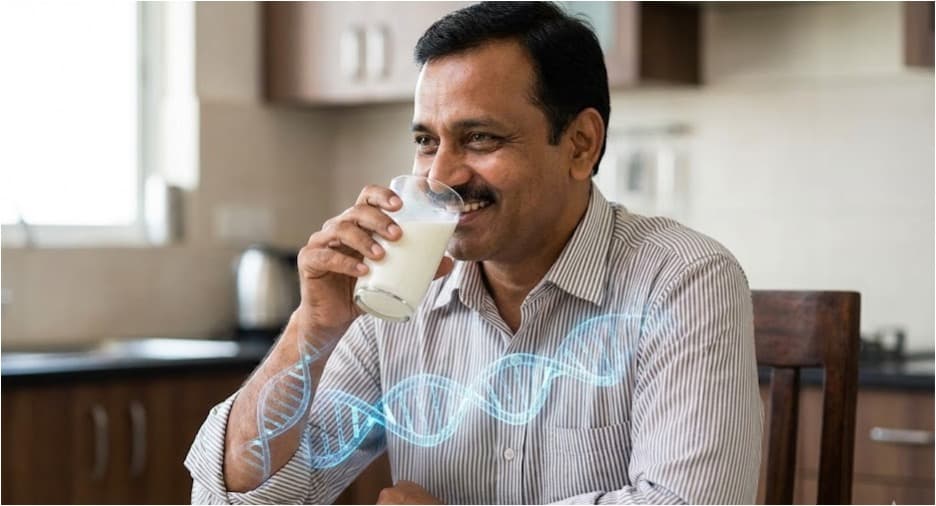
A new genomic study reveals intriguing insights into why many adults in South Asia — the world’s largest dairy producing and consuming region — remain largely lactose intolerant, yet certain populations have developed a strong ability to digest milk into adulthood.

Despite the subcontinent’s deep cultural and dietary association with dairy, most adults in India, Pakistan and Bangladesh do not produce enough lactase, the enzyme needed to digest lactose — the sugar found in milk — beyond infancy. As a result, many traditional dairy foods in South Asia are fermented or processed (like yogurt, ghee and paneer) to reduce lactose content and make them easier to digest.

Researchers from the University of California, Berkeley analysed around 8,000 modern and ancient genomes from across the region to understand the evolutionary history of lactase persistence — the ability to continue digesting lactose into adulthood. They focused on the genetic variant known as −13,910*T, which in many global populations is linked with sustained lactase production.

The study found that this milk-digesting gene variant was introduced into South Asia during historic and medieval periods, likely linked to migrations from steppe pastoralists, but it did not spread widely across most populations as it did in Europe. In most groups, the prevalence of the gene largely mirrors ancient ancestry rather than broad natural selection across the region.

However, an exception emerged in two traditional pastoralist communities — the Toda of South India and the Gujjar of northwest India and Pakistan — where lactase persistence reaches unusually high levels (up to ~90%). This suggests that lifestyle and prolonged reliance on fresh dairy products exerted strong evolutionary pressures in these herding populations, enabling sustained milk digestion into adulthood.

The findings highlight that the evolution of lactase persistence is multifaceted, shaped by ancient migrations, culture, diet and ecological history, rather than a single narrative of adaptation. Understanding this complex genetic landscape provides fresh perspectives on human dairy consumption patterns and nutritional biology.

Source : Dairynews7x7 Dec 30th 2025 Read full story here

Download research paper from here 

Swipe to continue reading

Previous Article

Next Article