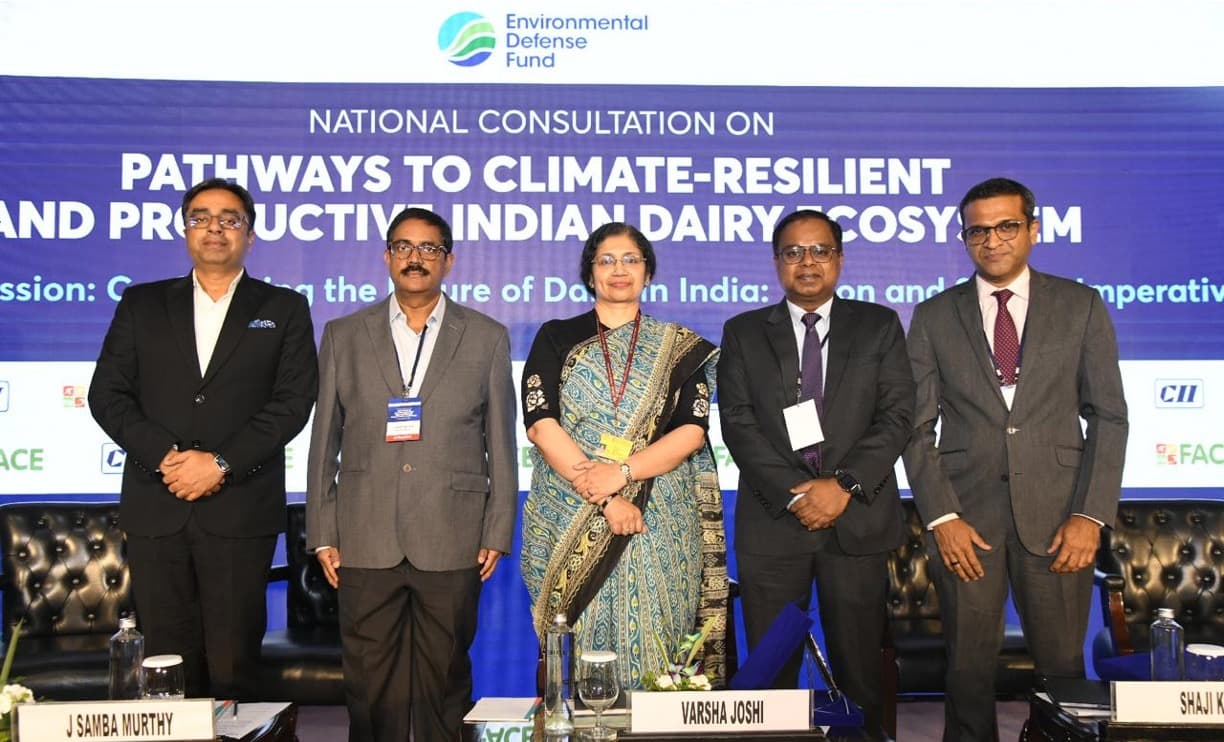
The conversation on climate resilience in India’s dairy sector is no longer about intent—it is about execution. This was the underlying tone of the recent industry dialogue convened by the Confederation of Indian Industry in collaboration with Environmental Defense Fund, on March 30th,2026 at Le Meridan New Delhi., where policymakers, industry leaders, and practitioners came together to examine what it really takes to transition Indian dairy from climate vulnerability to climate resilience.
Opening Session: Co-creating the Future of Dairy in India: Vision and Shared Imperatives
The opening session brought together key voices including Ms Varsha Joshi, Additional Secretary
DAHD, Mr Shaji K V, Chairman
NABARD, Mr Jay Agarwal ,MD,
CP Milk and Foods Pvt Ltd , and J Samba Murthy, COO,
Heritage Foods and Mr Hisham Mundol ,Chief Advisor, India Environmental Defense Fund and set the direction with a clear message: climate risk is no longer external to dairy—it is now embedded within its economics.
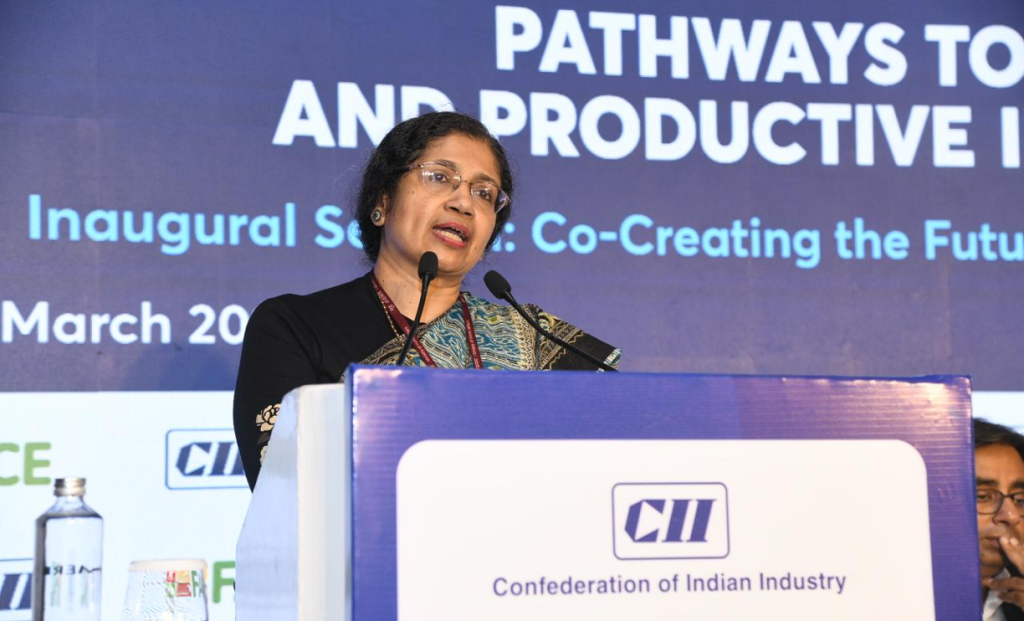
Rising temperatures, erratic rainfall, and increasing input volatility are already impacting milk productivity, feed availability, and farm-level viability. What emerged strongly was that climate resilience cannot remain a sustainability initiative—it must become a core design principle of dairy development itself. India’s dairy ecosystem, dominated by smallholders with limited buffers, is particularly exposed, making the need for systemic and scalable solutions even more urgent.
A key framing insight was that climate resilience must move from being a sustainability agenda to a core business imperative. The sector cannot rely on incremental improvements; it requires system-level transformation across feed systems, animal management, and supply chains.
There was also strong emphasis on India’s unique position:
- A large smallholder-driven dairy ecosystem
- High dependence on climate-sensitive inputs like fodder and water
- Limited buffer capacity at farm level
This makes the sector highly vulnerable but also highly responsive to targeted interventions.
Session-I Creating the Enabling Environment: Policy, Finance, and Institutions
The first session, anchored around on-ground interventions and moderated by Mr Jay Aggarwal, reinforced a critical but often misunderstood idea—
productivity and sustainability are not competing goals; they are aligned outcomes when systems are optimised. The discussions brought sharp focus to feed and fodder as the single largest lever of change. Improved feed quality, climate-resilient fodder varieties, and silage-based systems were highlighted not only for their ability to enhance milk yield but also for reducing emission intensity.
The potential of digital advisory platforms also came through strongly—real-time, data-driven guidance on feeding practices, weather-linked decisions, and animal health management can significantly improve outcomes. However, the gap remains in last-mile delivery. Manure management was another important theme, with discussions pointing towards circular models that convert waste into value—biogas and organic fertilisers—while reducing methane emissions. Yet, despite the availability of proven solutions, the session repeatedly returned to a hard truth: India does not lack pilots—it lacks scale. Fragmented implementation, weak extension systems, and absence of standardised models continue to limit adoption.
Key insights from Session I included:
1. Feed & Fodder as the Biggest Lever
- Improved feed quality can significantly enhance milk yield while reducing emissions intensity
- Climate-resilient fodder varieties and silage practices are emerging as critical interventions
2. Data & Advisory Systems
- There is growing potential for digital advisory platforms to guide farmers on:
- Feed optimisation
- Weather-linked decisions
- Animal health management
However, last-mile delivery remains a constraint.
3. Manure Management & Circularity
- Better manure handling systems can:
- Reduce methane emissions
- Create additional value streams (biogas, organic fertiliser)
4. Scaling Challenge
While solutions exist, the key bottleneck is scale and adoption:
- Fragmented implementation
- Limited extension capacity
- Lack of standardised models
The session highlighted that pilot success does not automatically translate into sectoral transformation.
Session-II Creating the Enabling Environment: Policy, Finance, and Institutions
The second session shifted the lens from solutions to enablers, and was moderated by Mr Ramnath Vaidyanathan from Godrej. Here, the conversation became sharper and more structural. The central issue was financing. Climate-resilient dairy requires upfront investment, but traditional financing models are not designed for smallholder realities. The need for
blended finance mechanisms, carbon market integration, and sustainability-linked funding emerged as a key recommendation.
Equally important was the recognition that no single stakeholder can drive this transition alone. Government policy, private sector innovation, and development-sector expertise must converge. However, participants pointed out that while multiple schemes and initiatives exist, they operate in silos. What is missing is convergence—across programs, institutions, and value chain actors. Another critical gap identified was the absence of robust measurement, reporting, and verification (MRV) systems. Without credible frameworks to track both productivity gains and emission reductions, scaling climate finance and building market-linked incentives will remain constrained.
Key insights from Session 2 , shifted focus from solutions to enablers of scale, particularly policy frameworks and financing mechanisms.
1. Need for Innovative Financing
- Climate-resilient interventions require upfront investment
- Traditional financing models are inadequate for smallholders
Strong emphasis was placed on:
- Blended finance models
- Leveraging carbon markets
- Sustainability-linked funding
2. Public–Private Collaboration
Participants stressed that no single stakeholder can drive this transition alone.
- Government: policy direction and incentives
- Private sector: technology, aggregation, market linkages
- Development agencies: technical support and innovation
3. Convergence is Missing
A recurring concern was that:
- Multiple schemes and initiatives exist
- But they operate in silos
There is a need for convergence across programs, institutions, and value chain actors to create real impact.
4. Measurement & Accountability
- Lack of robust MRV (Measurement, Reporting, Verification) systems
- Need to track both:
- Productivity gains
- Emission reductions
Without this, scaling climate finance and market incentives remains difficult.
Key Cross-Cutting Takeaways
Across all three sessions, a few themes stood out with clarity. First, climate resilience must be seen not as an environmental obligation but as a
productivity and profitability strategy. Second, feed and fodder systems will ultimately determine the success or failure of this transition. Third, farmer-centric design is non-negotiable—solutions must be simple, affordable, and aligned with ground realities. Fourth, the sector must move beyond pilot-led thinking to system-led execution. And finally, finance will be the real catalyst—without innovative and accessible funding mechanisms, adoption will remain limited.
What this dialogue made evident is that the sector is not short of ideas. The technologies exist. The models have been tested. The intent is visible.
Across all sessions, a few consistent themes emerged:
1. Climate Resilience = Productivity Strategy
Not an environmental add-on, but central to future dairy growth.
2. Feed Systems Will Define the Outcome
Feed and fodder interventions are the single largest lever for both:
- Cost optimisation
- Emission reduction
3. Farmer-Centric Design is Critical
Solutions must be:
- Simple
- Affordable
- Scalable
4. Scale Requires Systems, Not Pilots
India does not lack solutions—it lacks:
- Integration
- Delivery mechanisms
- Institutional alignment
5. Finance Will Be the Game Changer
Without innovative financing:
- Adoption will remain limited
- Climate transition will stay fragmented
Bottom Line
The discussions made one thing clear:
India’s dairy sector does not need new ideas—it needs to scale what already works, faster and more cohesively.
The transition to climate resilience will not be driven by isolated innovations, but by alignment across policy, finance, technology, and farmer adoption—at scale and with urgency.
What is missing is alignment—and speed.
Because climate risk is not waiting for perfect convergence. It is already playing out in the fields, in feed systems, and in farm economics.
The next phase of dairy growth in India will not be defined by new innovations.
It will be defined by how quickly and how coherently we scale what already works.
Source : Event coverage by Kuldeep Sharma Chief Editor Dairynews7x7 Mar 30th 2026