Latest Blogs
See More

Indian Dairy News

DairyNews7x7
Global Dairy News



DairyNews7x7

India has a fodder problem and the fate of over thirty crore cattle hangs by a thread, as fodder prices sharply increase and rumours of worsening shortages spread like wildfire in the farms. The government held emergency meetings in which it declared there are “no shortages”, but it is an open secret that India has a significant chronic fodder deficit. Typically, the shortfall is about 11-12% for dry fodder, 25-30% for green fodder, and 36% for concentrated fodder. As a result, meat and milk production gravely suffer. But what is the situation this year?
Cattle reeling under the lumpy skin disease have sent milk production plummeting, along with the earnings of those who rear them. Now, fodder prices have risen from Rajasthan to Bengal. Going by the government’s recent estimation, dry fodder prices rose to Rs. 8-14 per kg from Rs. 5-6 last year.
Major cattle-rearing states have reported over 200% increases in fodder prices. It is during the harvest season that fodder is usually available aplenty, and prices can fall to around Rs. 3-4 per kg. Currently, in many places, it is selling at over Rs. 10 per kg in unprocessed form. Even dairy operations, especially in the small and unorganised sector, are suffering due to sudden spikes in fodder prices.
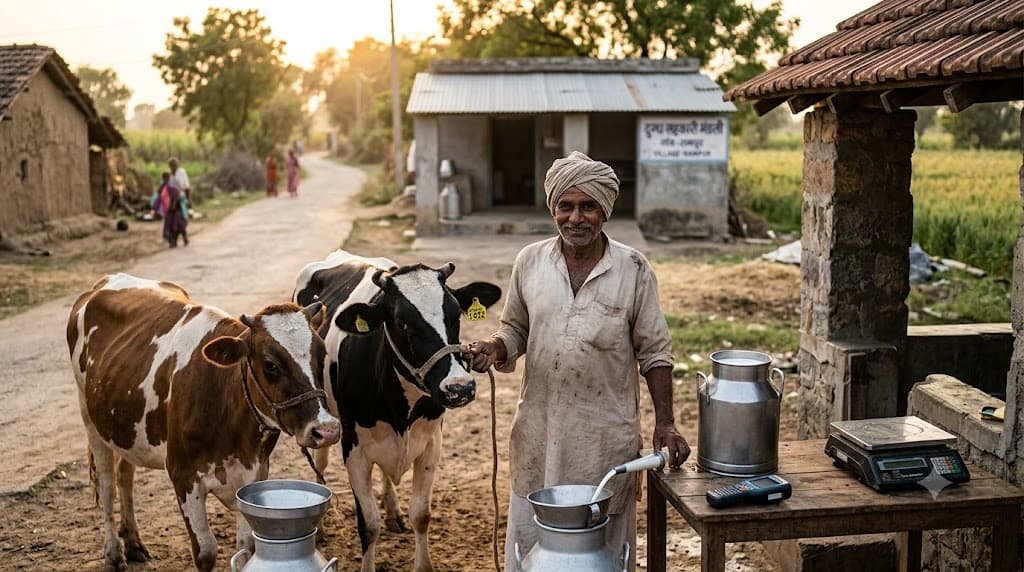
Feed and fodder contribute half or more to the cost of milk. Further, in India, improving fodder quality can enhance milk production and quality more than breed improvement. So, the higher fodder prices get, the costlier milk and derivates will get, while the average yield of Indian animal breeds would remain lower than globally.
In Gujarat, home to India’s largest dairy cooperative Amul, the bulk rate for jowar [sorghum], wheat straw and dried bajra [pearl millet] is over Rs. 15 per kg. When contacted, cattle farmers in Bikaner, Rajasthan, said they are able to procure as much fodder as they need—but only at sharply escalated prices. In May and June, there were serious concerns about shortages, but a spell or two of rainfall boosted the green fodder supply. The wheat under cultivation in Bikaner was already low this sowing season because many farmers preferred to sow higher-earning mustard. Therefore, in summer, Bikaner (and other parts of North India) had the classic conditions of fewer (than even the usual) supplies, leading to a price rise in the main crop as well as its offshoot—fodder.
The pressure on cow shelters and cattle farmers started amping up in the summer—farmers began to struggle to find fodder that met both the crucial needs of a steady supply and a reasonable cost.
Anurag Saxena, who looks after fodder production at the National Dairy Research Institute (NDRI), run by the autonomous government agency Indian Agriculture Research Institute (IARI) says, “The per quintal price of dry fodder has reached Rs. 1,800 this season, which very high. This is a result of the heat waves in March and April, which devastated the standing wheat crop. The market had less wheat stock, which led to price inflation.”
“Wheat production in Punjab, Haryana and Uttar Pradesh was impacted during Rabi season 2022. And now, due to irregular rain, the berseem [Egyptian clover] crop has also suffered. Other dry crops such as bajra, and fodder crops have also taken a hit,” Saxena says.
In Jhansi, Uttar Pradesh, Dr Purushottam Sharma, the head and principal scientist of livestock production and management at the Indian Grassland and Fodder Research Institute (IGFRI), another IARI body, says, “There is a huge price rise when it comes to fodder. From the usual Rs. 1,000 per quintal, now it is more than Rs. 1,500 per quintal. Now due to ongoing rains, the green fodder crops are also affected. Excessive rainfall has damaged crops. For example, untimely rainfall has badly affected legume crops in the Bundelkhand region. Dry fodder crops such as Bajra, pulses, etc., are also affected.”
Reports from across North India make it clear the fodder problem in 2022 also has a climate change angle. Untimely rain and heatwaves disrupted the fodder economy—an already deficit supply was further hampered, leading to price escalation. However, do Indian policymakers have a solution to the looming fodder deficits and inflations? Let us find out.
Fodder Solution
Fodder usually falls under the ambit of state governments. The IGFRI has put in the public domain State-wise plans for fodder management and supply. “But if States adopt multi-cropping along with perennial grass and fast-regrowing fodder, India could easily fill the gaps in shortages,” says Dr Sharma.
But Dr Saxena presents the reality check, “Food grains are the top priority for farmers. Fertile land is shrinking, while the population pressure is increasing. This situation makes fodder the last priority. That’s why we can only raise fodder production through price controls and support for farmers.”
Historical reasons are important here: the Green Revolution varieties of food crops diminished fodder availability. No doubt, fodder development has advanced too, but pre-green revolution paddy and wheat varieties had longer edible stocks, which were used as fodder, after the grain was threshed. Newer varieties are aimed at higher grain production, and hence have shorter inedible stocks, especially in paddy. At any rate, fodder crops now require to be grown in separate areas. Our current agricultural thinking only feeds humans and leaves the animals needs behind.
Zoom out to the national level, and harnessing the full potential of milk and meat production is still a far cry. And it would be impossible without setting up an authority dedicated to fodder management, along the lines of the Food Corporation of India. State-wise, farmers must be encouraged to grow fodder, green and dry, which can be transported for consumption in other regions. An introduction of minimum support price or MSP for fodder, accompanied by public procurement of crops that yield fodder, such as bajra, pulses, berseem, etc. could help fill the immediate gaps.
Experts advise caution in managing supplies and production. They say it would be essential to create fodder-producing clusters and FPOs backed by financial incentives. Climate change impact and seasonal lulls in supply and demand mean that better management techniques are as important as raising production. A fodder authority could establish village-based centres, especially in dry areas of Rajasthan and Gujarat, etc., to provide fodder at regulated rates. A network of fodder mandis (market yards) needs to be created in the major cattle-rearing states.
The central government has been mapping the cattle population through a tagging system—think of it as an Aadhaar card for cows—but what we need is fair-priced fodder for livestock on a mass basis, not policing of cow populations and consumption habits. States need emergency supplies and stockyards for fodder, which can be converted into silage (preserved fodder) and stored for future use. And last but not least, the Union budget 2022-23 made a Rs. 8,514 crore allocation for agriculture research, the same as the revised estimate in 2021-22, marking a 0% hike. Indeed, the Indian Council for Agricultural Research got the largest chunk of this allocation—Rs. 5,877 crore, up roughly Rs. 315 crore from the previous year. Most of this money goes to paying salaries and continuing older projects.
Fodder research in the light of climate change is essential too. India must devote more resources to climate adaptation strategies for fodder crops. Else, the while revolution may die a sad unprofitable death.
Source : India click 13th Oct 2022 by Indra Shekhar Singh The author is an independent analyst and writer. The views are personal.