Logo
IndianGlobalBlogsPublicationsPodcastsMarketAboutContact
Logo
IndianGlobalBlogsPublicationsPodcasts
7News
Heritage Foods inaugurates new Ice Cream PlantFSSAI makes registration to all milk vendors in IndiaGujarat Ice Cream Makers Face Cone ShortageSummer Heat to Stress India’s Dairy Cold ChainSavencia Profit Drops on Rising Milk Costs

Indian Dairy News

Heritage Foods  inaugurates new Ice Cream Plant
Mar 13, 2026

Heritage Foods inaugurates new Ice Cream Plant

Heritage Foods Limited, a leading dairy company offering a wide range of milk and value-added dairy products, today announced the inauguration of its new greenfield Ice cream manufacturing facility at...Read More

17 High-Genetic US Bulls Arrive to Boost Kashmir Dairy
Mar 13, 2026

17 High-Genetic US Bulls Arrive to Boost Kashmir Dairy

In a major step to strengthen dairy productivity, the Animal Husbandry Department (AHD) of Jammu & Kashmir has imported 17 high-genetic-merit dairy bulls from the United States as part of a breeding i...Read More

Jigawa to Partner India for Dairy Development
Mar 13, 2026

Jigawa to Partner India for Dairy Development

The Jigawa State Government in Nigeria has announced plans to collaborate with the National Dairy Development Board (NDDB) of India to promote livestock development and expand dairy production in the...Read More

DairyNews7x7
Advertisement

Latest Blogs

See More
FSSAI makes registration to all milk vendors in India
Mar 13, 2026

FSSAI makes registration to all milk vendors in India

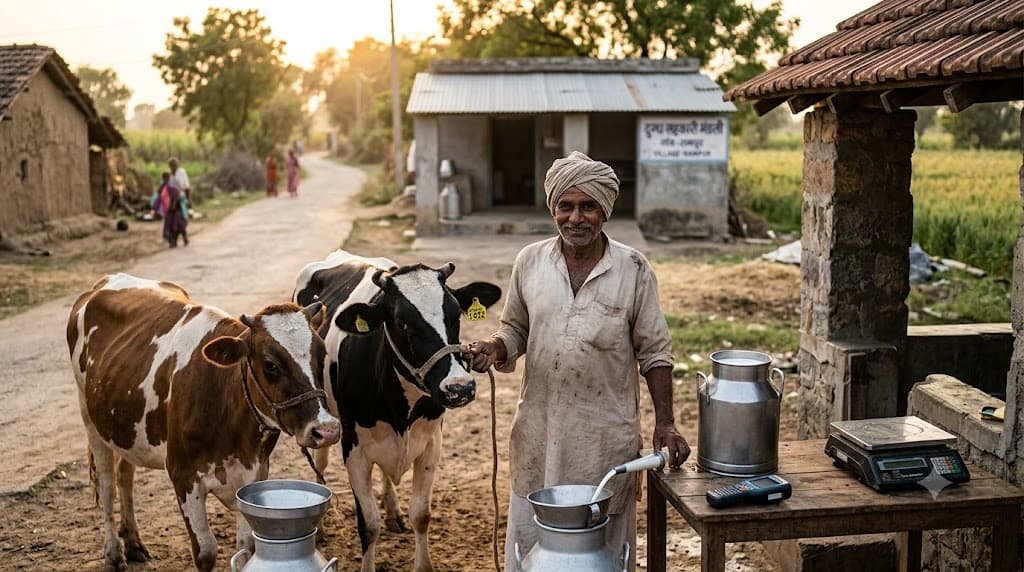
The recent advisory issued by Food Safety and Standards Authority of India (FSSAI) mandating registration of milk vendors is a timely and progressive step towards strengthening traceability and accou...Read More

Rajahmundry Milk Incident: Accident or Adulteration?
Mar 10, 2026

Rajahmundry Milk Incident: Accident or Adulteration?

The recent editorial “Bitter Milk” published by The Hindu raises important concerns about food safety in India. The editorial deserves appreciation for attempting to broaden the conversation and under...Read More

Milk Prices Rise in South & West: Is North Next?
Mar 05, 2026

Milk Prices Rise in South & West: Is North Next?

The recent round of retail milk price increases across South India and Maharashtra is no longer an episodic adjustment but a clear signal of structural stress building up in India’s milk economy. Over...Read More

India’s Dairy Climate Paradox: Production Triumph Meets Methane Time-Bomb
Mar 02, 2026

India’s Dairy Climate Paradox: Production Triumph Meets Methane Time-Bomb

India’s rise to the top of the global dairy league board has been one of the most remarkable agricultural success stories of the 21st century. With milk production surpassing 247 million tonnes per ye...Read More

Global Dairy News

Lactose-Free Milk Seen as Growth Driver in Coffee
Mar 13, 2026

Lactose-Free Milk Seen as Growth Driver in Coffee

Lactose-free milk is emerging as a major growth opportunity for the dairy industry, particularly in the rapidly expanding coffee and café segment. A recent US-based study highlighted that lactose-free...Read More

Nigeria’s Dairy Challenge: Many Cows, Little Milk
Mar 13, 2026

Nigeria’s Dairy Challenge: Many Cows, Little Milk

Despite having more than 20 million cattle, Nigeria produces far less milk than it consumes, highlighting deep structural challenges in its dairy sector. Most cattle in the country are...Read More

Israel Drops Controversial Dairy Reform From Budget
Mar 12, 2026

Israel Drops Controversial Dairy Reform From Budget

The Israeli government has removed a controversial dairy reform proposed by Finance Minister Bezalel Smotrich from the 2026 Arrangements Law, a key legislative package linked to the country’s state bu...Read More

DairyNews7x7
Advertisement
Dairy News 7x7

Your trusted source for all the latest dairy industry news, market insights, and trending topics.

FOLLOW US
CATEGORIES
  • Global News
  • Indian News
  • Blogs
  • Publications
  • Podcasts
SUBSCRIBE TO OUR NEWSLETTER

Stay informed with the latest updates and trending news in the dairy industry.

No spam, unsubscribe at any time

GET IN TOUCH
C-49, C Block, Sector 65,
Noida, UP 201307
+91 7827405029dairynews7x7@gmail.com

© 2026 Dairy News 7x7. All Rights Reserved.

Terms of ServicePrivacy Policy
Prefer Us
Prefer Us

ELISA method to test adulterated cow milk in camel milk

By DairyNews7x7•Published on April 06, 2024

ELISA method to test adulterated cow milk in camel milk
Prefer on

Camel milk might be adulterated with cheaper cow's milk because of its high price. The establishment of a rapid and reliable method for detecting cow milk in camel milk is a matter of great concern. In the study, the chromatogram of camel milk with different adulteration ratios was analyzed by High Performance Liquid Chromatography (HPLC). The peak area of liquid chromatography was analyzed by Principal Component Analysis (PCA). β-lactoglobulin (β-Lg) was screened as a characteristic protein. Enzyme-Linked Immunosorbent Assay (ELISA) was established selected β-Lg as the antigenic indicator. This study was aimed at developing an ELISA method that enabled rapid and highly sensitive detection of the proportion of adulterated milk in camel milk. The minimum detection limit was 1% of cow milk in camel milk, and the results were highly reproducible with no significant difference between true and measured values (P > 0.05).

Camel milk has an important role in human nutrition in the arid and semi-arid regions of the world because it contains all the essential nutrients found in other milks (Devendra, 2016; Swelum et al., 2021). Camels are rich in nutrients such as bioactive peptides, lactoferrin, zinc, vitamins (Kaskous, 2016; Konuspayeva, Faye & Loiseau, 2009). The nutritional value of camel milk is better than cow milk, and its protein composition is quite close to breast milk. Therefore, camel milk is often used as a substitute for breastfeeding (Zou et al., 2022).

As is known to all, olive oil adulteration is the biggest adulteration problem in the world (Calvano, Ceglie, D Accolti, & Zambonin, 2012). The adulteration of dairy products has had a tendency to increase in recent years. Adulteration of camel milk not only occurs in the Chinese market, but also in the European Union and other countries were very common (Mabood et al., 2017).

Camel milk costs 2-10 times more than cow milk. Moreover, it is reported that camel milk was also used for other potential therapeutic purposes (DeshwalTiwari & Kadyan, 2021), such as anti-carcinogenic (Habib, Ibrahim, Schneider-Stock, & Hassan, 2013), anti-diabetic (Agrawal et al., 2007), anti-aging activities (HoZou & Bansal, 2022; Izadi, Khedmat & Mojtahedi, 2019), and anti-hypertensive (Quan, Tsuda & Miyamoto, 2008), Camel milk will not cause allergic issues for cow milk allergic children (Devendra, 2016). In this case, many merchants adulterate cow milk with camel milk to seek windfall profits (Merin et al., 2001). The effects of milk adulteration are not only economic but may even have serious health implications. (El-Sayed & El-Agamy, 2022). For this reason, it is very necessary to quickly detect whether there is cow milk in camel milk to ensure the quality and the legitimate rights and interests of consumers.

To date, a number of methods have been developed to detect adulteration in dairy products (El-Hatmi, 2015). A quantitative method was developed to detect the different kinds of milk by infrared spectroscopy (Nicolaou, Xu & Goodacre, 2010). Polypropylene gel electrophoresis was used to distinguish different source milk(Sharma et al., 2021). The adulteration of dairy products and camel milk was measured by the low-field NMR method and liquid chromatography (Ribeiro et al., 2014). Although these methods have become quite sophisticated, there is still disadvantage, such as the expensive and heavy experimental equipment and high testing costs. ELISA was chosen in this study, which is a sensitive, rapid, and highly specific method widely used in the food industry. For low concentrations of biomarkers, ELISA typically has higher sensitivity than HPLC because it takes advantage of the amplification effect of the enzyme. ELISA is generally more economical and higher throughput than HPLC. It’s necessary to screen for a signature protein to distinguish before developing an ELISA to detect camel milk adulterated with cow milk.

Stay Updated

Get the latest dairy industry news directly in your feed.

Prefer Us on Google Search

Swipe to continue reading

Previous Article

Next Article