Latest Blogs
See More
Indian Dairy News

DairyNews7x7
Global Dairy News

DairyNews7x7
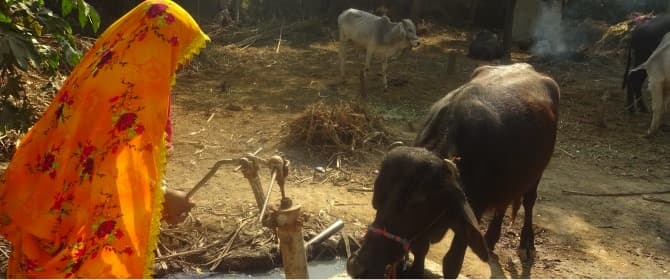
The livestock sector is one of the most rapidly growing components of the rural economy of India, accounting for 5% of national income and 28% of agricultural GDP in 2018-19. In the last six years, the livestock sector grew at 7.9% (at constant prices) while crop farming grew by 2%. Our field studies show that in rural households that own livestock, women are invariably engaged in animal rearing. On the International Day of Rural Women (October 15), we need to recognise the role of women in livestock rearing, and to include women in all facets of livestock development, be it breeding, veterinary care, extension services, training or access to credit and markets.
It is widely recognised that the majority of women workers in rural areas (72%) are engaged in agricultural activities. However, with the exception of participation in dairy co-operatives, specifically in milk marketing, women’s role in the livestock economy is not as widely known or discussed. There were five million women members in dairy co-operatives in 2015-16, and this increased further to 5.4 million in 2020-21. Women accounted for 31% of all members of dairy producer cooperatives in 2020-21. In India, the number of women’s dairy cooperative societies rose from 18,954 in 2012 to 32,092 in 2015-16.
Issues with data collection
Conventional labour force surveys fail to accurately record women’s work in livestock-raising for many reasons. Among the many problems in data collection, two significant ones are the sporadic nature of work undertaken for short spells throughout the day and often carried out within the homestead, and women’ own responses. A time use survey in a village of Karnataka showed that a poor peasant woman started her day by collecting dung from the cow shed for 10 minutes (5.15 a.m. to 5.25 a.m.). She engaged in some preparatory cooking tasks for a while. A little later she milked the cow for 25 minutes, and swept and washed the shed for around 30 minutes. After completing other household tasks, she went to work on a construction site. She took two cows along and tied them to graze near the work site. When she returned home in the evening, she again milked the animals and fed them, which took around 40 minutes. After dinner, she fed the animals for the last time in the day. This woman spent around 3.5 hours on livestock-related tasks, which were all combined with household duties. Given this pattern of work, the woman herself may not report “livestock raising” as an economic activity.
One way to adjust official statistics for this error is by calculating an augmented work participation rate. In other words, in addition to women reporting themselves as engaged in economic activity, this estimate includes women who reported themselves as “engaged in domestic duty” or care work for the major part of the year but spent time on specific activities such as kitchen gardening, household dairy/poultry, paddy husking, etc.
An underestimation
To illustrate, 12 million rural women were workers in livestock-raising, an estimate based on the Employment and Unemployment Survey of 2011-12. However, with the augmented definition, we estimated that around 49 million rural women were engaged in livestock raising. In short, women actually engaged in the livestock economy were four times the official estimate and a sizeable section of the rural population. Statistics from India’s first national Time Use Survey in 2019 corroborate this finding. By recording all activities done in the past 24 hours (be it cooking or working in the fields), 11% of rural women or 48 million women were engaged in animal rearing.
Data from village surveys conducted by the Foundation for Agrarian Studies in Karnataka show that in every household that owned a milch animal, a woman spent at least two hours a day on animal rearing. This was as much as seven to eight hours in some cases depending on other factors such as number and type of animals, and season (in the lean season, when fodder was not easily available, more time was spent on grazing). Additionally, livestock rearing was an occupation of older, less educated, women in the village.
The National Livestock Policy (NLP) of 2013, aimed at increasing livestock production and productivity in a sustainable manner, rightly states that around 70% of the labour for the livestock sector comes from women. One of the goals of this policy was the empowerment of women. The National Livestock Mission (NLM) of 2014-15 was initiated for the development of the livestock sector with a focus on the availability of feed and fodder, providing extension services, and improved flow of credit to livestock farmers. However, the NLM does not propose any schemes or programmes specific to women livestock farmers. The policy proposes that the State government allocates 30% of funds from centrally-sponsored schemes for women. There is no logic for the 30% quota.
Core problems
The problem clearly is that women livestock farmers are not visible to policymakers, and one reason is the lack of gender-disaggregated data, as illustrated here.
First, recent employment surveys such as the Periodic Labour Force Survey fail to collect data on specific activities of persons engaged primarily in domestic duties. So, the undercounting of women in the livestock economy continues.
Second, the reach of extension services to women livestock farmers remains scarce. According to official reports, 80,000 livestock farmers were trained across the country in 2021, but we have no idea how many were women farmers. In our village surveys, only a few women in each village reported receiving any information from extension workers. Women wanted information but wanted it nearer home and at times when they were free.
Third, in our village surveys, women in poor households, without collateral to offer to banks, found it difficult to avail loans to purchase livestock. Around 15 lakh new Kisan Credit Cards (KCC) were provided to livestock farmers under the KCC scheme during 2020-22. There is no information on how many of them were women farmers.
Fourth, women livestock farmers lacked technical knowledge on choice of animals (breeding) and veterinary care. According to our village surveys, men invariably performed these specific tasks and took animals for artificial insemination.
Fifth, our village studies showed that women were not aware of the composition and functions of dairy boards and that men exercised decisions even in women-only dairy cooperatives. Further, the voice of women from landless or poor peasant Scheduled Caste households was rarely heard.
Women’s labour is critical to the livestock economy. It follows then that women should be included in every stage of decision-making and development of the livestock sector. Today, women livestock workers remain invisible on account of their absence in official statistics. This must be corrected.
Source : The Hindu 15th Oct 2022 by Madhura Swaminathan is Professor and Head of the Economic Analysis Unit at the Indian Statistical Institute, Bangalore and Vijayamba R. is Senior Research Fellow at the Indian Statistical Institute, Bangalore