Latest Blogs
See More
Indian Dairy News
DairyNews7x7
Global Dairy News

DairyNews7x7
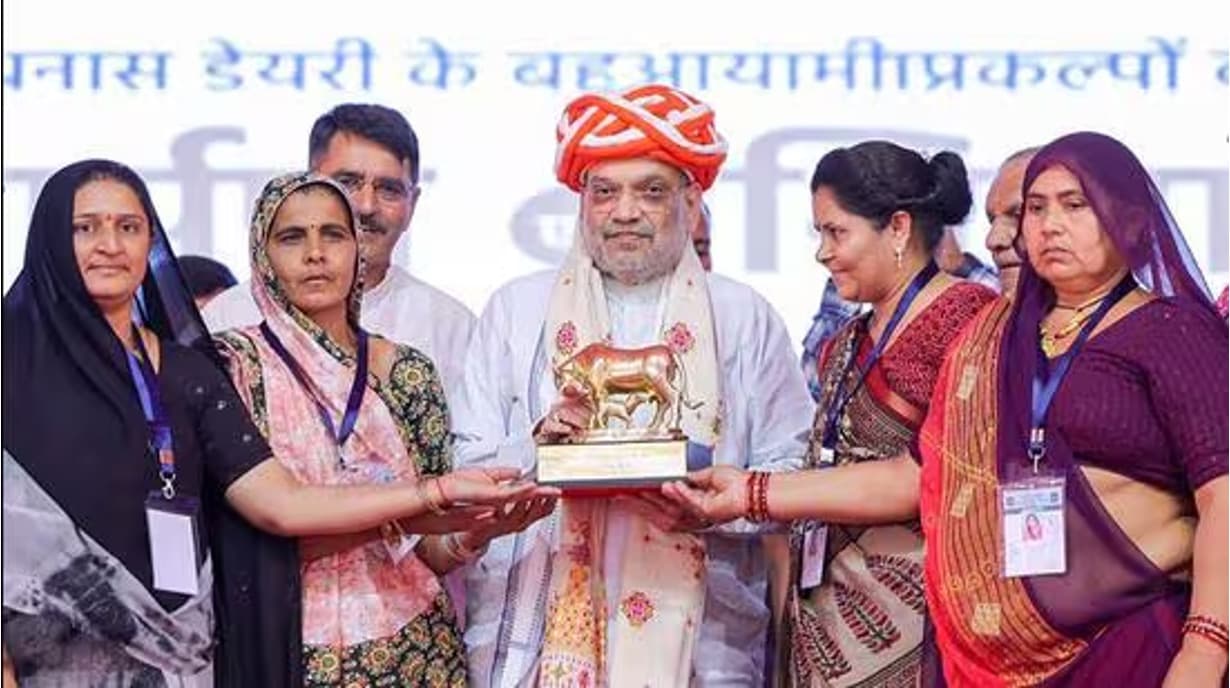
Union Home & Cooperation Minister Amit Shah on December 6, 2025 said that a new “circular economy” model in the dairy sector is expected to boost the income of dairy farmers by 20% over the next five years. The remarks were made during the inauguration of a bio-CNG and fertiliser plant at Banas Dairy in Banaskantha, Gujarat, along with the laying of the foundation stone for a 150-tonne milk-powder facility.
Under this circular-economy model, the dairy cooperative plans to convert cattle dung — collected from member-farmers — into biogas and organic fertiliser, thereby creating additional income streams beyond milk sales. Farmers supplying milk will receive a share of revenues generated from these by-products. Shah explained that the initiative is not limited to milk, paneer or curd products alone; the plan envisages value-added dairy production (milk powder, whey-protein, etc.), biogas, organic manure, and even recycling of hides of naturally deceased animals for leather — effectively turning “waste into wealth.”
According to Shah, this model — demonstrated successfully by Banas Dairy (which reportedly has a turnover of ₹ 24,000 crore) — will now be scaled across cooperatives nationwide under the framework of White Revolution 2.0. In support of this, the government plans to provide finance and technology to cooperatives so that feed, fertiliser, energy and dairy-byproduct processing are all managed internally rather than relying on external supply chains.
If implemented broadly, the move could reshape India’s dairy economics: farmers will no longer depend solely on per-litre milk procurement prices but also benefit from diversified revenue streams tied to by-product utilisation, bio-energy, fertiliser and value-added dairy products. This, officials hope, will significantly boost rural incomes, reduce waste, create more sustainable dairy-value chains, and incentivise better livestock management.
Government sources have announced that chairpersons and managing directors of major cooperative dairies across India will visit Banas Dairy in January 2026 to study the model. A national plan will follow their review, aimed at replicating the circular-economy structure across all cooperative dairies.
The announcement signals a paradigm-shift from volume-driven milk procurement to a diversified and value-added dairy ecosystem, where by-products (dung, hides), waste minimisation (bio-CNG, fertiliser), and downstream dairy-processing (powder, whey, re-ratioed feeds) provide additional income paths.
For farmers — especially small & marginal producers — this could mean enhanced and more stable income, less reliance on milk-price volatility.
For the dairy sector — this could lower dependence on imported ration/feeds/fertiliser, improve sustainability, and make Indian dairy more resilient to global commodity price fluctuations.
For rural economies — integrating energy (bio-CNG), fertiliser supply, dairy and value-addition may spur job creation, clean energy adoption, better waste management, and higher agricultural productivity.
For the national objective (White Revolution 2.0) — this could help raise dairy productivity, output quality, and farmer welfare — by aligning cooperative dairy with circular-economy principles and sustainable livelihoods.