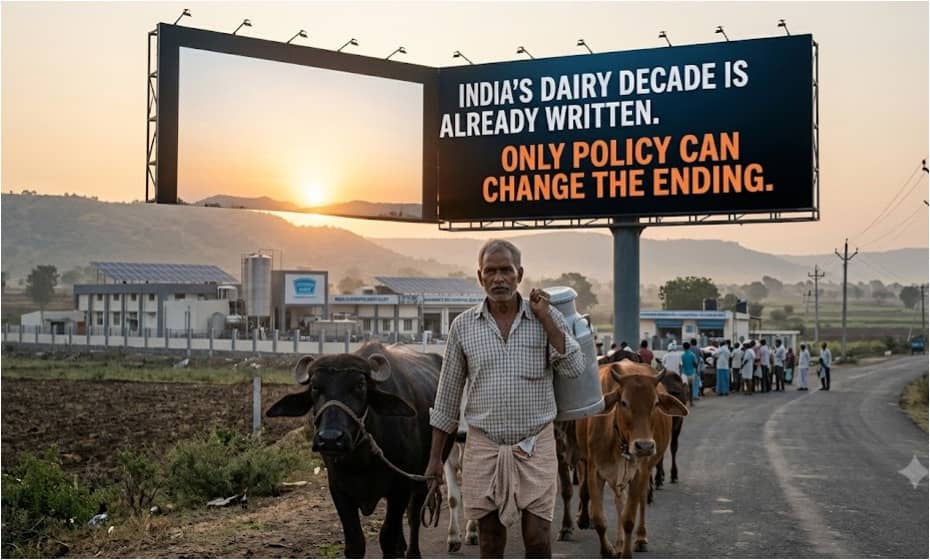
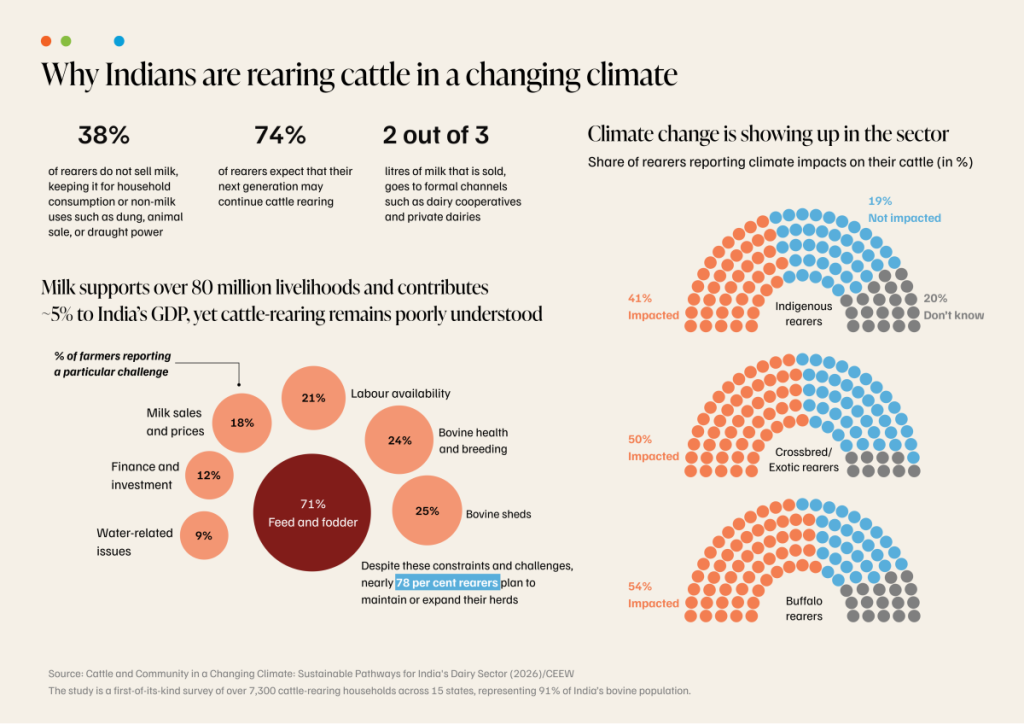
More than one-third of India’s cattle rearers prioritise non-market-oriented uses of bovines and do not sell milk, according to a new study by the Council on Energy, Environment and Water (CEEW). The study is based on a first-of-its-kind survey of over 7,300 cattle-rearing households across 15 states, representing 91 per cent of India’s bovine population (including cows, buffaloes, bulls, and bullocks). Milk supports over 80 million livelihoods and contributes 5 per cent to India’s GDP. The study examines how cattle rearing functions as a livelihood system alongside this amid a changing climate.
The CEEW study, Cattle and Community in a Changing Climate, shows that seven per cent of rearers keep cattle exclusively for non-milk purposes such as dung, draught power, or income from selling animals. The share rises to around 15 per cent in states such as West Bengal and Maharashtra. About 74 per cent rearers value dung for manure, fuel, or sale, and many depend on cattle for draught power and broader farm support.
Indigenous cattle play a critical role in these non-market uses, particularly within integrated farming systems. In several states—including Jharkhand, West Bengal, and Himachal Pradesh—more than half of rearers prioritise household milk consumption and use of dung over milk sales, while even in relatively formalised dairy states such as Maharashtra and Karnataka, over 30 per cent prioritise non-milk benefits.
Abhishek Jain, Fellow and Director – Green Economy and Impact Innovations, CEEW, said, “India’s dairy sector policies are primarily focused on milk output, while cattle rearing on the ground functions as a much broader livelihood system. Moreover, as the CEEW study shows, the realities, contexts, challenges and motivations of rearers vary significantly across states and farmer typologies. Aligning public investment with this diverse reality requires moving from uniform dairy strategies to differentiated, responsive policies that reflect how households actually value cattle, the constraints they face, and how climate risks for the sector are evolving. This will not only ensure acceptance of public interventions, thereby improving the effectiveness of budget allocations, but also preserve the rich diversity of rearing systems across the country.”
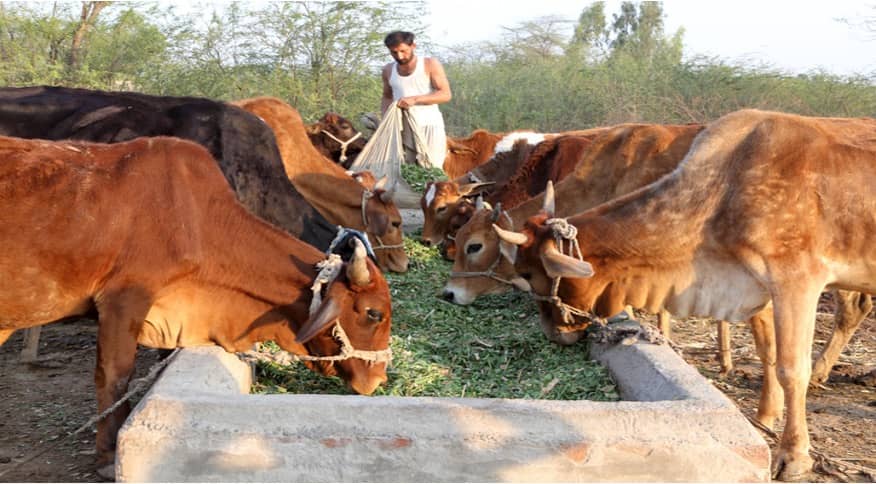
Cattle rearers also highlighted a range of challenges that they face. Three out of four rearers reported facing feed and fodder shortages, making it the most widespread constraint nationally. While fodder surpluses exist in some regions, affordability concerns persist in most states, and shrinking grazing lands and limited land for fodder cultivation compound the problem. Awareness of key government feeding interventions remains strikingly low: around 80 per cent of rearers are unaware of measures such as silage-making and ration-balancing programmes, and adoption stands at just five per cent. In contrast, less than a quarter of rearers report animal health and breeding challenges, showcasing the success of continued policy focus on improving coverage of artificial insemination, vaccination, and animal deworming.
Climate change is compounding the sector’s challenges. The CEEW study finds that 54 per cent of buffalo rearers, 50 per cent of crossbred rearers, and 41 per cent of indigenous cattle rearers report climate-related impacts. For the rearers, these include higher disease incidence, mortality, and heat-induced stress and restlessness in their animals. While indigenous rearers are most resilient to a changing climate, many rearers seeking to expand their herds want to move to higher-yielding crossbreds and buffaloes. The study cautions that such shifts could increase the sector’s vulnerability to climate stress, and calls for adaptive measures.
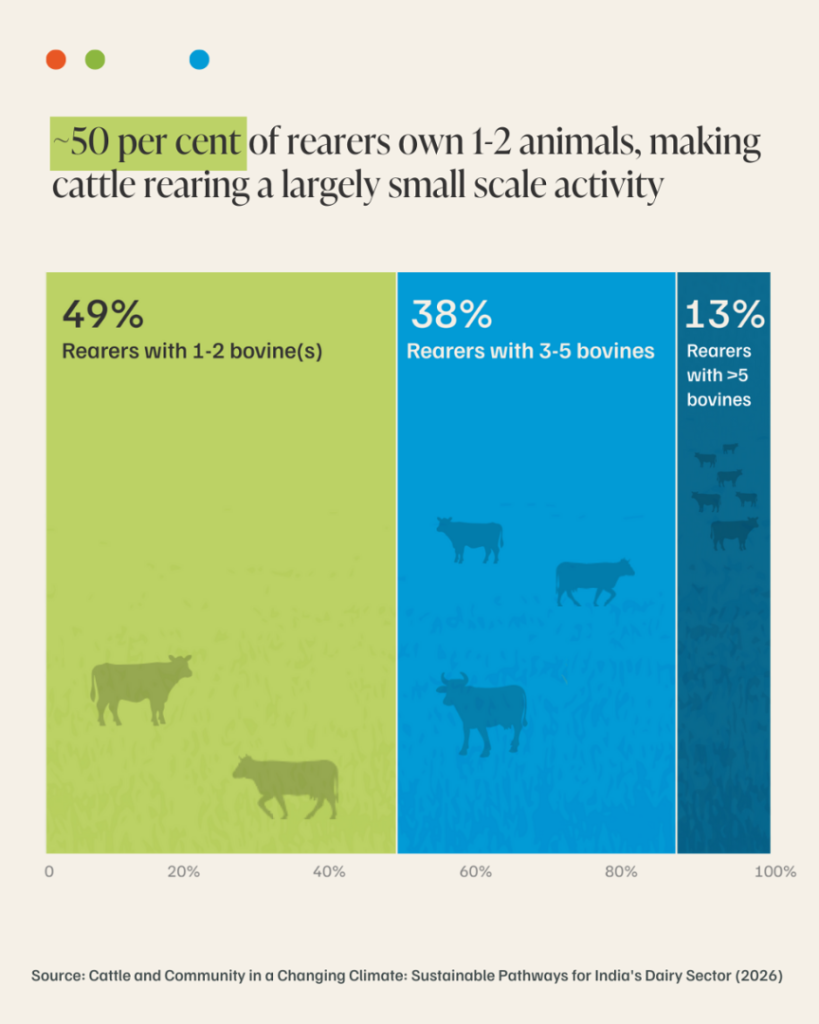
Further, the CEEW study highlights that half of India’s rural cattle rearers own just one or two animals. These small herds are concentrated in hilly, central, and eastern regions, while larger herds (over five animals) are more prevalent in states such as Gujarat, Rajasthan, Maharashtra, Tamil Nadu, and Punjab. Despite being half of the rearers, small rearers (up to 2 animals in a herd) account for only 29 per cent of total milk production and 22 per cent of milk sales, while medium and large herds generate most of the marketable surplus.
Ruchira Goyal, Programme Associate, CEEW, said, “Feed and fodder shortages cut across regions, animal types, and herd sizes. Yet adoption of basic feeding interventions remains low. Addressing these gaps, through stronger extension services and improved fodder supply chains, can deliver immediate gains for small rearers. To future-proof the sector in the face of rising climate stress and realise the true potential of genetic improvements, budgetary allocations must expand beyond breeding and vaccination to support decentralised, localised feed and fodder solutions. These solutions must respond to local needs: from promoting hydroponics and Azolla cultivation in drier, land-constrained regions to protecting common grazing lands in states like Assam. Such investments can simultaneously improve productivity, resilience, and environmental sustainability.”
CEEW recommends that livestock and allied programmes—including the National Livestock Mission and related state schemes—adopt more targeted approaches aligned with rearer typologies and regional contexts. Priorities include improving last-mile veterinary services, supporting non-milk value chains such as dung-based energy and manure, and integrating climate considerations into breeding choices and animal housing.
Source : Dairynews7x7 Jan 21 2026 DDnews