Logo
IndianGlobalBlogsPublicationsPodcastsMarketAboutContact
Logo
IndianGlobalBlogsPublicationsPodcasts
7News
World Pays More, Demands More: New Frontier of Dairy TradeFarm Economy Seen Stabilizing in 2026; Costs & Policy Still Key ConstraintsThe FAO Dairy Price Index declined by 4.4% in Dec 2025Heritage Foods MD Wins Outstanding Dairy Professional Award 2025Parag Milk Sharpens Focus on Health & Nutrition with Protein-Led Push

Indian Dairy News

Farm Economy Seen Stabilizing in 2026; Costs & Policy Still Key Constraints
Jan 11, 2026

Farm Economy Seen Stabilizing in 2026; Costs & Policy Still Key Constraints

According to the December Ag Economists’ Monthly Monitor, agricultural economists now expect the farm economy to stabilise in 2026 after years of pressure, but high input costs and policy uncertainty...Read More

The FAO Dairy Price Index declined by 4.4% in Dec 2025
Jan 11, 2026

The FAO Dairy Price Index declined by 4.4% in Dec 2025

The FAO Dairy Price Index declined by 5.9 points (4.4 percent) in December. Butter prices fell sharply, driven by seasonally higher cream availability in Europe and stock accumulation following strong...Read More

Heritage Foods MD Wins Outstanding Dairy Professional Award 2025
Jan 11, 2026

Heritage Foods MD Wins Outstanding Dairy Professional Award 2025

Heritage Foods Limited announced that Mrs. N. Bhuvaneswari, Vice Chairperson & Managing Director, received the Outstanding Dairy Professional Award 2025 (Andhra Pradesh) at the Indian Dairy Associatio...Read More

DairyNews7x7
Advertisement

Latest Blogs

See More
From Forecast to Fact: 2025 Lessons, 2026 Dairy Outlook
Jan 01, 2026

From Forecast to Fact: 2025 Lessons, 2026 Dairy Outlook

As we step into 2026, it is worth pausing to reflect on how the Indian dairy sector navigated the challenges of 2025 and how closely reality tracked the forecasts I outlined in the first blog of last...Read More

India–NZ Dairy FTA: Safeguards or Silent Slippages?
Dec 26, 2025

India–NZ Dairy FTA: Safeguards or Silent Slippages?

The recently concluded India–New Zealand Free Trade Agreement (FTA) marks an important milestone in bilateral trade, while carefully ring-fencing India’s sensitive dairy sector. Under the agreement, c...Read More

Vision 2047: India’s Dairy Development Roadmap
Dec 21, 2025

Vision 2047: India’s Dairy Development Roadmap

As India moves steadily toward Vision 2047, the dairy sector stands at a strategic inflection point. From being a food security instrument in the decades following Independence, dairy has evolved into...Read More

Global Dairy Dynamics: Innovation, Sustainability & Inclusion
Dec 18, 2025

Global Dairy Dynamics: Innovation, Sustainability & Inclusion

The International Dairy Processing Conference (IDPC) 2026, organised by the Trade Promotion Council of India (TPCI) at Yashobhoomi Convention Centre, Dwarka, New Delhi on 7 January 2026, will serve as...Read More

Global Dairy News

Midan’s Top 10 Meat & Dairy Trends to Watch in 2026
Jan 10, 2026

Midan’s Top 10 Meat & Dairy Trends to Watch in 2026

Midan Marketing has published its annual Top 10 meat and dairy industry trends for 2026, highlighting the forces likely to shape consumer behaviour, product development and value-chain strategies in t...Read More

U.S. Dietary Guidelines Overhaul Raises Dairy, Meat
Jan 09, 2026

U.S. Dietary Guidelines Overhaul Raises Dairy, Meat

The newly released 2025–2030 U.S. Dietary Guidelines, unveiled by Health Secretary Robert F. Kennedy Jr. and the Department of Agriculture, represent a major shift in federal nutrition policy, placing...Read More

Spoiled Dairy Becomes 3D Printing Plastic
Jan 07, 2026

Spoiled Dairy Becomes 3D Printing Plastic

Researchers patent a biomaterial from wasted milk proteins, creating biodegradable 3D printing filament and a potential new revenue stream for dairy. Excess milk that once flowed down farm drains duri...Read More

DairyNews7x7
Advertisement
Dairy News 7x7

Your trusted source for all the latest dairy industry news, market insights, and trending topics.

FOLLOW US
CATEGORIES
  • Global News
  • Indian News
  • Blogs
  • Publications
  • Podcasts
SUBSCRIBE TO OUR NEWSLETTER

Stay informed with the latest updates and trending news in the dairy industry.

No spam, unsubscribe at any time

GET IN TOUCH
C-49, C Block, Sector 65,
Noida, UP 201307
+91 7827405029dairynews7x7@gmail.com

© 2026 Dairy News 7x7. All Rights Reserved.

Terms of ServicePrivacy Policy

World Pays More, Demands More: New Frontier of Dairy Trade

Published on January 12, 2026

Higher prices, tighter rules and an uncomfortable truth for the industry: without compliance, there is no market
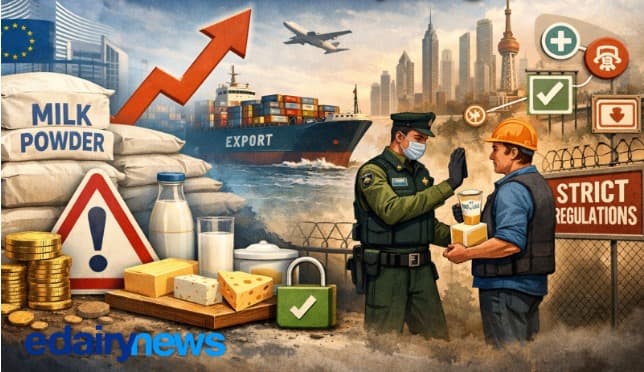
The start of 2026 has delivered a signal the global dairy industry cannot afford to ignore. International prices have strengthened decisively. Milk powder values have moved above USD 3,300 per metric ton, even for lower-margin reference products, reshaping expectations across supply chains, balance sheets and policy agendas.

Yet the underlying message is far less comforting than it appears. Higher prices no longer buy tolerance. On the contrary, rising values are coinciding with higher entry barriers, redefining dairy trade at three inseparable levels: industrial, financial and political.

A Market That Improves — But Does Not Forgive

For years, weak prices served as an excuse for structural inefficiencies. When returns were low, gaps in productivity, delayed regulatory reforms and sanitary shortcomings were often rationalised as unavoidable constraints.

That narrative has now collapsed. The latest Global Dairy Trade rebound is not merely a technical correction. It reflects active demand, tighter availability and buyers increasingly willing to secure volumes amid geopolitical uncertainty. More importantly, it confirms that global dairy trade no longer tolerates ambiguity.

Mastellone and the Message the Industry Resists

Few voices express this reality more clearly than Flavio Mastellone, a senior executive and long-standing reference within the Argentine dairy industry:

“Higher prices do not change the fundamentals. There is no international demand for dairy products without full sanitary certification. Compliance is not optional — it is the entry ticket to value-added markets.”

This is not rhetoric. It is the perspective of an operator competing in regulated, competitive and increasingly unforgiving markets.

The End of ‘Tolerant’ Markets

For decades, certain regional destinations — Brazil being the most emblematic case — functioned as pressure valves for surplus production. Proximity and relatively flexible requirements allowed volumes to flow even when structural competitiveness was weak.

That model is fading. With supply expanding across producing regions and global prices strengthening independently of regional demand, reliance on a single outlet has shifted from strategy to vulnerability. Global trade now demands diversification, predictability and compliance.

Mercosur: A Debate That Can No Longer Be Delayed

The discussion around Mercosur’s Common External Tariff, currently set at 28% for dairy products, exposes a deeper political dilemma. In a world where average tariffs are significantly lower, excessive protection increasingly clashes with the need for global competitiveness.

Reducing barriers implies greater competition — but also forces a long-overdue industrial transformation. The question is no longer ideological. It is strategic: is the sector prepared to operate under global rules, or not?

Europe and Asia: Different Regions, Same Requirement

In the European Union, sanitary compliance, traceability and certification are not debated — they are assumed. The challenge lies in margins, efficiency and managing supply growth.

Asia, meanwhile, remains the primary engine of global demand. But it is a highly professionalised demand. Buyers pay premiums, but only where quality, consistency and sanitary guarantees are unquestionable.

In both cases, the conclusion converges: market access has become binary.

Industry, Finance and Politics: One Equation

This new phase exposes an uncomfortable reality. Producing more is not enough. Price recovery does not compensate for structural weaknesses. Global dairy trade requires investment, financial discipline, regulatory alignment and coherent policy decisions.

Strong prices offer an opportunity — but also a test. Those who fail to use this window to align with international standards risk being confined to low-value markets precisely when global demand is recovering.

Conclusion: Less Narrative, More Access

The signal from the market is unmistakable. It pays more, but demands more. Sanitary standards are non-negotiable. Traceability is mandatory. Delays are punished.

In today’s dairy trade, competitiveness is measured not only in tonnes or prices, but in credibility. And credibility, once lost, is far harder to rebuild than capacity.

The world is ready to buy. The question is who is truly ready to sell.

Source : DAirynews7x7 Jan 12th 2026 Guest blog by Valeria Hamann from ur parner Channel EDAIRYNEWS


Swipe to continue reading

Previous Article

Next Article