Logo
IndianGlobalBlogsPublicationsPodcastsMarketAboutContact
Logo
IndianGlobalBlogsPublicationsPodcasts
7News
World Pays More, Demands More: New Frontier of Dairy TradeIndia-EU Carbon Trade Talks: Why Dairy Is Watching CloselyDairy Demand to Spike for Makar Sankranti FestivalSouthern Dairy & Food Conclave Ends, Blending Technology with TraditionFarm Economy Seen Stabilizing in 2026; Costs & Policy Still Key Constraints

Indian Dairy News

India-EU Carbon Trade Talks: Why Dairy Is Watching Closely
Jan 11, 2026

India-EU Carbon Trade Talks: Why Dairy Is Watching Closely

India and the European Union (EU) are intensifying negotiations on a long-pending Free Trade Agreement (FTA), with the EU’s Carbon Border Adjustment Mechanism (CBAM) at the centre of climate and trade...Read More

Dairy Demand to Spike for Makar Sankranti Festival
Jan 11, 2026

Dairy Demand to Spike for Makar Sankranti Festival

As Makar Sankranti approaches, India’s dairy industry — especially in Bihar and neighbouring regions — is gearing up for a significant seasonal surge in demand for milk, curd and related dairy product...Read More

Southern Dairy & Food Conclave Ends, Blending Technology with Tradition
Jan 11, 2026

Southern Dairy & Food Conclave Ends, Blending Technology with Tradition

The Southern Dairy & Food Conclave 2026 (SDFC-2026) — organised by the Indian Dairy Association’s South Zone under the banner of the Southern Dairy Summit — concluded in Calicut (now Verghese Kurien N...Read More

DairyNews7x7
Advertisement

Latest Blogs

See More
From Forecast to Fact: 2025 Lessons, 2026 Dairy Outlook
Jan 01, 2026

From Forecast to Fact: 2025 Lessons, 2026 Dairy Outlook

As we step into 2026, it is worth pausing to reflect on how the Indian dairy sector navigated the challenges of 2025 and how closely reality tracked the forecasts I outlined in the first blog of last...Read More

India–NZ Dairy FTA: Safeguards or Silent Slippages?
Dec 26, 2025

India–NZ Dairy FTA: Safeguards or Silent Slippages?

The recently concluded India–New Zealand Free Trade Agreement (FTA) marks an important milestone in bilateral trade, while carefully ring-fencing India’s sensitive dairy sector. Under the agreement, c...Read More

Vision 2047: India’s Dairy Development Roadmap
Dec 21, 2025

Vision 2047: India’s Dairy Development Roadmap

As India moves steadily toward Vision 2047, the dairy sector stands at a strategic inflection point. From being a food security instrument in the decades following Independence, dairy has evolved into...Read More

Global Dairy Dynamics: Innovation, Sustainability & Inclusion
Dec 18, 2025

Global Dairy Dynamics: Innovation, Sustainability & Inclusion

The International Dairy Processing Conference (IDPC) 2026, organised by the Trade Promotion Council of India (TPCI) at Yashobhoomi Convention Centre, Dwarka, New Delhi on 7 January 2026, will serve as...Read More

Global Dairy News

Midan’s Top 10 Meat & Dairy Trends to Watch in 2026
Jan 10, 2026

Midan’s Top 10 Meat & Dairy Trends to Watch in 2026

Midan Marketing has published its annual Top 10 meat and dairy industry trends for 2026, highlighting the forces likely to shape consumer behaviour, product development and value-chain strategies in t...Read More

U.S. Dietary Guidelines Overhaul Raises Dairy, Meat
Jan 09, 2026

U.S. Dietary Guidelines Overhaul Raises Dairy, Meat

The newly released 2025–2030 U.S. Dietary Guidelines, unveiled by Health Secretary Robert F. Kennedy Jr. and the Department of Agriculture, represent a major shift in federal nutrition policy, placing...Read More

Spoiled Dairy Becomes 3D Printing Plastic
Jan 07, 2026

Spoiled Dairy Becomes 3D Printing Plastic

Researchers patent a biomaterial from wasted milk proteins, creating biodegradable 3D printing filament and a potential new revenue stream for dairy. Excess milk that once flowed down farm drains duri...Read More

DairyNews7x7
Advertisement
Dairy News 7x7

Your trusted source for all the latest dairy industry news, market insights, and trending topics.

FOLLOW US
CATEGORIES
  • Global News
  • Indian News
  • Blogs
  • Publications
  • Podcasts
SUBSCRIBE TO OUR NEWSLETTER

Stay informed with the latest updates and trending news in the dairy industry.

No spam, unsubscribe at any time

GET IN TOUCH
C-49, C Block, Sector 65,
Noida, UP 201307
+91 7827405029dairynews7x7@gmail.com

© 2026 Dairy News 7x7. All Rights Reserved.

Terms of ServicePrivacy Policy

India-EU Carbon Trade Talks: Why Dairy Is Watching Closely

By DairyNews7x7•Published on January 11, 2026

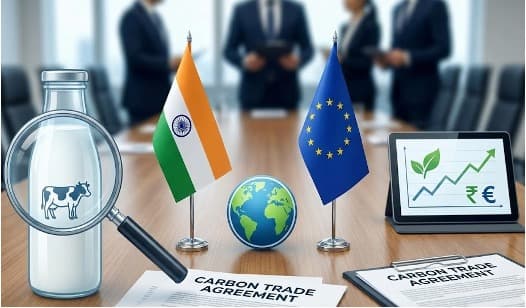
India and the European Union (EU) are intensifying negotiations on a long-pending Free Trade Agreement (FTA), with the EU’s Carbon Border Adjustment Mechanism (CBAM) at the centre of climate and trade policy discussions. New Delhi is pressing Brussels for flexibility and recognition of its domestic carbon-reduction efforts within the trade deal framework — including its imminent Carbon Credit Trading Scheme slated for rollout in 2026 — even as both sides accelerate talks ahead of visits by senior EU leaders to India later this month.

The CBAM, recently entering its definitive phase, introduces a carbon-linked cost on imports of emissions-intensive goods such as steel, aluminum, cement, fertilizers, hydrogen and electricity to the EU market. It aims to discourage “carbon leakage” — the shifting of production to countries with weaker climate regulations — by aligning carbon costs with those imposed on EU producers under the EU Emissions Trading System (EU ETS).

Indian officials view CBAM as a non-tariff barrier that could erode export competitiveness for carbon-intensive sectors and are seeking to mitigate its impact through trade negotiations and recognition of equivalent domestic carbon measures. While agricultural and dairy products are currently outside the CBAM’s direct coverage, European farming unions have debated whether future border carbon policies should address inputs like fertilisers that indirectly affect agri-food production costs.

The current trade dialogue underscores the challenge of balancing climate commitments with equitable trade access. Indian exports to the EU — especially in metals — have already seen declines as reporting and compliance requirements were introduced, even before full CBAM tariffs take effect. The mechanism is expected to raise compliance costs and could squeeze margins for exporters unless compliance systems and carbon accounting infrastructure are strengthened.

Why This Matters for Dairy:


• While dairy itself isn’t currently subject to CBAM tariffs, broader carbon compliance regimes and border climate policies can affect indirect inputs like fertilisers, energy and logistics that underpin dairy production costs, especially for feed and processing. Higher fertilizer costs and carbon-driven supply chain shifts in Europe may indirectly influence global feed prices and dairy supply chains.  
• As India and the EU negotiate, agricultural safeguards — including dairy protections — have been part of past discussions on sensitive products, reflecting policy awareness of domestic producer vulnerabilities.  India’s strategy involves advocating for policy equivalence — ensuring that domestic carbon reduction efforts and upcoming carbon credit schemes are recognised as fulfilling global climate goals, rather than becoming de facto trade barriers. Both sides aim to finalise an ambitious trade agreement that balances market access, climate goals and equitable treatment for developing economies amid evolving global carbon pricing frameworks.

Source : Dairynews7x7 Jan 12th 2026 UNI

Swipe to continue reading

Previous Article

Next Article