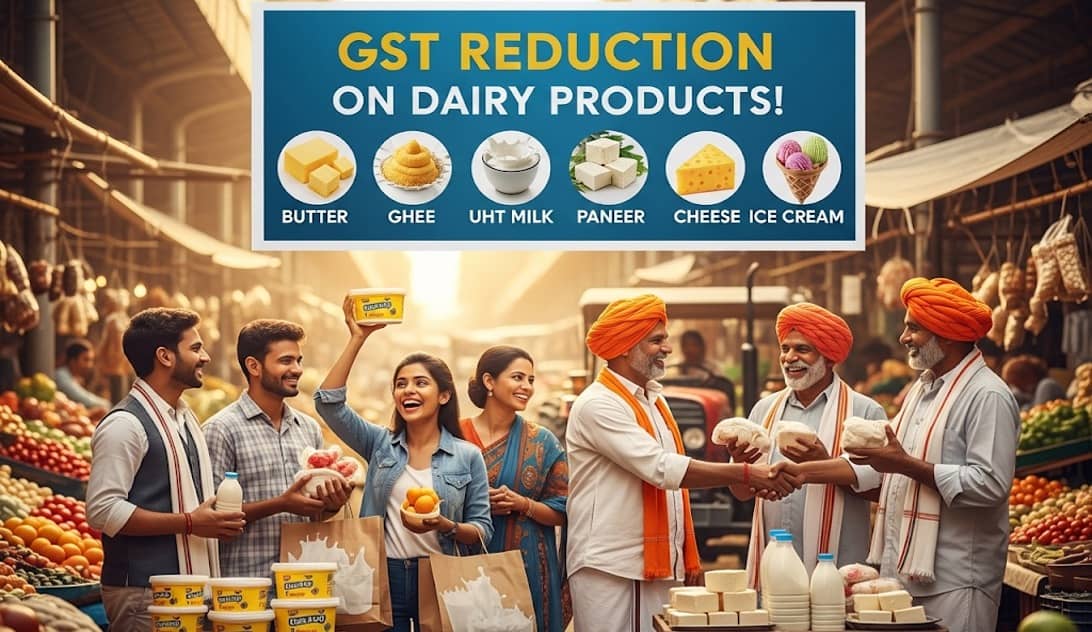
India’s recent GST changes for dairy—cutting rates from 12% to 5% on ghee, cheese, and ice-cream (without chocolate), and zeroing GST on UHT milk, paneer, and chhanna—deliver significant cost relief across value-added segments. Ghee-bearing households may pocket savings of around ₹42 per kilogram, assuming full pass-through.
Packaged paneer and UHT milk, now exempt, could become up to ₹3–₹4 cheaper, enhancing affordability and organized trade’s grip on these categories. India’s ghee market infuses around ₹3.48 trillion annually, while paneer (₹648 billion) and UHT milk (1.31 billion liters in 2024) already display rapid growth trajectories.
With these GST cuts, categories such as cheese (₹108–120 billion) and ice cream (₹268 billion) may see accelerated growth—especially as price-sensitive demand responds to the 7–13-point tax cuts. Processed dairy typically has higher price elasticity than basic milk, and academic modeling supports a boost in volume following such fiscal stimulus.
Consumer Savings (assuming full pass-through)
However, zero-rating paneer and UHT milk introduces sales-impacting complexities. Under GST, exempt items cannot generate Input Tax Credit (ITC), meaning manufacturers and retailers cannot offset input GST costs—an issue addressed through Rule 17 and Section 16(4). That means the GST paid on packaging, processing aids, logistics, etc., becomes a cost unless structured through taxable lines, prompting possible partial pass-back via higher ex-factory prices over time. Such stranded credits raise cost bases and may prompt producers to re-engineer packaging or supply chains to preserve margin.
If goods earlier taxed become exempt, related credits often need proportionate reversal as per rules/FAQs—another short-term hit to margins.
Distortion between exempt and 5% items also needs a redressal . Firms balancing exempt (UHT milk/paneer) with 5% lines (ghee/cheese) must apportion common credits (Rule 42/Section 17(2)), complicating compliance and potentially nudging product-mix decisions.
Looking at precedent: In 2017, when GST was launched, much of the dairy category was slotted in as butter, cheese (12%), ice cream (18%), and packaged paneer/milk (5%), while fresh milk was exempt. The ice-cream sector had vocally protested against the 18% GST, terming it luxury-treatment of a mass-market product. Since then, sentiment and policy have been sensitive to food tax parity.
Anti-Profiteering measures
The anti-profiteering measures underpinning GST policy further comfort consumers. The NAA—the National Anti-Profiteering Authority—was established in 2017 under Section 171 of the CGST Act, empowered to ensure tax reductions benefit end-users, investigate complaints, and impose penalties where benefits were unpassed. Although the NAA was sunsetted in 2022 and its functions shifted to the Competition Commission of India (CCI), persistent concerns about enforcement gaps have prompted government consideration of a limited revival.
Policy discussions signal that, under GST 2.0 reforms, anti-profiteering oversight may be reinstated for up to two years to prevent businesses from absorbing tax savings improperly. Additionally, several states are pushing for stringent mechanisms to enforce passing tax cuts through to consumers.
Enforcement channels may include consumer complaints to the Directorate General of Safeguards, state-level screening committees, and adjudication in the GST Appellate Tribunal. Such frameworks protect consumer welfare and lend credibility to tax reform. Should businesses delay or under-deliver cost reductions, they may face orders to refund differential amounts with 18% interest, cancellation of GST registration, or even penalties, under Rule 137 and Sections 171 and 122 of CGST.
What could this do to demand?
Milk and core dairy have relatively low price elasticities (necessities), but value-added dairy (cheese, ghee, ice cream) typically shows stronger price response. Academic and NDDB work using demand-system models confirms lower own-price elasticities for liquid milk and higher responsiveness for processed dairy; thus, the GST cuts should mostly lift volumes in value-added segments while consolidating organised players
Market sizes and Category wise impact
-
Ghee: A ₹3.48 trillion market (2024); 7% cut may strengthen demand and help organized players compete with edible oil alternatives. GST cut with strict enforcement by food regulator against spurious ghee will drive the sales up exponentially.
-
Paneer: ₹648 billion market (2024); nil-GST may help shift consumers from loose to hygienic, packaged products.GST cut with strict enforcement by food regulator against fake paneer will drive the sales up exponentially.
-
UHT Milk: 1.31 billion litres in 2024, projected to triple by 2033; zero-GST supports further growth, especially in tier-2/3 and e-commerce channels.
-
Cheese: ₹108–120 billion market (2024); lower tax may accelerate household and food-service usage amidst rising income levels. GST cut with strict enforcement by food regulator against analogue and implementing its notification for HORECA sector will drive the sales of dairy cheese up exponentially.
-
Ice Cream: ₹268 billion (2024); heavy GST previously raised prices significantly—5% slab is expected to revive the market, especially seasonal and regional players. It will certainly provide big opportunity for consumption of dairy based ice creams as against Frozen desserts.
Likely industry outcomes (next 6–12 months)
Price pass-through first, mix optimisation later: Expect visible MRP cuts or larger promo packs now; over time, companies may re-engineer packs and sourcing to minimise stranded ITC on exempt lines. Broader FMCG commentary today also points to a demand stimulus from “GST 2.0.”
Formalisation boost for paneer/UHT: Nil rate reduces incentive to buy unorganised loose paneer or untreated milk, aiding safety/traceability. PIB emphasises the paneer change is targeted at pre-packaged, labelled products.
Value-added dairy growth: Cuts on ghee/cheese (to 5%) and ice cream (to 5%) should add 100–200 bps to category growth in FY26 if input inflation stays benign, given mid-teens baselines for cheese/ice cream and high single-digit for ghee. (Inference based on current market CAGRs and typical price elasticities of processed dairy.)
In essence, while GST cuts on dairy offer immediate consumer savings and growth potential across India’s fast-evolving dairy economy—especially in value-added categories—they also test manufacturers’ ability to manage ITC inefficiencies and compliance obligations. The potential revival of anti-profiteering oversight ensures that price reductions are real, not symbolic, and that the tax reform’s credibility remains intact.
The GST reduction on key dairy products is expected to create a demand impetus across both staple and value-added categories, translating into higher offtake of milk at the farmgate level. As organized processors expand their procurement to meet increased demand for ghee, paneer, cheese, and ice cream, the benefits are likely to percolate down to India’s 80 million dairy farm households. With more milk being absorbed into formal value chains, farmers gain from assured procurement, better price realization, and reduced dependence on volatile local markets. This uplift aligns with the government’s vision of doubling farmer incomes by enabling a steady market pull, and reinforces the role of dairying as India’s largest agri-based livelihood support system, particularly for smallholders and women farmers.
Source : Blog by Kuldeep Sharma Chief editor Dairynews7x7 Sep 4th 2025
Never miss an important dairy update
Follow DairyNews7x7 on Google to get live milk prices, policy alerts, and daily headlines directly in your feed.