Israel’s Remilk serves up dairy products made without Cows and animals
Israeli startup Remilk hopes to be the first company in the world to bring real dairy milk products to market without needing a single cow in the process.
“Relying on animals to make our food is no longer sustainable,” said Aviv Wolff, who co-founded the startup up last year. “The implications of animal farming are devastating for our planet.”
The time has come, he said, for “a new revolutionary invention that will enable the transition to a food system that takes no more than what our planet can give.”
The technology Wolff and his scientist partner Ori Cohavi have developed produces milk proteins that are “chemically identical” to those present in cow-produced milk and dairy products, explained Wolff in a phone interview. That essentially means they are dairy products with dairy proteins, minus the cows.
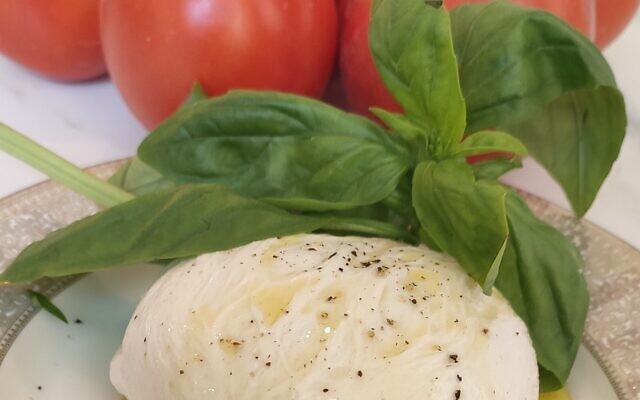
A mozzarella cheese ball made with Remilk’s milk proteins
The two entrepreneurs mapped out the chemical composition of milk, assessed the fat, lactose and sugar in the liquid, and determined that the key ingredient to making milk is the proteins.They thus set out to recreate the proteins by taking the genes that encode them and inserting them into a single-cell microbe, which they manipulated genetically to express the protein “in an efficient and scalable way,” said Wolff. Using a microbial fermentation process, they increased the number of proteins, which they then dried into a powder.
“We’re making dairy products that are identical to cow-milk products, with the same taste, texture, stretchiness, meltiness, with no cholesterol and no lactose,” he said. “We’ve basically ported the whole mechanism of producing milk into a single-cell microbe. We don’t need the ‘rest of the cow,’ and we surely don’t need to spend resources in the process of creating a 900-kilogram animal.”
More efficient system than conventional
This model of food production will be up to 100 times more land efficient than the existing dairy system, 25 times more feedstock efficient, 20 times more time-efficient, and 10 times more water-efficient, he said.When mixed with water, plant-based oils like coconut oil or sunflower oil, and plant-based sugar, the milk liquid and its derivatives can be produced with exactly the same properties, taste and structure, he said.
The dried protein will be sold to dairy companies, and manufacturers can add water and fat to create a range of cheeses, yogurts and ice creams, Wolff said.
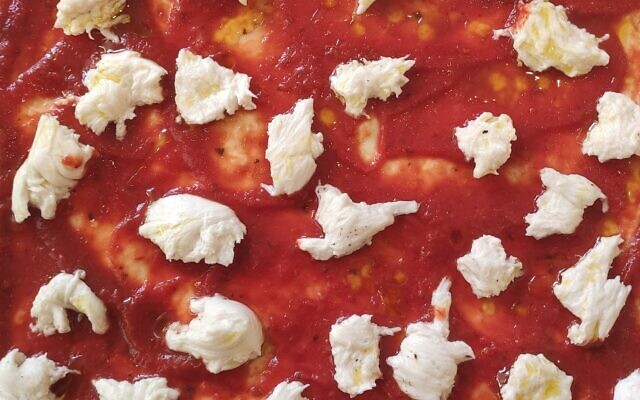
A pizza with cheese made with Remilk’s milk proteins (Courtesy)
Will the dairy products be considered milk-based, for Jewish dietary considerations?
“I am not a rabbi,” said Wolf. “But not a single cell is taken from a cow, as even the gene is a fully synthesized gene. There is no animal in any part of the process.”
Product is non dairy but protein is milk protein
So technically, the product is a non-dairy product. On the other hand, he said, the protein is actually a milk protein. “In the lab it is exactly the same” as a protein that came from a cow, he said.Wolff said the company is not yet allowing observers to taste the milk. But the firm has held double-blind tastings for research and development purposes with independent audiences that were not able to distinguish the alt-cheese products from traditional cheeses, he said.
The product is ready but not yet ripe for commercialization, as the partners are now trying to lower the production price of the protein, he said. Because of the generally low price of milk globally, the company will not initially be able to compete with liquid milk and will focus initially on cheese products, Wolff said.
Wolff is a former combat commander in a special forces unit of the IDF. After eight years of military service, he worked in several startups until he set up Remilk. His partner Cohavi has a PhD in protein biochemistry from the Weizmann Institute of Science and formerly led research and development activities in biotech firms.
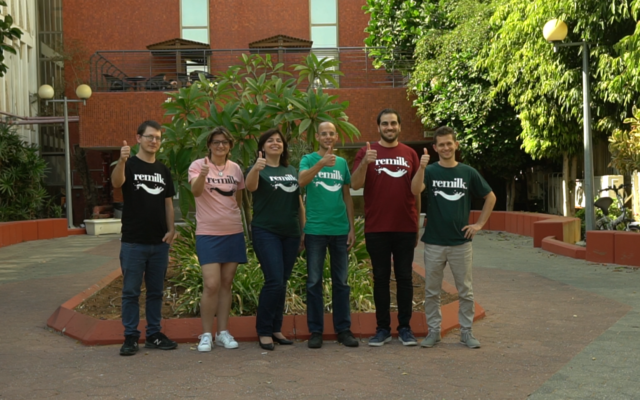
The Remilk team. Co-founder Ori Cohavi is in the middle with the light green T-shirt; Aviv Wolff is the first on the right (Courtesy)
The firm employs 10 workers and is seeking to add an additional 15 within the next six months, said Wolff.The market for dairy alternative, or plant milk beverages made from soy, almond, coconut, oats and hemp, is projected to grow from $21.4 billion in 2020 to $36.7 billion by 2025, according to research firm Markets and Markets.
These alternatives offer nutritional perks, such as lower cholesterol levels, lower sugar levels and improved cardiovascular health, all of which have led to an increase in consumption, the report said.
According to a World Wildlife Fund report demand for dairy products continues to rise due to the global population growth, rising incomes, urbanization and the westernization of diets in Asian giants such as China and India. This increases the pressure on natural resources, including soil and water.
Leading companies on dairy alternatives
Remilk is not the only tech company working on alternative milk products. Australian-US firm Change Foods uses bioengineering technology to create animal-free cheese and dairy products, its website says. San Francisco-based New Culture says it makes “cow cheese without the cow.”Germany’s Legendary Foods also uses microbial fermentation to produce the same proteins that are found in cow’s milk, and Belgium’s Those vegan cowboys says it makes products with the same of cows’ milk but without the use of animals.
“They use similar processes,” said Wolff. “But we have very strategic commercial partners working with us, and we will be quick to go to market.”
In a different vein, Israel’s Bio Milk, which is planning to go public in Tel Aviv by merging with a shell company, isolates the milk-producing cells in cows’ udders and transfers them to a bioreactor, where they are exposed to materials patented by the firm to produce milk.The dairy industry has been criticized by animal rights organizations, such as People for the ethical treatment of animals (PETA), which say that dairy cows are treated like milk-producing machines. Most cows raised in the dairy industry are intensively confined, repeatedly inseminated to give birth to calves and then are separated from their newborns at birth, so the milk produced to nourish their offspring can be sold to humans. Genetic manipulation, and, in some cases, antibiotics or hormones, are also used to cause cows to produce additional quantities of milk.
Wolff targeted early 2022 for Remilk to offer its first commercial, affordable product. “Remilk will be the first to market, we believe.”